Welcome to Raul On The Prowl--your one stop blog for all things food and travel straight from me, Raul Dias a writer, restaurant reviewer and crazy travel & food addict! Here you will find articles on food and travel--the two consummate loves of my life that I write about in various Indian and international magazines & newspapers on an almost daily basis. You will also find recipes & interviews with the top movers-n-shakers of the food/travel industry around the world.
Sunday, September 18, 2022
Diving with a Difference
Sunday, February 28, 2021
Notes from a kallbad
By Raul Dias
Almost exactly a year ago, when countries around the world started going under lockdown one after the other like some sort of uncertain global game of dominos, there was one among them that resolutely refused to let its chips fall. And that country was Sweden.
Faced with mounting criticism, the Scandinavian county still managed to flatten its Covid-19 curve rather rapidly and effectively. This, without ever implementing a full-scale lockdown. A controversial strategy that at once had the country’s health leadership claim victory. But the cynics were not so impressed with this apparent inaction. And rightly so.
With many Swedes choosing the more sensible self-quarantine and social distancing, cases of mental unrest and depression saw a remarkable upswing across the country. All the while getting further exacerbated by the long, dark and miserably frigid Nordic winter that sets in as early as late September. Enough to send the country hurtling down the precipice of a major mental health crisis.
Slam Dunk
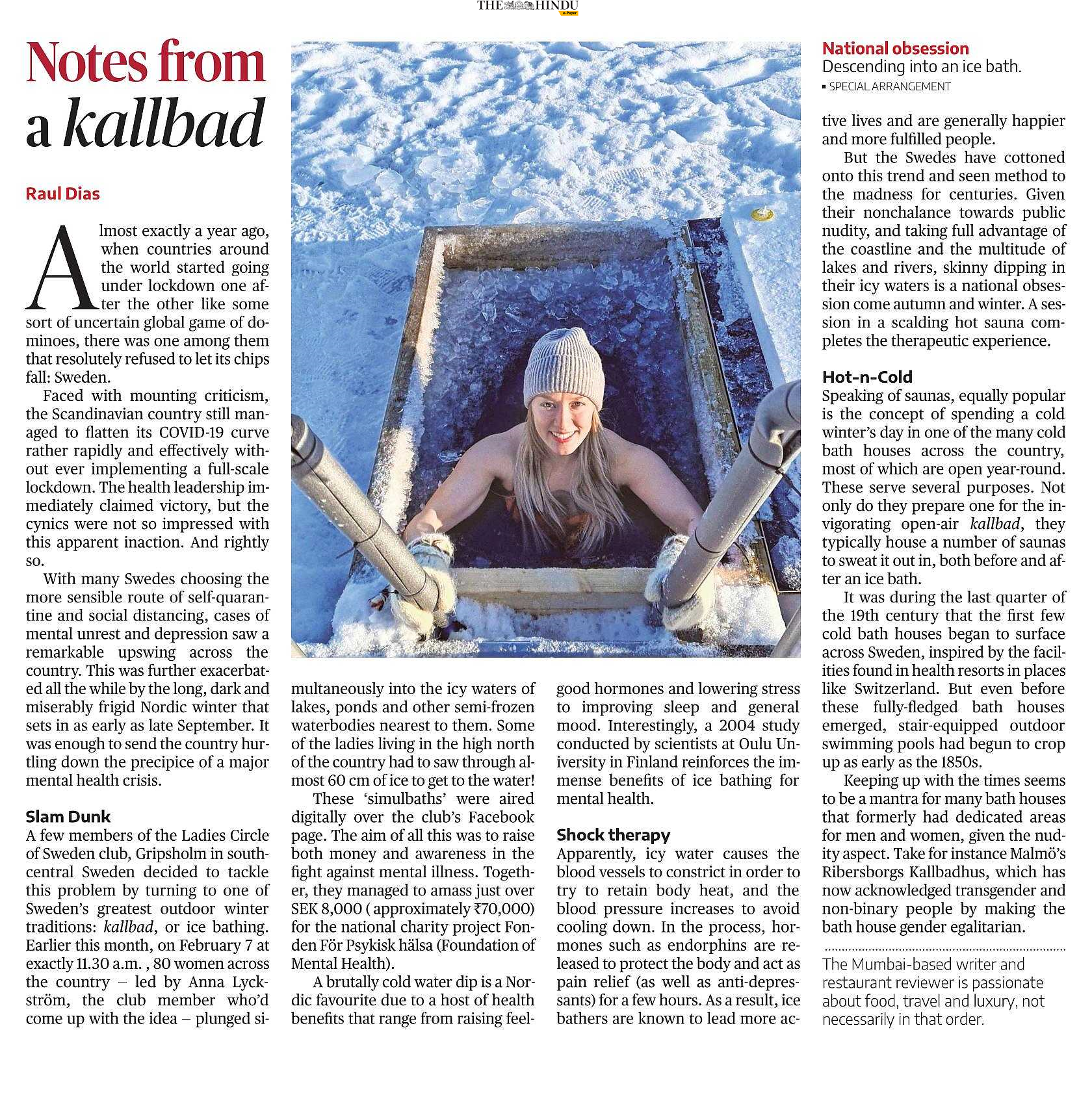
Recognising this and attempting to remedy it by turning to one of the Sweden’s greatest outdoor winter traditions of ice bathing called kallbad in Swedish is a charity initiative taken on by a few of the members of the Ladies Circle of Sweden club, Gripsholm in south central Sweden. Earlier this month, on the 7th of February at exactly 11.30am Sweden time, 80 women across the country—led by Anna Lyckström, a club member who came up with the idea—plunged simultaneously into the icy waters of lakes, ponds and other semi-frozen waterbodies nearest to them. Some of the ladies living in the high north of the country needing to saw through almost 60cm of ice to get through the water!
All this to raise both money and awareness in the fight against mental illness. Together, they managed to amass just over SEK 8,000 (INR 70,000 approximately) for the national charity project Fonden För Psykisk hälsa (Foundation of Mental Health). With the 'simulbaths' being aired digitally over the club’s Facebook page.
Shock Therapy
A brutally cold water dip is a Nordic favourite for many due to a host of health benefits ranging from raising ones feel-good hormones and lowering stress to improving sleep and general mood. Interestingly, a 2004 study conducted by scientists at Oulu University in Finland reinforces the immense benefits of ice bathing on mental health.
Apparently, icy water causes the blood vessels to constrict in order to try to retain body heat and the blood pressure increases to avoid cooling down. In the process to protect the body, hormones such as endorphins, are released and act as pain relief (as well as anti-depressants) for a few hours. As a result, ice bathers are known to lead more active lives and are generally happier and more fulfilled people.
But the Swedes have cottoned onto this trend and seen method to the madness for centuries. Given their nonchalance towards public nudity and taking full advantage of the coastline and multitude of lakes and rivers, skinny dipping in their icy waters is a national obsession come autumn and winter. With a session in the scalding hot sauna completing the therapeutic experience.
Hot-n-Cold
Speaking of sauna, equally popular is the concept of spending a cold winter’s day in one of the many cold bath houses across the country, most of which are open year-round. These serve several purposes. Not only do they prepare one for the invigorating open-air kallbad, they typically house a number of saunas to sweat it out in, both before and after an ice bath.
It was during the last quarter of the 19th century that the first few cold bath houses began to surface across Sweden. All greatly inspired by the facilities found in health resorts in places like Switzerland. But before the fully-fledged bath houses emerged, stair-equipped outdoor swimming pools started cropping up as early as the 1850s.
But keeping up with the times seems to be a mantra for many bath houses that earlier had specifically dedicated areas for men and women given the nudity aspect. Take for instance Malmö’s Ribersborgs Kallbadhus that now acknowledges transgender and non-binary people by making the bath house gender egalitarian.
(This column first appeared in the 28th February 2021 issue of The Hindu newspaper's Sunday Magazine section on page 7 https://www.thehindu.com/life-and-style/travel/notes-from-a-kallbad-or-ice-bath-in-sweden/article33940727.ece)
Saturday, June 30, 2018
South Africa’s Other Big 5!
By Raul Dias
Hugging the Indian Ocean with all its might, South Africa’s stunning Garden Route—or to use the local Afrikaner name ‘Tuinroete’—is one of the most popular drives in the world you could ever take. Stretching a languid, 300 kilometres along the south-western coast of South Africa which extends from Mossel Bay in the Western Cape to the Storms River in the Eastern Cape, the route takes in the beauty of places like Knysna, Plettenberg Bay, Mossel Bay and George among others.
Here, nestled amidst the imposing Swartberg mountains you will also find the Outeniqua and Tsitsikamma indigenous forests. You will see a unique mixture of Cape Fynbos and Temperate Forest here, where you can indulge in the many hiking trails and eco- and adventure-tourism activities. Speaking of which, cast aside all preconceived notions of South Africa being a safari stronghold and think adrenaline-pumping, daredevilry when in this region. With everything from cave exploring to bungy jumping and shark cage diving, the Garden Route has it all and then some more.
We bring you South Africa’s ‘Other Big 5’…
1. Great White Shark Diving
With probably the most accessible Great White Sharks in the world, Seal Island in Mossel Bay is only 2 kilometres from the harbour and very close to the local beach. Once you meet the shark diving crew, you can enjoy a light breakfast and will receive a safety briefing about the boat and the trip to come. Arriving at anchor site, the crew will immediately start to chum the water to attract the sharks which consists of natural marine products and fish which is natural to their diet. Once the sharks are around the boat and comfortable with the boat, the cage will be dropped into the water and attached to the side of the boat. Then you will be lowered into the cage and your close encounter with good old ‘Jaws’ will begin! Interestingly, you do not need any experience in diving to do the shark cage dive, as this is a simple surface dive and non-technical. (www.sharkzone.co.za)
2. Go Cave Exploring at Cango
The magnificent Cango Caves in the Klein Karoo area of the Garden Route are regarded as South Africa’s largest show caves. And rightly so! Discovered by Dutch colonists in 1780, the caves are said to have begun forming 20 million years ago when acidic ground water chemically eroded the 100-million-year-old limestone rock. Take the daily adventure tour and visit the deepest sections of the caves. Once inside the 5.3 kilometres long caves, put aside any latent claustrophobia, as you wriggle and slither your way into the bowels of the cold, damp caves. Make sure to stop every now and then to ogle at the dramatic melted wax-like formations of stalactites and stalagmites. And they have equally dramatic monikers like ‘Bridal Chamber’, ‘Cleopatra’s Needle’ and ‘Frozen Waterfall’ to name a few. (www.cango-caves.co.za)
3. Ride an Ostrich!
Oudtshoorn is famous for its huge ostrich population, which thrive in the semi-desert conditions. To ride an ostrich, you need to visit one of the town’s many ostrich show farms like Highgate. Here, you can first observe large flocks of ostriches at various stages of development. You will then be instructed on how to hold on along with the commands to be employed to stop the bird and off you go for the ride of your life. And once you’re done with your ostrich race, make sure to add to the adventure and try an ostrich steak or an ostrich egg (which feeds 20 people). You can also visit the shop on site and purchase exclusive leather handbags and feather boas and a variety of decorated and plain ostrich eggshells. (www.highgate.co.za)
4. Close Encounter Whale Watching
With the only close encounter whale watching permit holder for the greater Knysna area, Ocean Odyssey takes you on its 26-seater boat for a spot of whale watching. Departing from Thesen Harbour Town, an island off the main Knysna coast, the boat cruises across the sweeping Knysna estuary and out to sea through the iconic Knysna Heads in search of both the Southern Right and Humpback whales. These two species of whales are said to leave their icy feeding grounds off Antarctica and migrate and calve in the warmer waters of this coastline and chances of sighting a few are very good here. But don’t worry. Even if the mighty gentle giants of the ocean prove to be elusive the day you set out to visit them, their playful companions—the bottlenose dolphins are always present along the Knysna Heads to show you a wonderful time! (www.oceanodyssey.co.za)
5. Jump the World’s Highest Bungy Jump
We’ve truly saved the best…or, rather the most dreaded of all Garden Route activities for last! Combining the thrills of a bungy jump and of being part of a Guinness World Record, this jump off the Bloukrans Bridge that fords over the Bloukrans River valley at a depth of 216 meters, is terrifying to say the very least, but worth every ounce of adrenaline that kicks in once you’re done with it. Recognised as the ‘highest bungy from a bridge’ in the world, the Bloukrans Bungy uses pendulum bungy technology to ensure that you get to enjoy a 360-degree view of the beautiful Tsitsikamma National Park and of Africa’s highest bridge. But one needn’t do the bungy to enjoy the view, Face Adrenalin, the guys who conduct the jump, also offer ziplining and a walk under the bridge for non-jumpers. (www.faceadrenalin.com)
FACT FILE
Getting there
Although there are no direct flights from India to South Africa at the moment, the best way to get there is via Dubai on Emirates that has daily flights to and from Cape Town, Durban and Johannesburg. Once in South Africa, you can hire a car and drive down the Garden Route. Book a car at www.avis.co.za, www.europcar.co.za or www.budget.co.za. Indian passport holders need a visa to enter South Africa, which is easy to procure via the VFS facility.
When to visit
Because South Africa is situated in the Southern Hemisphere, the seasons are in reverse. This means that spring (mid-September to November) through to summer (late November to March) are ideal times for a vacation along the Garden Route when the temperature hovers between a comfortable 19C to 25C.
Accommodation
The Garden Route has an excellent selection of hotels to choose from to suit all budgets and tastes. Some of the best options are:
* Turnberry Boutique Hotel (www.turnberryhotel.co.za) in Oudtshoorn
* Belvidere Manor Hotel (www.belvidere.co.za) in Knysna
* Park House Lodge (www.parkhouse.co.za) in Mossel Bay
(An edited version of this article appeared in the 29th June 2018 issue of the Afternoon Despatch & Courier newspaper, India on pages 14 and 15 http://www.afternoondc.in/48-hrs/south-africas-other-big-5/article_225973)


