Showing posts with label AUSTRIA. Show all posts

Friday, January 13, 2023

6 Iconic Dishes and Drinks From Equally Legendary Establishments


(This article first appeared online on 13th January 2023 on ZeeZest https://zeezest.com/food/6-iconic-dishes-and-drinks-from-equally-legendary-establishments-2965)

Sunday, December 23, 2018

Christmas with a Difference

Christmas isn’t always about genial Santas, mistletoes and mugs of mulled wine. Raul Dias introduces you to a few alternative and decidedly wacky Christmas traditions around the world.   


By Raul Dias

In a little under two days’ time, most of the world will celebrate Christmas Day as we know it. Replete with all the Advent accoutrements pat in place. Read: carol singing, steaming mugs of mulled wine, nativity pageants and portly, white-bearded Santas frolicking about the place. But before we get carried away with all the above mentioned—and dare-we-say, cliched—merriment montages, it is pertinent to note that that’s not necessarily how the season’s festivities are represented everywhere. Remember we said ‘most’ and not ‘all over’ the world!
Here are a few such interesting, out-of-the-box and downright bizarre ways in which the world celebrates the birthday of Lord Jesus:  

The ‘anti-Santa’
This scary Austrian version of Santa, aka. Krampus really knows how to show those kids who’ve been bad, his…well, bad side! The ghoulish, hooved and horned creature that stems from Alpine folklore is believed to be the evil accomplice of St Nicholas and is said to wander the streets in search of badly-behaved children. During the month of December, you can expect to see terrifying masked figures out and about scaring kids and adults alike with ghastly pranks. The Krampus myth is so popular in Austria that there is even an annual Krampus parade in the capital Vienna. 

In a finger lickin’ mood, anyone?
Forget the Japanese language version of the “Merry Christmas!” greeting. For nearly five decades the refrain on Christmas Eve in Japan has been “Kurisumasu ni wa kentakkii!” (Kentucky for Christmas!). Yes, eating Colonel Sanders’ fried poultry pieces have become a sort of ritual for a true-blue Japanese Christmas Eve. Back in 1974, the American fast-food restaurant giant released a festive marketing campaign in Japan that spawned this rather strange national tradition that still thrives to this day. Families from all over the country head to their local KFC for a special Christmas Eve meal with table reservations being made weeks in advance.

Get, set…skate
There’s a very unique tradition that takes place in Caracas, Venezuela from the 16th to the 24th of December every year, where the city’s streets are closed off for heavy traffic before 8am so that people can go skating. And come Christmas Eve, the streets are closed off the whole day. Local residents then roller skate to church to attend the early morning mass called misa de aguinaldo, shooting off fireworks and shouting out “Jesus is born!” as they skate way.

In a mighty pickle! 
Forget those shiny buntings and kiss those cute turtle doves goodbye. In Germany, the must-have Christmas tree ornament has got to be a big green dill pickle. Confused? Well, in this Teutonic nation—where many believe the Christmas tree originated—it is customary to hide a pickle shaped ornament somewhere within the branches of the tree and give a gift to whichever child in the household finds it. According to a legend, two young boys were held captive inside a pickle barrel when the jolly St Nicholas rescued them, bringing them back (and a new tradition) to life.

Barbie and thongs
Do pardon the above sub-header, but this unique Christmas tradition maintained by our antipodean friends from down under in Australia has got nothing whatsoever to do with dolls or underwear! With Australia enjoying sunny Christmas days—what with December being peak summer time—the festivities here are kicked off with family-style barbecues that are affectionately called ‘barbies’ where people come dressed ultra-casually in shorts and sporting ‘thongs’ or flip flops on their feet. Very often, after a typically Aussie Christmas barbie, the action shifts to the local beach for a swim in the waters or simply to lounge about on the sand.  

Duck off!
We’ve probably saved the wackiest (and cutest!) of all Christmas traditions for the last, all the way from Sweden. The story goes back to the 1960s when televisions which were relatively new in Sweden aired only two channels. Now, one of these played Disney cartoons at Christmas, and in particular a 1958 Christmas special called “Kalle Anka och hans vänner önskar God Jul” or “Donald Duck and his friends wish you a Merry Christmas”. Very soon the tradition of watching this particular special took root. So much so that till this day, every Christmas, families around Sweden gather in front of the television set at 3pm sharp, all to watch the antics of a duck named Donald. Interestingly, everything on Christmas Day is planned around the television special that enjoys a viewership of more than 40 per cent of Sweden’s population.

(An edited version of this article first appeared in the 23rd December 2018 issue of The Free Press Journal newspaper's Weekend section on page 3 https://www.freepressjournal.in/travel/christmas-2018-wacky-christmas-traditions-you-may-not-know-about/1420469)


Wednesday, January 3, 2018

Edible Icons!


The Others…
·         Not content with laying claim to the Waldorf Salad alone, The Waldorf Astoria hotel in New York is also the place where Eggs Benedict was first invented in 1894 at the behest of a Wall Street stockbroker named Lemuel Benedict, who instructed the chef to construct his poached eggs dish just the way he wanted them—Hollandaise sauce et al! 
·         An unknown hotel chef in Wellington, New Zealand, is said to have created the cloud-like meringue and fruit dessert we know today as the Pavlova for the famous Russian ballerina Anna Pavlova, who visited there in 1926 on her world tour.
·         We have the American hotelier Bertha Palmer of the Palmer House in Chicago to thank for the diet/stress/blues-busting gooey Brownie,s who created it along with her chef at the hotel for the World’s Columbian Exposition held in Chicago in 1893.

·         It was in 1892 when Dame Nellie Melba, the famed Australian opera singer paid a visit to The Savoy in London, that the equally legendary French pâtissier Auguste Escoffier created the Peach Melba in the prima donna’s honour.

(An edited version of this article first appeared in the January 2018 issue of Jetwings Domestic in-flight magazine of Jet Airways https://www.jetairways.com/EN/DE/JetExperience/magazines.aspx) 


Gardens of the Bard

For many, the concept of a literary garden evokes William Shakespeare and a sweet-perfumed floral arrangement of rosemary, violets, lilies and roses that find fond mention in the Bard’s works. No great surprise then, Shakespeare Gardens can be found all over the world with some landscaped in the style popular during his lifetime, while some, a riot of flowers, herbs and other botanicals. We take you to a few…


By Raul Dias

“I know a bank where the wild thyme blows
Where oxlips and the nodding violet grows
Quite over-canopied with luscious woodbine,
With sweet musk-roses and with eglantine.”
—A Midsummer Night’s Dream

Shakespeare’s Flowers at the Golden Gate Park, San Francisco
The Golden Gate Park is a mammoth, urban park consisting of 1,017 acres of public grounds with everything from a well-appointed Japanese Tea Garden to hosting the San Francisco Botanical Garden at Strybing Arboretum. But neatly tucked away at the intersection of the garden’s Martin Luther King Jr. Drive and Middle Drive East is a fecund spot with a sundial at its dead centre. Simply called Shakespeare’s Flowers, this Shakespeare Garden was planted in 1928 under the patronage of Alice Eastwood, the then director of botany for the Academy of Sciences. With over 200 flowers and plants lining this modest-sized garden, visitors can find visual, floral references to the Bard’s staggering body of work. Here, bronze plagues are engraved with notable quotations from his historic comedies, tragedies, and sonnets that accompany the floral arrangements.
Entry: Free

The Shakespeare Park at Herzogspark, Regensburg
Germany’s south-eastern city of Regensburg in Bavaria is famous for its location, as it is situated at the confluence of the Danube, Naab and Regen rivers. But its greatest calling card to a die-hard Shakespeare fan is the Herzogpark—a tiny, municipal park with an even smaller botanical garden dedicated to William Shakespeare. The Shakespeare Park is designed as an alpine garden meets Renaissance garden, replete with bell flowers, carnations, primroses, and rhododendrons, besides of course, a rose garden. Set in the Renaissance style of geometric parterres edged by boxwood hedges, the Shakespeare Park is a peaceful nook where you can almost always find someone sitting on one its low, stone benches, engrossed in a book.
Entry: Free

Shakespeare Garden at Johannesburg Botanical Garden, Johannesburg
Gritty and chaotic Jo’berg—as the locals call their city of Johannesburg—is probably the last place on earth you’d expect to find a Shakespeare Garden. But this 81-hectare large green lung, situated in the otherwise bleak suburb of Emmarentia harbours a beautiful little secret at its very center. Established as a rose garden in 1964, the Shakespeare Garden has over 10,000 roses in bloom almost every day, besides a fine collection of herbs like rosemary and thyme as mentioned in the Bard’s plays. Being in Africa, the garden that overlooks the Emmarentia Dam, has an abundance of local bird life, such as ibises and weavers, and one can even feed the ducks and geese at Bird Island. And during concert season expect to be enthralled by a Shakespearean performance or two.
Entry: Free

The Vienna Shakespeare Garden at the Kagran School Gardens, Vienna
The newest Shakespeare Garden on our list that opened a little over a decade ago in 2005, The Vienna Shakespeare Garden is one of the best homages to the Bard. One enters this arboreal paradise through the ‘Laburnum Walk’, a floral tunnel created solely out of laburnum plants and is greeted by five distinct beds of flowers. A shady bed, a bed with afternoon sun, a magnificent display bed, a herbal bed and a classic English-style flower bed where each plant features a corresponding quote from a selection of Shakespearean literature. In fact, the garden even has a sign indicating the direction and distance of Shakespeare’s birthplace, Stratford-upon-Avon!
Entry: Free

The Shakespeare Garden at New Place, Stratford-upon-Avon
The ‘holy grail’ of all things William Shakespeare and a must-visit for the Bard’s legion of worshippers, is Stratford-upon-Avon in England’s West Midlands. And his last home, New Place is Ground Zero. This stately home that was reopened in April 2016 after a lengthy refurbishment, to coincide with the quatercentenary of Shakespeare’s death is also famous for being the place that hosts the most beautiful of all Shakespeare Gardens. Here, the mansion’s three zones are connected to each other by the garden that features rows of plants such as mulberry and rose with commemorative flags representing all of Shakespeare’s plays fluttering above the plants. The Bard’s sonnets and longer plays are represented by a ribbon of white bronze darts set into the stonework of the wall that hems the garden in.
Entry: £17.50 (adult) and £11.50 (child)


America’s Shakespeare Gardens
Cottoning onto the early 20th century craze for the Shakespeare Garden, when everything English was considered ultra-trendy, a host of popular public parks and university gardens across the United States fashioned for themselves their own spots to pay homage to the Bard:
·         The Shakespeare Garden at Pittsburgh’s Mellon Park is devoted to herbs and medicinal plants.
·         Perfumed with the fragrance of pansies and musk-roses, the Shakespeare Garden at Manhattan’s Central Park is a breath-taking place to visit. It is also the place where the mulberry tree is said to have come from Shakespeare’s property at his final home, New Place in Stratford-upon-Avon.
·         Believed to be America’s first Shakespeare Garden is the one in Evanston, Illinois.
·         The Shakespeare Garden at Gordon Park in Cleveland was built in 1916 in honour of the tercentenary of Shakespeare’s death.
·         Also created in 1916 is the Shakespeare Garden at Vassar University in Poughkeepsie, New York, by a group of English literature and botany students.


A Quartet of Shakespeare’s ‘flowery’ Verses

·         Roses:
“I have seen roses damask’d, red and white,
But no such roses see I in her cheeks…”
—Sonnet 130

·         Daisies and Violets:
“When daisies pied and violets blue
And lady-smocks all silver-white
And cuckoo-buds of yellow hue
Do paint the meadows with delight.”

—Love’s Labours Lost (5.2.900-4)


·         Lilies:
“Like the lily,
That once was mistress of the field and flourish’d,
I’ll hang my head and perish.”

—Henry VIII (3.1.168-70)


·         Poppy and Mandrake:
“Not poppy, nor mandragora,
Nor all the drowsy syrups of the world,
Shall ever medicine thee to that sweet sleep
Which thou owedst yesterday.”
—Othello (3.3.368-71)


(An edited version of this article first appeared in the January 2018 issue of Jetwings Domestic in-flight magazine of Jet Airways https://www.jetairways.com/EN/DE/JetExperience/magazines.aspx) 


Wednesday, March 8, 2017

Unusual ‘Spa’ing!

From a floating spa to one 20,000 leagues (well, not really!) under the sea, and from a salt-encrusted cave spa to a ‘leviating’ science fiction-esque one, a few unusual spas around the world are pushing the envelope, offering up a plethora of rejuvenating treatments for the adventurous sybarite. RAUL DIAS takes you to seven such repositories of relaxation 


THE BOTA BOTA SPA
CANADA
25,000 square feet. 678 portholes. 40 types of services. 35 massage therapists. 21 treatment rooms. In numbers, the floating Bota Bota Spa in Old Montreal, Canada is über impressive to say the very least. But throw in the fact that in its earlier avatar, it was a ferryboat carrying passengers from Sorel to Berthier in Quebec in the 1950s and ’60s, as well enjoying a run a showboat on the Richelieu River and you soon realise how truly unusual this floating spa is! Today, the gentle ebbing of the St. Lawrence River relaxes and energizes guests on the boats five decks that boast an eucalyptus steam bath, outdoor whirlpools and relaxing gardens. The treatments are mostly centred on the benefits of water, including the in-demand Nordic baths that detoxify and cleanse the body. While it might look slightly industrial from the outside, the Bota Bota Spa is surprisingly comfortable and very relaxing on the inside. There is also a restaurant on-board the ship, serving meals made from fresh, healthy and locally sourced ingredients from Quebec.

Top Indulgence: The 60 minutes ‘The Escape Treatment’ that includes an exfoliation, body wrap, head and neck massage.


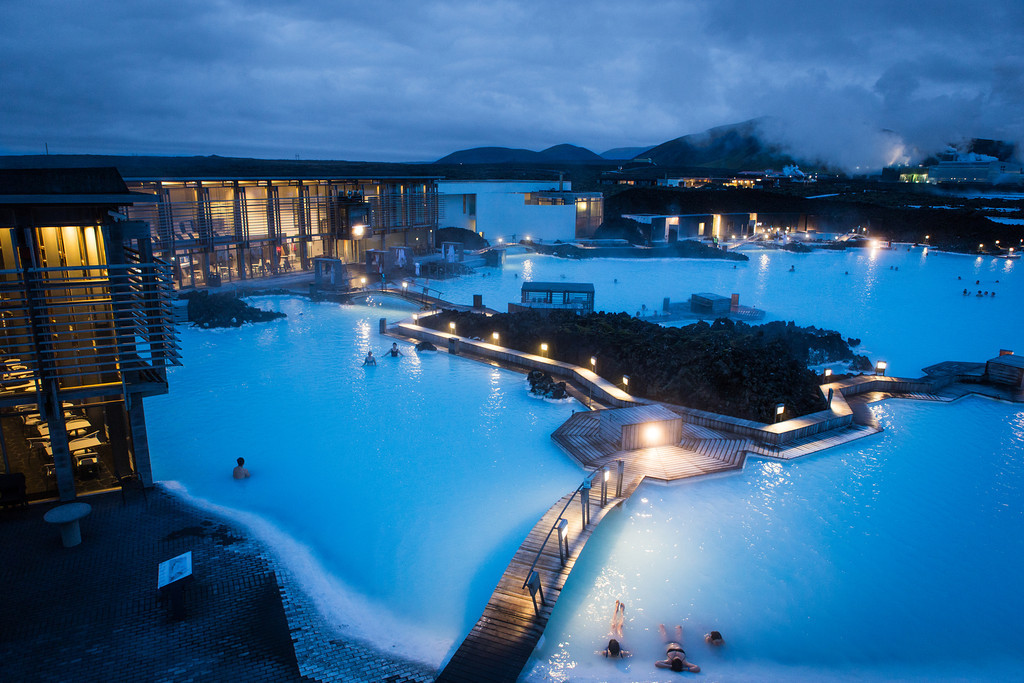
THE BLUE LAGOON
ICELAND
As one of Iceland’s most popular spas — renowned for its therapeutic waters — it is no great surprise that The Blue Lagoon draws in over 400,000 visitors annually. Allowing guests to commune with nature in six million litres of geothermal seawater, the spa is located in Iceland’s lava fields of Grindavik on the Reykjanes Peninsula. This scenic, and often extreme environment is the perfect setting for this mineral-rich spa that, as its website claims, affords guests the chance to “actually bathe between two continents as the Euro-Asian and American tectonic plates meet at the Blue Lagoon”. While soaking in the waters is said to do wonders for the skin leaving it supple and smooth, the all-natural spa also uses the silica mud surrounding the lagoon to help soothe troubled skin. Be sure to experience the sauna at the spa, which has been carved into the lagoon’s lava rocks.
Top Indulgence: The 30 minutes Silica Mud Mask treatment that is the spa’s signature treatment is legendry for its soothing, toning and rehydrating properties, leaving your face rejuvenated.  


THE AQUADOME SPA
AUSTRIA
Amply displaying more similarities with an eerie extraterrestrial habitation, than a spa, the Aquadome Spa that is situated in the Alps in Lӓngenfeld, Austria, seems straight out of the latest Hollywood sci-fi movie. From three levitating bowl-shaped pools with underwater music and light effects to thermal domes housing indoor pools, everything about this spa is so cool; you can’t help but want to go there to see it for yourself. With plenty of options to pamper you silly, this spa offers classic treatments along with a heady mix of aesthetic and cosmetic packages, along with bath ceremonies and rituals. So, if you can picture yourself floating across the surface of a heated pool while gazing up at the alpine peaks; the thermal Aquadome Spa is there to make it a reality!
Top Indulgence: The specially designed for men 50 minutes Mountain Force Sport Treatment is the ideal treatment for reinvigorating your stressed muscles with cupping, massaging and stretching actions employed to rebalance you.


THE LIME SPA
THE MALDIVES
While The Maldives Islands have so far been famous for their myriad underwater suites and restaurants, an underwater spa of this magnitude is a first. The Lime Spa at Per Aquum Niyama on the Dhaalu Atoll has taken that concept to the extreme by creating the world’s first underwater spa that offers natural treatments with a view of the ocean floor. Set within its own lagoon, The Lime Spa enables you to float through multi-day journeys of hydrating wraps, intuitive massages, couture facials and underwater dream therapies. It’s an immersive environment, designed to reflect the serene, aquatic surroundings — right down to the plush cushions that evoke a skin-friendly version of coral and sea sponges, to the ethereal fabrics created to look like kelp. In addition to the underwater and overwater treatment rooms, the spa is also home to Sublime, which offers pre and post-treatment relaxation with sauna, steam, an onsen shower, mist shower, ice room, and a relaxation lounge with panoramic views of the Indian Ocean as you spot exotic marine swim by. Trust us; Finding Dory was never this fun!
Top Indulgence: The 75 minutes Holistic Duo is the perfect couples’ treatment that includes an aromatherapy massage and a Himalayan singing bowl session that they guarantee will lull you both into a state of deep relaxation...


THE INTEGRATRON
USA
An acoustically perfect tabernacle and energy machine in the mystical Mojave Desert in south-eastern California, USA, The Integratron is a geomagnetic vortex desert spa offering some seriously alternative therapies to balance out your body’s Qi. Creator George Van Tassel, who was an aeronautical engineer and test pilot, claimed that the structure is based on the design of Moses’ Tabernacle, the writings of Nikola Tesla and telepathic directions from extra-terrestrials (yes, you read that right!). The giant dome structure offers sonic healing sessions to those seeking a one-stop shop for physical and spiritual healing. Known as ‘Sound Baths’, the sessions will have you resting comfortably in the deeply resonant, multi-wave sound chamber, while a sequence of quartz crystal singing bowls are played, each one keyed to the energy centres or chakras of the body.
Top Indulgence:  The 60 minutes All Sound Baths Sonic Healing Session that consist of 25 minutes of crystal bowls played live and the balance of the hour to integrate the sound and relax in the sound chamber to recorded music that results in waves of peace, heightened awareness, and relaxation of the mind and body.


THE TSCHUGGEN BERGOASE SPA
SWITZERLAND
Created to resemble vegetal forms and trees, the striking, geometric structures jutting from the Tschuggen Bergoase Spa in Arosa, Switzerland are a sight to behold with their vertiginous metal and glass shards that almost seem to piece the still, cool Alpine air. Set on 5,000 square meters of land, the spa provides an exceptional view of the rugged mountain terrain and allows natural light into the treatment rooms that are spread over four floors—some of them even underground and set into the mountain itself. Architect Mario Botta was mindful of the surrounding villages and natural environment, so he aimed to “build without over-building.” With Switzerland famous for its spas, the Tschuggen Bergoase Spa has plenty of treatment to choose from, using products from Sensai, Clarins, Comfort Zone, OPI and La Biosthétique for a truly indulgent experience. Moreover, the mountain  sauna  of  original,  ancient  rock  combined  with  the  various steam rooms  and  saunas  helps you rejuvenate with the energy of nature seeping in.
Top Indulgence:  The 50 minutes Men’s Facial is a personalised treatment using Clarins Men’s products, specially formulated for men’s skin types, designed to leave your skin feeling fresh, clear and rejuvenated.


THE GALOS SALT-IODINE CAVES SPA
USA
This haven of tranquillity slap bang in the middle of Chicago, USA, relies on the benefits of Crimean salt. Low levels of iodine in parts of the US make Chicago a perfect spot for this pastel-hued spa. Derived from the mysterious Black Sea, which is known to have healing effects on dysfunctions in the respiratory, digestive, nervous and cardiovascular systems, the Crimean salt is crystallised naturally to mimic these effects. While the crystallised salt itself has a delicate pink colour, the lights inside the caves subscribe to colour therapy and are arranged in a way to soothe your senses. With a plethora of treatments that offer healing baths, water treatments, inhalation and irrigation, and the faint flowery aroma of the salt, this unique spa is a culmination of overall wellness and relaxation. Besides its cosmetic benefits, a visit to Galos is beneficial to the body, as the air is intensively charged with salt particles and has a natural anti-infectious effect; it stimulates the immune system and is great for the skin. The sea microclimate created inside the caves provides an oasis of peace and relaxation. Ah, bliss!
Top Indulgence: The 45 minutes Balneotherapy session uses the minerals from water, peloids and gases for glowing skin and rids the body of toxins.  


(An edited version of this piece was first published in the March, 2017 issue of The Week's The Man magazine)