Showing posts with label JAPAN. Show all posts

Sunday, July 14, 2024

Asia's Wonderful DIY Dishes


This article first appeared in print and online on 14th July in the Sunday Magazine section of The New Indian Express newspaper https://www.newindianexpress.com/lifestyle/food/2024/Jul/13/diy-on-asian-griddles

Sunday, June 9, 2024

Food Festivals Around The World


(This article first appeared in the 9th June 2024 issue of Deccan Herald newspaper's Sunday Herald section both in print and online here https://www.deccanherald.com/lifestyle/food-and-drink/where-food-festivals-join-forces-3056962)


Wednesday, February 28, 2024

Japan's Culture Kare


(This story first appeared in the 24th February 2024 issue of The New Indian Express newspaper's Sunday Magazine section on page 8 and online here 

Wednesday, September 27, 2023

Friday, June 18, 2021

On a Roll


(This article appeared in the 18th June 2021 issue of the Mid-Day newspaper, India on page 17 https://www.mid-day.com/mumbai-guide/mumbai-food/article/on-a-roll-23178780 )

Saturday, November 14, 2020

Bells, Broken Hearts and Paper Cranes

Celebrating the innocence of childhood in their own unique ways, this trio of monuments around the world are places of immense beauty and gut-wrenching despair in equal measure 


By Raul Dias

Decades ago, a wise one close to me had prophesied that this day would come. “One day, you are going to mourn the loss of your childhood!”, a precocious, 13-going-on-30-year-old me was warned.

This, after I was caught doing something no child of 13 should have ever indulged in. With the insufferable insouciance of an approaching adolescence as my ally, I cast aside that prophecy like a pair of smelly socks. But now, I grieve. 

And it took a pandemic to put it all into perspective. I long for the days of my childhood when I feared so very little that plagues the adult me today. The health of loved ones, work-related stress and most of all, that big, dark question mark looming over our collective, uncertain future. All constantly piercing thorns in my side. 

So today, as India celebrates Children's Day, I have decided to take a short little detour from my worldly worries. And go back to three places around the world, which in some way or form have helped me recoup a little bit of my lost childhood as I visited each of them at different points in my life as a travel writer. Places reflective of immense beauty and gut-wrenching despair in equal measure. Each dedicated to children and childhood--both lost and found.


Peals of peace

Lying on the outskirts of Sofia, Bulgaria's unremarkable capital, the Business Park suburb with its monoliths of glass and steel seems like an unlikely place to find a monument honouring children. But in 1979, when the Kambanite Park was established, the area was nothing more than a grassy woodland with abundant wildlife gambolling about at the base of the Vitosha mountain. 

Besides being the year of my birth, 1979 was also declared by the United Nations as the International Year of the Child. As part of the International Children’s Assembly's 'Flag of Peace' events held across the world, Bulgaria decided to up the ante and construct its very own monument to commemorate it. Named after the Bulgarian word for bells, “kambanite”, the monument's main bell tower is composed of four, 37-meter vertical concrete pylons that meet at the top to form a hollow sphere symbolising the earth, with its seven bells representing the seven continents. 

But what makes it the largest percussion instrument in Europe are the 133 (and growing!) bells sent in by countries around the world to reaffirm their commitment towards the betterment of the lives of children. These bells are arranged in four semi circles around the base of the main bell tower and range in shape, size and even age. 

While Bulgaria’s bell weighs in at a whopping 1,300 kgs, in honour of the 1,300th  anniversary of the country's birth as a nation in 681AD, the oldest bell dates back to the 11th century. Each of the bells are emblazoned with a message of peace from the children of that particular nation. While an inscription at the monument’s base reads, “Children of the future accept the eternal, fiery call of immortality - Unity, Creativity, Beauty.” 


Soaring high

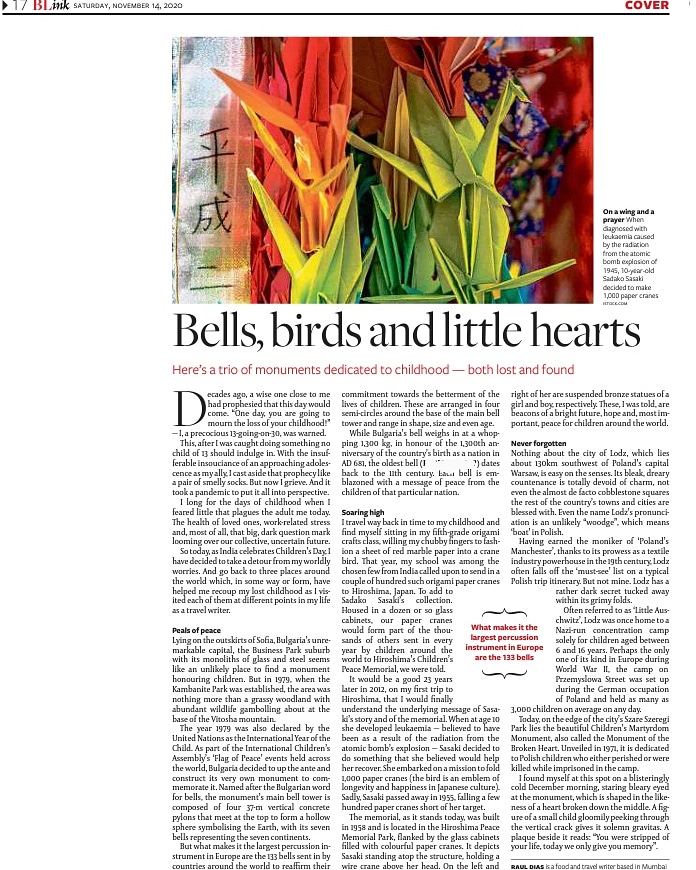
I travel way back in time once again to my childhood, as I find myself sitting in my fifth grade origami crafts class, willing my chubby fingers to fashion a sheet of red marble paper into a crane bird. That year, my school was among the chosen few from India called upon to send in a couple of hundred such origami paper cranes all the way to Hiroshima, Japan. To add to Sadako Sasaki's collection. Housed in a dozen or so glass cabinets, our paper cranes would form part of the thousands of others sent in every year by children around the world to Hiroshima's Children's Peace Memorial, we were told. 

It would be a good 23 years later in 2012, on my first trip to Hiroshima, that I would finally understand the underlying message of Sadako's story and of the memorial. When at age 10 she developed leukaemia--which was believed to have been a result of radiation from the atomic bomb's (ironically called 'Little Boy') explosion--Sadako decided to do something that she believed would help her recover. She embarked on a mission to fold 1,000 paper cranes. As cranes are believed to be emblems of longevity and happiness in Japanese culture. Sadly, Sadako passed away in 1955 falling a few hundred paper cranes short of her target.

The memorial, as it stands today, was built in 1958 and is located in the Hiroshima Peace Memorial Park, flanked by the glass cabinets filled with colourful paper cranes. It depicts Sadako standing atop the structure, holding a wire crane above her head. On the left and right of her are suspended bronze statues of a girl and boy, respectively. These, I was told, are beacons of a bright future, hope, and most importantly, peace for children around the world.


Never forgotten

Nothing about the city of Lodz that lies about 130km southwest of Poland's capital Warsaw is easy on the senses. Its bleak, dreary countenance is totally devoid of any charm, punctuated by the absence of those almost de-facto cobblestone squares the rest of the country’s towns and cities are blessed with. Even the name Lodz's pronunciation is an unlikely "woodge" that means 'boat' in Polish.

Having earned the moniker of 'Poland's Manchester' thanks to its prowess as a textile industry powerhouse in the 19th century, Lodz often falls off the 'must-see' list on a typical Polish trip itinerary. But not mine. For you see, Lodz has a rather dark secret tucked away within its grimy folds. 

Often referred to as 'Little Auschwitz', Lodz was once home to a concentration camp solely for children aged between 6 and 16 years. Perhaps, the only one of its kind in Europe during World War II, the camp on Przemyslowa street was set up during the German occupation of Poland and held as many as 3,000 children on an average at any one day. 

Today, on the edge of the city's Szare Szeregi Park lies the beautiful Children's Martyrdom Monument also called the Monument of the Broken Heart. Unveiled in 1971, the monument is dedicated to Polish children who either perished or were murdered while being imprisoned in the camp. 

I found myself at this spot on a blisteringly cold December morning, staring bleary eyed at the monument that is shaped in the likeness of a heart broken down the middle. A figure of a small child gloomily peeking through the vertical crack giving it solemn gravitas. A plaque besides it reads: "you were stripped of your life, today we only give you memory."


(An edited version of this article first appeared in the 14th November 2020 issue of The Hindu Business Line newspaper's BLink section on page 17 https://www.thehindubusinessline.com/blink/cover/three-monuments-dedicated-to-children/article33091946.ece )

Sunday, November 1, 2020

Raw Beauties!


Showing us that there’s a whole lot more to raw fish dishes than plain old Japanese sashimi are a host of interesting and exotic preparations from as far as Peru to the Philippines. Smart Life introduces you to a few such edible wonders.  

By Raul Dias

It’s safe to say that most of the world’s love affair with raw fish is rather recent. And one that is in its embryonic stages as far the average Indian diner is concerned. Once looked upon as freakishly alien and best left to where it belonged, the raw fish wonder that is Japanese sashimi has ensnared the entire world with its fresh, clean taste and healthy diet appeal. 

Today, sushi bars are an ubiquitous site the world over, with patrons hungry for a piece of that freshly sliced amberjack or for a portion of those gossamer thin slivers of yellowfin tuna—all anointed with a dab of wasabi and a splash of shoyu (soy sauce). And while smoked salmon too has made its way around the world via Scandinavia in the form of gravlax and New York (where it is known as lox), our notion of raw fish preparations is still woefully confined to the above-mentioned two. Not anymore! 

Digging a little deeper into the vast sphere of world cuisine shows us the existence of a whole smorgasbord (pun intended!) of raw fish dish iterations from a diverse number of places that have been enjoyed for centuries in various forms and styles.

Here are a few such raw revelations: 


Poké from Hawaii

Pronounced poh-kay and meaning to “cut crosswise into pieces” this supremely healthy and tasty one bowl Hawaiian origin dish is a very simple preparation that sees short grain sushi rice that has been pre-vinegared as the base. This rice is then topped with diced raw fish and other seafood that can range from salmon and tuna to octopus and sea urchin. A splash of soy, a squirt of Japanese mayonnaise, a dusting of the Japanese spice blend called furikake, sesame seeds and dried flakes of nori (seaweed) finish off this dish that is criminally addictive and clean tasting. Interestingly, very similar to poké is the Korean dish called hoedeopbap that consists of marinated raw tuna served over rice.


Ceviche from Peru

Over the last decade or so the popularity of this paradoxically raw, yet ‘cooked’ fish dish from Peru has reached dizzying heights. This seemingly simple dish is a complex preparation made from fresh raw fish cured in citrus juices, such as lemon or lime, and spiced with ají chillies and other seasonings including chopped onions, salt, and coriander. It is the all-important citrus that cooks the fish, turning its translucent flesh into a milky opaque. Ceviche is usually accompanied by side dishes that complement its flavours such as sweet potato, lettuce, roasted corn kernels called cancha and the current hipster chic craze—avocado!


Kokoda from Fiji

Coming to us straight from the swaying coconut trees and cool waters of the lush Fijian islands, this raw fish dish celebrates two of the island’s greatest resources—coconuts and its abundant seafood. Pronounced ko-kon-da, kokoda is a refreshing salad-appetizer that’s perfect after a day swimming the cerulean ocean. Just like a ceviche, cubed white fish like snapper, walu or mahi mahi is first marinated in a citrus mixture so that it cures and cooks and then a splash of cooling coconut cream is added to give the dish its creamy consistency. Diced tomatoes and a few fronds of coriander finish off this dish that is always served in a hollowed-out coconut shell.  


Crudo and Carpaccio from Italy

Literally meaning ‘crude’ or ‘raw’ in Italian, crudo is a super popular and versatile raw fish dish from Italy that can be anything from slices of raw fish drizzled over with olive oil and seasoning, to a chopped version just like a steak tartare that’s always topped with an egg yolk. Similarly, fish carpaccio is the pescatarian version of the thinly sliced raw beef dish of the same name that was invented in 1950 by Giuseppe Cipriani, founder of Harry’s Bar in Venice and named in honour of Vittore Carpaccio, the Venetian painter known for his characteristic red and white tones.  


Yusheng from China

Literally meaning “raw fish” the dish is basically a Cantonese-style raw fish salad consisting of strips of raw fish mixed with shredded vegetables and a variety of sauces and condiments, among other ingredients. Also known as the “prosperity toss”, yusheng has been a Cantonese favourite for decades with the most common form being the qicai yusheng (seven-coloured raw fish salad) served in local restaurants during the Chinese New Year period. And although versions of it are thought to have existed in ancient China, the contemporary version was created and popularised in the 1960s.


Kinilaw from the Philippines

An interesting raw fish dish that is closely related to not one but two dishes on this list, kinilaw from the Philippines borrows elements from both a ceviche and a kokoda. Hailing from the Visayan region of the archipelago, the name kinilaw is derived from the word, “kilaw”, which means raw or uncooked. Just like a ceviche, the seafood is ‘cooked’ without the application of heat but is rather cured in vinegar. Additional souring agents like the native calamansi (a lime-orange like fruit), tamarind, or green mangoes are added to enhance its tartness. To complete the dish, black pepper, onions, ginger, seaweed and sliced chilies are also added. And in some parts of the country, just like a kokoda, a dash of coconut milk or cream is added to give the dish a creamy, sweetish send-off! 

(A differently edited version of this piece was first published in the November 2020 issue of The Week's Smart Life magazine)


Sunday, July 28, 2019

Sunday, December 23, 2018

Christmas with a Difference

Christmas isn’t always about genial Santas, mistletoes and mugs of mulled wine. Raul Dias introduces you to a few alternative and decidedly wacky Christmas traditions around the world.   


By Raul Dias

In a little under two days’ time, most of the world will celebrate Christmas Day as we know it. Replete with all the Advent accoutrements pat in place. Read: carol singing, steaming mugs of mulled wine, nativity pageants and portly, white-bearded Santas frolicking about the place. But before we get carried away with all the above mentioned—and dare-we-say, cliched—merriment montages, it is pertinent to note that that’s not necessarily how the season’s festivities are represented everywhere. Remember we said ‘most’ and not ‘all over’ the world!
Here are a few such interesting, out-of-the-box and downright bizarre ways in which the world celebrates the birthday of Lord Jesus:  

The ‘anti-Santa’
This scary Austrian version of Santa, aka. Krampus really knows how to show those kids who’ve been bad, his…well, bad side! The ghoulish, hooved and horned creature that stems from Alpine folklore is believed to be the evil accomplice of St Nicholas and is said to wander the streets in search of badly-behaved children. During the month of December, you can expect to see terrifying masked figures out and about scaring kids and adults alike with ghastly pranks. The Krampus myth is so popular in Austria that there is even an annual Krampus parade in the capital Vienna. 

In a finger lickin’ mood, anyone?
Forget the Japanese language version of the “Merry Christmas!” greeting. For nearly five decades the refrain on Christmas Eve in Japan has been “Kurisumasu ni wa kentakkii!” (Kentucky for Christmas!). Yes, eating Colonel Sanders’ fried poultry pieces have become a sort of ritual for a true-blue Japanese Christmas Eve. Back in 1974, the American fast-food restaurant giant released a festive marketing campaign in Japan that spawned this rather strange national tradition that still thrives to this day. Families from all over the country head to their local KFC for a special Christmas Eve meal with table reservations being made weeks in advance.

Get, set…skate
There’s a very unique tradition that takes place in Caracas, Venezuela from the 16th to the 24th of December every year, where the city’s streets are closed off for heavy traffic before 8am so that people can go skating. And come Christmas Eve, the streets are closed off the whole day. Local residents then roller skate to church to attend the early morning mass called misa de aguinaldo, shooting off fireworks and shouting out “Jesus is born!” as they skate way.

In a mighty pickle! 
Forget those shiny buntings and kiss those cute turtle doves goodbye. In Germany, the must-have Christmas tree ornament has got to be a big green dill pickle. Confused? Well, in this Teutonic nation—where many believe the Christmas tree originated—it is customary to hide a pickle shaped ornament somewhere within the branches of the tree and give a gift to whichever child in the household finds it. According to a legend, two young boys were held captive inside a pickle barrel when the jolly St Nicholas rescued them, bringing them back (and a new tradition) to life.

Barbie and thongs
Do pardon the above sub-header, but this unique Christmas tradition maintained by our antipodean friends from down under in Australia has got nothing whatsoever to do with dolls or underwear! With Australia enjoying sunny Christmas days—what with December being peak summer time—the festivities here are kicked off with family-style barbecues that are affectionately called ‘barbies’ where people come dressed ultra-casually in shorts and sporting ‘thongs’ or flip flops on their feet. Very often, after a typically Aussie Christmas barbie, the action shifts to the local beach for a swim in the waters or simply to lounge about on the sand.  

Duck off!
We’ve probably saved the wackiest (and cutest!) of all Christmas traditions for the last, all the way from Sweden. The story goes back to the 1960s when televisions which were relatively new in Sweden aired only two channels. Now, one of these played Disney cartoons at Christmas, and in particular a 1958 Christmas special called “Kalle Anka och hans vänner önskar God Jul” or “Donald Duck and his friends wish you a Merry Christmas”. Very soon the tradition of watching this particular special took root. So much so that till this day, every Christmas, families around Sweden gather in front of the television set at 3pm sharp, all to watch the antics of a duck named Donald. Interestingly, everything on Christmas Day is planned around the television special that enjoys a viewership of more than 40 per cent of Sweden’s population.

(An edited version of this article first appeared in the 23rd December 2018 issue of The Free Press Journal newspaper's Weekend section on page 3 https://www.freepressjournal.in/travel/christmas-2018-wacky-christmas-traditions-you-may-not-know-about/1420469)


Thursday, October 4, 2018

Between Breads


From its frugal beginnings—when it was put together by the 4th Earl of Sandwich as a quick-n-easy hunting trip snack to its various gourmet avatars available today—the ubiquitous sandwich sure has come a long way. As gourmands across the world prepare to celebrate the annual International Sandwich Day on the 3rd of November, we bring you a serving of a few famous sandwiches from around the world


By Raul Dias

The Philly Cheesesteak, USA
As its name suggests, this iconic submarine-style sandwich has its origins in the state of Philadelphia and the city of Boston to be more specific. So, what we have here is a long hoagie bread roll holding within its soft center, thinly sliced slivers of meat and grilled sweet, white onions all slathered with the luridly yellow coloured Cheese Whiz cheese sauce. And while the rest of America and even the world has produced several, rather ersatz iterations of the Philly Cheesesteak sandwich, the original is a true-blue Bostonian. Right down to legendary ‘war’ between two rival cheesesteak sandwich shops Pat’s and Geno’s, located bang opposite each other at the triangular intersection of 9th St, Wharton St and Passyunk Ave. in the city’s South Philly neighbourhood.

The Bánh Mì, Vietnam
As a lasting ‘legacy’ of its French colonial past, Vietnam’s most iconic street-side snack the Bánh Mì has more than a few elements that reference the, well…French connection! A mini French baguette also called a bánh mì is split lengthwise and layered with a fusion of meats and vegetables from Vietnamese cuisine such as chả lụa sausage, fresh coriander, cucumber ribbons, and pickled carrots and daikon radish, combined with condiments from French cuisine such as pâté along with jalapeño chillies and a sweet-spicy mayonnaise. A typical Saigon dish, the Bánh Mì came into being after the 1954 Partition of Vietnam when migrants moved from North Vietnam to South Vietnam, putting their stamp on Saigon’s local cuisine. Today, one of the best places in Ho Chi Minh City, as Saigon is known as today, to try a Bánh Mì is at the Bánh Mì Bùi Thị Xuân restaurant in the Phạm Ngũ Lão backpacker ghetto.

The Torta Ahogada, Mexico
Like most great sandwiches, the Torta Ahogada has extremely humble underpinnings as a working man’s lunch. Here the porous, yet firm birote bread which has a thick, crunchy crust and softer interior is filled with slices of fried meat or chicken along with cheese and beans. The sandwich is then dunked into a vat of sauce made from vinegar, arbol chilies, garlic, oregano, and other spices and served in its soggy state with a side of tortillas, onion rings and slices of cooling avocado. Invented in the early 1900s in the Mexican city of Gudalajara—with the word ‘torta’ meaning sandwich and ‘agohada’ meaning drowned—several theories abound as to its genesis. One such belief is that the sandwich maker accidentally dropped his freshly made torta into a pan of chilli salsa and his customer loved it so much he kept repeating his ‘mistake’ to remarkable success. But whatever be its origins, one thing is clear: this spicy, messy sandwich is a multisensory treat!

The Balik Ekmek, Turkey
One of the best things about this humble fish sandwich called Balik Ekmek (literally meaning “fish bread”) is that you don’t have to look too hard to find one to treat yourself with when in the Turkish capital of Istanbul. Simply let your olfactory senses lead you to the nearest boat selling this street…err, we mean waterside delicacy! On either sides of the city’s mighty Galata Bridge, in the waterfront neighbourhoods of Eminonu and Karakoy, you can find boats lined up with makeshift grills set up on them dispensing these yummy treats for around 5 Turkish Lira (Rs 56) a piece. What you’ll get is a sturdy round Turkish bread stuffed with a deboned filet of either grilled or fried oily fish such as sardines or mackerel topped with hot sauce and accompanied by sides of raw onion rings, radish, lettuce and a wedge of lemon.   

The Chip Butty, UK  
While this aberration of a sandwich might sound like a carb-on-carb keto diet nightmare, let us assure you that one bite of this classic, yet insanely simple British sandwich and you’ll surrender to its charms. Known as a ‘butty’ in the local vernacular, a sandwich is that quintessential British snack whose avatars are numerous, from the dainty cucumber and watercress ones to the cholesterol-rich bacon butty. For a chip butty, you’ll need to pile on two slices of buttered, thick white sandwich bread with another classic, chips—that we know of as thick cut fries—and slather it all with bright red pumpkin and tomato ketchup. And voila, you’ll be staring down at a typical post binge drinking treat that can be found at almost any fish and chip shop across the country.   

The Po’ Boy, USA
Shrimp, crawfish, lobster, oyster you name it and it can be found in a typically New Orleans, Louisiana style Po’ Boy sandwich. A corruption of the term ‘poor boy’ as it was the most preferred meal of the striking streetcar conductors in 1929, the sandwich evolved from the1800s fried oyster sandwiches on French loaves to include any breaded, deep-fried mollusc or crustacean loaded onto French bread and dressed with lettuce, tomato, pickles, and mayonnaise. Though essentially a seafood sandwich, places like Texas have been known to put own their spin on a Po’ Boy with versions that come stuffed with BBQ meat and chicken. But for the real deal, head down to joints like Avery’s On Tulane along New Orleans’ Tulane Ave. for a taste of the divine that defies explanation.

The Smørrebrød, Denmark
Proving to the world of casual cuisine that a sandwich isn’t always about two pieces of bread holding forth fillings, this Danish classic open-faced sandwich may be a mouthful to pronounce, but the sheer mind-boggling varieties of Smørrebrød will leave you salivating. A typical Smørrebrød is usually constructed out of a slice of buttered rye bread called rugbrød, known for its dense crumb and deep brown hue. Called pålæg, which translates as “lay-on”, the toppings range from cold cuts, slivers of meat or fish, cheese or spreads. But hands down the most popular of all pålæg has got to be cured salmon called gravad laks that’s further topped off with a frond of dill, a splodge of sweet mayonnaise and sent off with a squirt of lemon juice. 


Oddities of the Sandwich World
* At $214 a pop, the title of the World’s Most Expensive Sandwich would have to go to “The Quintessential Grilled Cheese Sandwich,” that’s made by New York City’s legendary Serendipity 3 restaurant. Besides holding unfathomable bragging rights within its folds, the sandwich is made up of two slices of French bread that has Dom Perignon champagne and 23-karat gold baked into it. It is stuffed with caciocavallo podolico, a rare cheese imported from southern Italy and brushed with white truffle oil and gold leaf before it meets the grill.
* Ever heard of the ‘Candwich’? An American company produces these rather bizarre sandwiches in a can! Yes, each tin contains a bread roll and an assortment of flavours, including Peanut Butter and Jelly and Honey BBQ chicken. ‘nuff said.
* As an homage to the King of Rock and Roll, Elvis Presley, The Elvis sandwich is stuffed with an odd assortment of ingredients Elvis was particularly partial to all his life. So, we have peanut butter, banana and bacon ensconced within slices of commercial white bread and grilled with dollops of butter slathered onto the whole thing.
* In Japan, one of the most popular kinds of sandwiches is the Fruit Sando where sweet, soft white cake-like bread is stuffed with whipped cream and a whole ‘orchard’ of fruits from the most popular being strawberries to the downright strange persimmon and musk melon.

(An edited version of this article first appeared in the October 2018 issue of Jetwings Domestic in-flight magazine of Jet Airways http://www.jetairways.com/EN/IN/jetexperience/magazines.aspx)


Monday, June 18, 2018

Sushi 2.0

Today, on International Sushi Day, we liberate all you sushi fans from the shackles of boring, old, run-of-the-mill iterations and introduce you to six of the most unusual and odd ball interpretations of sushi available in the city.


By Raul Dias

Prawns and Edamame Sushi Pizza
If there’s one aspect of sushi that’s truly remarkable, then that would have to be its ability to experiment with both ingredients and presentation styles. Take this innovative sushi pizza for example. Locally sourced prawns and that quintessential Japanese ingredient, edamame are combined with a honey, chilli and fresh mango sauce and shaped to resemble a slice of pizza. “Sushi and pizza are perhaps two the most loved comfort foods and there couldn’t have been a better occasion than International Sushi Day to celebrate the confluence of the two,” says Chef Paul Kinny, Culinary Director, Shizusan Shophouse & Bar.  
At Shizusan Shophouse & Bar, High Street Phoenix, Lower Parel.
Call 62373536
Cost
Rs 375 (per slice)


BLT Sushi Sandwich
Pushing the boundary even further, this sushi variant gets a top score on the innovation charts! Taking the classic all-American bacon, lettuce and tomato sandwich and giving it a far eastern fillip as a sushi are the guys at The Fatty Bao. Here, bacon, lettuce and roasted tomato are layered in vinegared-rice and a nori sheet for the ultimate sushi sandwich hybrid. “This sandwich sushi is inspired by the onigirazu sushi, where sushi rice and nori sheets are used to make sandwich shapes with various fillings,” says Chef Prashanth, Executive Chef, The Fatty Bao.
At The Fatty Bao, G1, 108, Morya Classic, Off New Link Road, Andheri West.
Call 62366323/7738008460
Cost Rs 490 (4 pieces)


Tsu No Maki

Just when you thought you’d seen the last mango of the season, you see it well-represented in this totally wacky maki sushi. Joining the salmon-tuna protein duo are slivers of ripe mango and vinegar-sushi rice to make a quadrant shaped piece of sushi. And this is why it is named Tsu No Maki, because in Japanese “Tsu No” means four. “Classical sushi consists of seasonal ingredients prepared using the most sophisticated methods to bring out the best natural flavour of the dish. Where as in the case of innovative versions of sushi, we use local and seasonal ingredients like mango which are much appreciated by our guests,” says Chef Yogendra Adep, Chef De Cuisine, The St. Regis Mumbai

At Yuuka, Level 37, The St. Regis Mumbai, 462, Senapati Bapat Marg, Lower Parel West.
Call
61628422
Cost
Rs 2,100 (8 pieces)


Gobo Nigiri

As one of Japanese cuisine’s most popular ingredients, the burdock root or gobo is a herb that not just detoxifies the blood, but it is also great for the lymphatic system and skin. Distilling the goodness of this ingredient that we very rarely see in Indian Japanese restaurants is Pa Pa Ya’s all veg Gobo Nigiri. Here, gobo root is combined with carrot, cucumber and avocado that are rolled in a nori sheet, resulting in a sweet, yet pungent sushi roll. “Gobo has a high percentage of irons and vitamins A and B. While creating the dish I wanted to keep the taste authentic as well as make it a healthier option for sushi with the further addition of carrots, cucumber and avocado,” says Chef Sahil Singh, Sr Executive Chef, Pa Pa Ya.
At Pa Pa Ya, Hotel Diplomat, B. K. Boman Behram Marg, Colaba.
Call
8451011174
Cost
Rs 625 (8 pieces)


Battera Sushi with Salmon and Tuna
Very little is known about the Osaka-style pressed sushi called oshizushi. Introducing us, to not just this regional sushi speciality, but going one step further and topping it off with three very unusual ingredients—avocado tartare, capers and onion salsa is the Battera Sushi with salmon and tuna. “Battera sushi, that is moulded in a special wooden box, is both fun to eat and lovely to look at. And not to mention different from the usual monotony of rolled sushi, that one sees everywhere,” says Chef Vikram Khatri, Executive Chef, Hello Guppy.
At Hello Guppy, Ground Floor, Godrej-BKC, G-Block, BKC.
Call 26534720
Cost
Rs 720 (8 pieces)


Mafia Roll
Never mind its rather intimidating name, this sushi roll is all about fun. How else can one explain the use of popping corn as one of its main ingredients? This uramaki (inside out) roll of corn tempura with piquillo peppers and gochujang mayonnaise that’s garnished with some popcorn and parsley has an interesting story behind its name. “The pop and bang of the Italian Mafia is carried forward into this sushi roll which has popping corn and fiery roasted piquillo peppers along with the bang of spicy gochujang mayonnaise,” says Chef Farrokh Khambata, Owner-Chef, Joss.
At Joss, Ground Floor, Savoy Chambers, Linking Road, Santacruz West.
Call
26617771
Cost
Rs 850 (8 pieces)


Recipe for…
Sriracha Blush Maki Sushi


Ingredients:
15gm Avocado Cubes
15gm Cucumber Batons
10gm Shredded Carrot
15gm Jalapeño Tempura Fried
15gm Cream Cheese
10gm Black Sesame Seeds
120gm Sushi Rice (boiled)
30ml Sushi Vinegar
1 Nori Seaweed Sheet
10ml Sriracha Hot Chilli Sauce
10gm Tobanjan Paste
10gm Togarashi Japanese Spice Powder
10gm Kewpie Japanese Mayonnaise


Method:
* Place the nori sheet on a sushi mat and spread the cooked and vinegar-sprinkled sushi rice on it. Sprinkle togarashi and sesame seeds on top of the rice.
* Turn over the sheet. Put cream cheese, avocado, cucumber, carrot, fried jalapeño tempura in the centre of the sheet.
* Roll it tightly and cut into eight pieces and arrange on a platter.
* Drizzle with Kewpie mayonnaise mixed with tobanjan paste and dot with sriracha sauce.


--Recipe courtesy Chef Paul Kinny, Culinary Director, Shizusan Shophouse & Bar

(An edited version of this article appeared in the 18th June 2018 issue of the Mid-Day newspaper, India on page 22 https://www.mid-day.com/articles/international-sushi-day-heres-six-unusual-picks-from-across-mumbais-eateries/19530158)