
(This article first appeared online on 10th January 2024 on Live Mint and in print on 11th January in Mint newspaper India https://lifestyle.livemint.com/food/discover/bulgarian-cheese-yogurt-cuisine-111704874667279.html)
(This article first appeared online on 10th January 2024 on Live Mint and in print on 11th January in Mint newspaper India https://lifestyle.livemint.com/food/discover/bulgarian-cheese-yogurt-cuisine-111704874667279.html)
With a menu full of interesting Hungarian street food, this tiny Juhu eatery takes you on a vicarious culinary holiday straight to the food markets of Central Europe.

By Raul Dias
One of the last places we flew to just before the pandemic clipped out travel-happy wings was to the Hungarian capital of Budapest. And while this beautiful Central European city may be better known for its grand architecture and for the serpentine Danube that bisects it into the Buda and Pest sides, there is something to be said about the city’s food as well.
Redolent with copious amounts of the de facto national spice of smoky paprika, the goulashes that we indulged in were just as memorable as the spit-roasted kurtoshes and deep fried langos. Perfect snacks to munch on on a chilly winter's day. So, imagine our delight when we chanced upon Kurtosshhh, a tiny (and dare-we-say numerologically-savvy!) eatery in Juhu that claims to serve Hungarian street food. Albeit with a twist.
With barely enough room for a couple of people to sit at its wooden tables and chairs, with a cosy mezzanine level housing a single table, we realised that dining in at Kurtosshhh in these days may not be such a great idea. And so, we picked up a couple of dishes that came packed in regular aluminium foil containers and paper boxes.
The eponymous kurtosh that is the eatery’s flag bearing dish is a conical spit cake that’s also known multifariously as a chimney cake, a baumstriezl in Germany and a trdelnik in the Czech Republic. Generally served in its sweet avatar, all dusted with sugar and cinnamon, at Kurtosshhh you can also try a number of savoury iterations; ranging from grilled vegetables to cottage cheese filled ones. Out eight-inch tall chipotle chicken kurtosh (Rs.189) was composed of a buttery, blistered dough that we were told was made with a mixture of 18 secret flours. It held forth creamy, well-seasoned succulent bits of chicken with diced onions and peppers.
Served in individual rings and piping hot, the sweet cinnamon trdelnik (Rs.189) was decadently more-ish, all doused in chocolate and caramel sauce. We also tried the open-faced grilled cottage cheese kartoos kurtosh (Rs.229) that was quite different in taste and texture from its conical cousin. And while it may seem similar to a flatbread, the deep fried langos topped with molten cheese and olives, all dusted with smoky paprika (Rs.199) took us straight back to Budapest’s Central Food Market Hall where we had tried langos for the first time.
We decided to wash all this down with the thick and creamy safrany kulfi shake (Rs.169), served in the now-ubiquitous mini milk bottle. As a parting shot, we decided to succumb to a cliché and called for the chicken goulash rice bowl (Rs.249) which, though quite tasty and satisfying, fell a tad short in the authenticity department, missing that all-important paprika hit.
Well, I guess we'll just have to go back for a more genuine one—both to Kurtosshhh and yes, Hungary too!
AT: Kurtosshhh, Shop 12, Juhu Ruturaj CHS, Juhu Tara Road, Santacruz West.
DELIVERY: Swiggy and Zomato
TIME: 11 am to 11 pm
CALL: 9321055321
(An edited version of this review appeared in the 13th January 2021 issue of the Mid-Day newspaper, India on page 16 https://www.mid-day.com/mumbai-guide/mumbai-food/article/hungary-tide-23155492)
Celebrating the innocence of childhood in their own unique ways, this trio of monuments around the world are places of immense beauty and gut-wrenching despair in equal measure
By Raul Dias
Decades ago, a wise one close to me had prophesied that this day would come. “One day, you are going to mourn the loss of your childhood!”, a precocious, 13-going-on-30-year-old me was warned.
This, after I was caught doing something no child of 13 should have ever indulged in. With the insufferable insouciance of an approaching adolescence as my ally, I cast aside that prophecy like a pair of smelly socks. But now, I grieve.
And it took a pandemic to put it all into perspective. I long for the days of my childhood when I feared so very little that plagues the adult me today. The health of loved ones, work-related stress and most of all, that big, dark question mark looming over our collective, uncertain future. All constantly piercing thorns in my side.
So today, as India celebrates Children's Day, I have decided to take a short little detour from my worldly worries. And go back to three places around the world, which in some way or form have helped me recoup a little bit of my lost childhood as I visited each of them at different points in my life as a travel writer. Places reflective of immense beauty and gut-wrenching despair in equal measure. Each dedicated to children and childhood--both lost and found.
Peals of peace
Lying on the outskirts of Sofia, Bulgaria's unremarkable capital, the Business Park suburb with its monoliths of glass and steel seems like an unlikely place to find a monument honouring children. But in 1979, when the Kambanite Park was established, the area was nothing more than a grassy woodland with abundant wildlife gambolling about at the base of the Vitosha mountain.
Besides being the year of my birth, 1979 was also declared by the United Nations as the International Year of the Child. As part of the International Children’s Assembly's 'Flag of Peace' events held across the world, Bulgaria decided to up the ante and construct its very own monument to commemorate it. Named after the Bulgarian word for bells, “kambanite”, the monument's main bell tower is composed of four, 37-meter vertical concrete pylons that meet at the top to form a hollow sphere symbolising the earth, with its seven bells representing the seven continents.
But what makes it the largest percussion instrument in Europe are the 133 (and growing!) bells sent in by countries around the world to reaffirm their commitment towards the betterment of the lives of children. These bells are arranged in four semi circles around the base of the main bell tower and range in shape, size and even age.
While Bulgaria’s bell weighs in at a whopping 1,300 kgs, in honour of the 1,300th anniversary of the country's birth as a nation in 681AD, the oldest bell dates back to the 11th century. Each of the bells are emblazoned with a message of peace from the children of that particular nation. While an inscription at the monument’s base reads, “Children of the future accept the eternal, fiery call of immortality - Unity, Creativity, Beauty.”
Soaring high
I travel way back in time once again to my childhood, as I find myself sitting in my fifth grade origami crafts class, willing my chubby fingers to fashion a sheet of red marble paper into a crane bird. That year, my school was among the chosen few from India called upon to send in a couple of hundred such origami paper cranes all the way to Hiroshima, Japan. To add to Sadako Sasaki's collection. Housed in a dozen or so glass cabinets, our paper cranes would form part of the thousands of others sent in every year by children around the world to Hiroshima's Children's Peace Memorial, we were told.
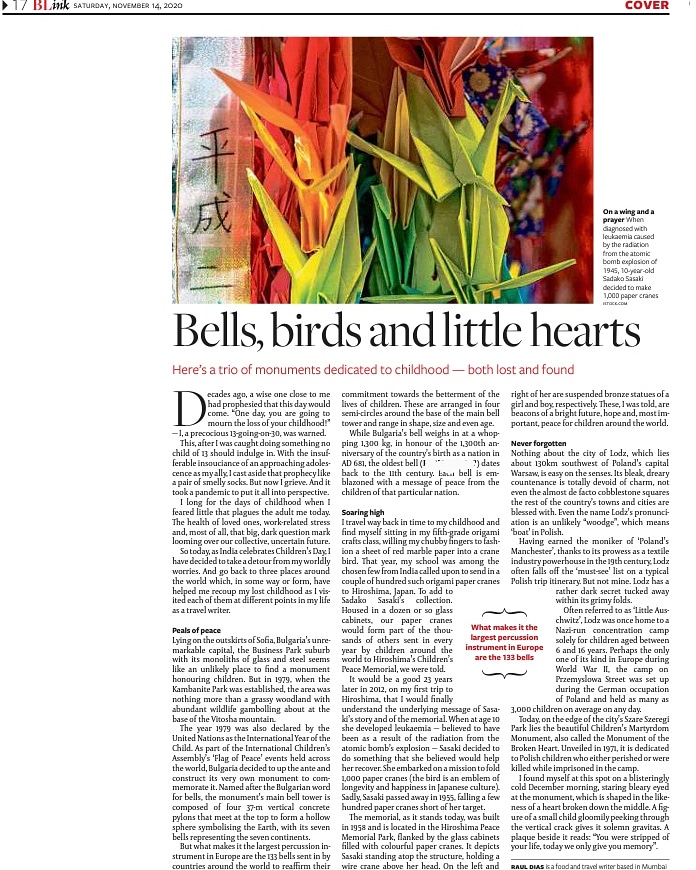
It would be a good 23 years later in 2012, on my first trip to Hiroshima, that I would finally understand the underlying message of Sadako's story and of the memorial. When at age 10 she developed leukaemia--which was believed to have been a result of radiation from the atomic bomb's (ironically called 'Little Boy') explosion--Sadako decided to do something that she believed would help her recover. She embarked on a mission to fold 1,000 paper cranes. As cranes are believed to be emblems of longevity and happiness in Japanese culture. Sadly, Sadako passed away in 1955 falling a few hundred paper cranes short of her target.
The memorial, as it stands today, was built in 1958 and is located in the Hiroshima Peace Memorial Park, flanked by the glass cabinets filled with colourful paper cranes. It depicts Sadako standing atop the structure, holding a wire crane above her head. On the left and right of her are suspended bronze statues of a girl and boy, respectively. These, I was told, are beacons of a bright future, hope, and most importantly, peace for children around the world.
Never forgotten
Nothing about the city of Lodz that lies about 130km southwest of Poland's capital Warsaw is easy on the senses. Its bleak, dreary countenance is totally devoid of any charm, punctuated by the absence of those almost de-facto cobblestone squares the rest of the country’s towns and cities are blessed with. Even the name Lodz's pronunciation is an unlikely "woodge" that means 'boat' in Polish.
Having earned the moniker of 'Poland's Manchester' thanks to its prowess as a textile industry powerhouse in the 19th century, Lodz often falls off the 'must-see' list on a typical Polish trip itinerary. But not mine. For you see, Lodz has a rather dark secret tucked away within its grimy folds.
Often referred to as 'Little Auschwitz', Lodz was once home to a concentration camp solely for children aged between 6 and 16 years. Perhaps, the only one of its kind in Europe during World War II, the camp on Przemyslowa street was set up during the German occupation of Poland and held as many as 3,000 children on an average at any one day.
Today, on the edge of the city's Szare Szeregi Park lies the beautiful Children's Martyrdom Monument also called the Monument of the Broken Heart. Unveiled in 1971, the monument is dedicated to Polish children who either perished or were murdered while being imprisoned in the camp.
I found myself at this spot on a blisteringly cold December morning, staring bleary eyed at the monument that is shaped in the likeness of a heart broken down the middle. A figure of a small child gloomily peeking through the vertical crack giving it solemn gravitas. A plaque besides it reads: "you were stripped of your life, today we only give you memory."


