Showing posts with label SOUTH EAST ASIA. Show all posts

Wednesday, January 17, 2024

East Asia's Food Towns


(This article first appeared online on 17th January 2024 on Live Mint and in print on 18th January in Mint newspaper India https://lifestyle.livemint.com/food/discover/east-asia-food-places-gi-tag-111705460453578.html)

Monday, October 23, 2023

10 New And Interesting Things To Try In Singapore


(This article first appeared online on 23rd October 2023 on ZeeZest https://zeezest.com/travel/10-new-and-interesting-things-to-try-in-singapore-4372)

Saturday, December 5, 2020

Holding 'suey'!

With as many iterations as its myriad components, the Burmese dish of khao suey is a well-travelled one.


By Raul Dias


'A sort of Burmese bhel' is perhaps one of the most succinct--if a tad short of being apt--descriptions for khao suey that I recently came across on a pan-Asian, Mumbai-based restaurant's menu card. None of that flowery 'tender morsels of farm-raised chicken, simmered in an unctuous coconut milk broth...' hyperbolic overdrive, menu jargon seem to veer towards these days at most other places. 

For the uninitiated among us (though I highly doubt there would be many), khao suey is a much-loved, and dare-I-say, callously co-opted curried noodle dish of Burmese origin that had been shamelessly adapted and tweaked the world over and here in India in particular. But more on that later. 


Bowls of Sunshine

With its soothing, yet punchy taste, khao suey can easily be classified as a comfort food dish. One that can be scarfed down at anytime of the day like they do in Myanmar and other South East Asian countries. It sees everything from chicken, beef, pork, seafood and even tofu morsels added to a spicy, (mostly) coconut milk- and turmeric-based curry. This bright orange hued curry is then ladled over thin rice noodles to form a soup-meets-stew kind of hybrid dish. 

But hold on! It needs more jazzing up. The supporting acts to the main show take the form of a variety of condiments that range from crispy fried shallots and garlic to halved, boiled eggs, fresh coriander fronds and roasted, crushed peanuts. Each adding textural and flavourful heft to the dish.

As I travelled around Myanmar a few years ago, I realised, that, much like how the word ‘curry’ is misconstrued in the West that divests it of its genericness, khao suey is a similar victim. In the Burmese language, khao suey simply means rice noodles. How one treats those noodles in a dish, creates local variations of what we know commonly as khao suey, the all-in-one meal.


The name game

The dry noodle version of the dish called shwedaung khao suey, that is popular as a street-side snack in places like Yangon, is akin to a crunchy salad. And this is perhaps how the 'Burmese bhel' inference comes into play. While the coconut milk-laden, Southern Myanmarese ohn no khao suey is more in line with the iteration of khao suey we are familiar with in India. 

Crossing the Myanmarese border from the town of Payathonsu into Sangkhla Buri in Northern Thailand via the Three Pagodas Pass, I noticed how easily khao suey had segued into the local cuisine. Known as khao soi Islam, the pork-bereft version (substituted by beef or chicken) is almost similar to ohn no khao suey and is prepared mostly by the Muslim community who prefer adding the locally grown mustard greens in a pickled form to the dish. 

The other neighbour of Myanmar that has its own version of the dish is Laos. This Northern Laotian version also called khao soi is more of a soup made with wide rice noodles, chopped pork and has that unmistakable funky taste of fermented soy beans. All this is topped off with pork rind, coriander and bean sprouts. Interestingly, many are of the belief that the two versions of the shared Singaporean and Malaysian dish of laksa i.e assam (meaning: sour) and curry laksa owe their genesis to khao suey due to their startling similarities. 


Colonial cousins

Perhaps the greatest surprise in store for me on the khao suey front was the rather serendipitous discovery of the Memoni Muslim dish of khausa and how closely it is related to Burmese khao suey. Tasting this truly desi version of the dish at a Memoni food pop-up by a Mumbai-based home chef a few weeks ago, I couldn’t but help marvel at how well the dish had travelled and had gotten adapted along the way.

Often bearing the moniker of the 'sailor businessmen of India,' the Memons, who originally hail from Gujarat, have always had very strong ties to Myanmar since the time it was known as British-occupied Burma. Mainly involved in the pre-independence textile, oil and paper production trade, they would travel to Burma regularly. With a few even settling there permanently and trading from the British set-up port at Akyub, which is in present-day Sitwe.

Many Memons subsequently moved back to India in 1947, with a second exodus taking place in the early 1960s after the Burmese military junta regime, known to be intolerant of foreigners, came into power. Bringing back with them an edible emissary that they named khausa. Adapted to suit their tastes, khausa employs the more Italian-style wheat spaghetti in lieu of rice noodles. This is topped off with a cubed chicken curry made with yoghurt, coconut milk and gram flour. Garnishes take the form of piquant sliced green chillies, ginger juliennes, and crunchy deep-fried samosa dough strips, with a sprinkling of chaat masala giving it an unmistakably desi tadka. 

Sure wins the vote for the most widely travelled and adapted dish, wouldn’t you say?


(An edited version of this article first appeared online in The Hindu Business Line newspaper's BLink section on 5th December 2020 https://www.thehindubusinessline.com/blink/takeaway/khao-suey-is-burmas-global-dish/article33249771.ece)

Saturday, July 25, 2020

Bali-hoo!

The idyllic island of Bali seems poised to become the post-pandemic world’s epicenter for the hipster drifter with ‘digital nomadism’ finding a strong footing in the millennial lexicon.


By Raul Dias 

“Trust me, it’s paradise. This is where the hungry come to feed. For mine is a generation that circles the globe and searches for something we haven’t tried before…”, says Leonardo Di Caprio’s mononymous character ‘Richard’ in the 2000 film The Beach. A backpacker cult classic, so ahead of its time that it effortlessly segues into the current milieu, exactly two decades later. A time when digital nomadism seems to be the way forward for millennials-on-the-go, as they chart their course in the (hopefully!) post-pandemic world. One that is ruled by the unholy trinity of anxiety, apprehension and uncertainty.
All this, while attempting to precariously juggle travel, work and a little adventure on the side. Constantly searching for their version of a modern-day Valhalla if you may. Nesting in places as far flung as Cancun in Mexico to Bali in Indonesia where tribes of wannabe digital nomad warriors like themselves—be they app developers, social media marketers or the ubiquitous travel vlogger–hunker down for extended periods of stay. Armed with their hi-tech weaponry and millennial coolth, ready to conquer the digital world and beyond, one oat milk latte at a time!

Digi go-go
Loath as I may be to admit, I am one of these people now. Even though I have been on the fringes of the digital nomadic lifestyle for nearly a decade as a freelance travel and food writer, setting up temporary ‘shop’ wherever I travel, I have somehow always found succor and comfort in being tethered to the familiarity of my writing desk, here in my home base of Mumbai. The fulltime, peripatetic lifestyle scene was not something I could wrap my head around for an assortment of reasons that seem trivial to me today.
Like a lot of things in our lives that have changed over the course of the tumultuous first half of this pandemic-ridden year, I have done a rethink. I guess it was the ennui resulting from five months (and counting) of suspended animation that has sealed the deal for me. I want…nay, need a change. “If I can work from home, I can work from anywhere”, is a mantra I now chant on a loop.
As we do a rethink—both about how we work and how we travel—an important realisation comes to the fore. The tradeoff by combining work with leisure over an extended period, while remaining socially distant is far greater than the ephemeral lure of a short trip. The latter no longer as attractive and realistic as before, what with mandatory Covid-19 testing and fortnight quarantines putting a kibosh on everything.
I am not alone in recognising this need of being untethered. Quick on the uptake and saddling up to this cultural sea change are countries like Estonia which recently announced a special long-term digital nomad visa. The eastern Caribbean island of Barbados too has unveiled a similar 12-month digital nomad work visa to allow visitors from all countries to live and work there, tax free.       

Seas the day
But we need not look that far. As a frontrunner on the honeymoon-meets-family vacation scene for decades, the sea-n-surf paradise of Bali has had a facelift of sorts. Transforming itself into a hip digital nomad haven for the last couple of years, the Indonesian island is undoubtedly poised to become the post-pandemic world’s epicenter for the hipster drifter for a host of reasons that I will unspool shortly.
Exactly a year ago, back in the day when ‘Corona’ to me was just a brand of bottled beer, served with a wedge of lime bunged down its neck, I took a wee detour to Bali in the middle of a two-week-long work trip to Thailand. The purpose of my two-day trip to the island was to scope out an abridged version the digital nomadic lifestyle there as part of a writing project I was in consideration for. While said project did not work out, what I gleaned from that trip was a destination ripe for the picking.
Like almost every prospective digital nomad, I found myself in Canggu, Bali’s de facto digital nomad capital along the south coast of the island. A place that is relatively inexpensive to live and work in and easy to navigate around. I was there checking out the three main things a digital nomad in Bali seeks: accommodation, a place to work and something extra when R&R beckons. 

Ticking all boxes
While other areas in Bali like Ubud—the rice terrace-surrounded bucolic heart of the island—and the more upmarket Seminyak are no less attractive, there is something to be said about the beachy vibe of Canggu. Here, surfing lessons on lunchbreaks are the norm, as are al fresco sunset yoga sessions that replace post-work drinks.
With its explosion of avocado-toast serving cafés, cheap dive bars, art galleries and Insta-friendly vistas, Canggu garners some serious cred on hipster street. But is the wide variety of both coworking spaces (with lightning fast internet speeds) and a plethora of accommodation options available here that make it the very epicenter of Bali’s digital nomadic scene. From inexpensive guesthouses and plush Airbnb rentals to communal ‘coliving spaces’—the latest buzzword in digital nomad circles—the search in Bali ends here.
I was barely an hour into my dalliance with ‘digital nomading’ working at the open 24 hours a day Tropical Nomad Coworking space near Canggu’s Echo Beach trying hard to swallow the luridly purple contents of my acai fruit bowl, when I got chatting with Sarah. A digital content curator originally from Texas, she had been based in Bali for the last six months and by the look of it was still in the honeymoon phase with her digital nomad life. “It really does not matter if you are an aspiring digital nomad or an experienced one,” Sarah says rather encouragingly. “Bali is the kind of place where you are almost guaranteed to find some truly unique and inspiring places and people who help you get to your productive best, while living life to the fullest.”
Quite the prophetic solution for these bleak times, no?         


Travel log
Getting There
As there are no direct flights from India to Bali, one can take connecting flights via Bangkok, Singapore or Kuala Lumpur. Travel within the island of Bali is extremely easy with cheap and plentiful transport options available, including private taxis and bikes on hire. Citizens of 169 countries (including India) get a free 30-day on arrival which allows one to work as a digital nomad and which can be renewed by taking a short ‘visa run’ to places like Malaysia, Singapore or Thailand and coming back to Bali.

Stay and Work
* Dojo Bali (dojobali.org) along Canggu’s famuous surf break of Echo Beach ticks all three boxes offering a trendy coworking and coliving space along with recreational facilities like surf lessons and Balinese cooking lessons, all at very reasonable prices.
* Outpost (destinationoutpost.co) with its flagship sister property in Ubud is another great coworking and coliving space with an apt slogan of “design your best life.”

Tip
While the whole of Bali is very safe for women, there are places like Goddess Retreats (goddessretreats.com) which is a women-only retreat offering everything from accommodation and outdoor activities to transformative yoga sessions and spa treatments that are perfect for solo women digital nomads.
(Note: While it is not advisable to travel at the moment, the above information is intended to provide a general idea for future travel—whenever it is safe to do so again.)


(An edited version of this article first appeared in the 25th July 2020 issue of The Hindu Business Line newspaper's BLink section on page 20 https://www.thehindubusinessline.com/blink/takeaway/bali-is-the-capital-of-digital-nomadism/article32177278.ece)


Friday, January 3, 2020

Serene Bliss!

Offering a host of tailormade wellness solutions and world-class relaxation facilities, the luxurious Mövenpick BDMS Wellness Resort is a fecund, tropical paradise, all set in the heart of downtown Bangkok. 


By Raul Dias

A unique urban health retreat surrounded by 1.2 acres of lush greenery, the brand new Mövenpick BDMS Wellness Resort Bangkok by the Accor Group of hotels is one of those ultra-rare properties in that it is a proper, full-fledged resort set in the buzzing center of Bangkok. A classically elegant retreat, the property stands below tree height, shaded by the canopy of the adjacent Nai Lert Park, famed as Bangkok’s only remaining private city center park.
Within the resort a refined, minimalistic décor meets every modern convenience to take your stress away, reflecting Mövenpick’s renowned commitment to genuine comforts delivered exceptionally well. “Bangkok is a bustling and vibrant metropolis that travellers from all over the world aspire to visit at least once in their lifetime. We are delighted to bring a hotel inspired by such a unique wellness concept into the heart of the city, where our guests can relax within lush green gardens whilst enjoying convenient access to the BDMS Wellness Clinic,” says Patrick Basset, Chief Operating Officer of Accor for Upper Southeast & Northeast Asia and the Maldives.

Urban Oasis
The one aspect of the resort’s setting that’s truly impressive is the range of accommodation options the resort has on offer. While the Deluxe Rooms extend 42 sqm of personalised comfort, the Executive Suite is a spacious 74 sqm with separate living rooms and bedrooms. However, irrespective of room category, each offers either city views across the capital, or serene garden views from their broad balconies. And yes, in-keeping with the Mövenpick’s wonderful world-wide policy of a free mini bar for the first day of one’s stay, here too one can enjoy a range of non-alcoholic beverages on the house.
And while the signature Wellness Suites are unique to the resort, encompassing 74 sqm of therapeutic comfort, the Presidential Suite and Royal Suite are the pinnacles of Mövenpick’s renowned standards of comfort and style, stretching across a mammoth 164 sqm with private entrances.

Perfect Blend
Speaking of wellness, the resort shares its property with the BDMS Wellness Clinic which is the latest of the Bangkok Dusit Medical Services group’s centres of medical excellence. It applies world leading therapies and technologies to treat an illness’ root cause in seven specialised clinics with individually trained nurses and administrators. “With travellers placing more value on health and wellness than ever before, we are very excited to bring this innovative new concept to the market. Increasingly, wellness is moving beyond the walls of the spa and fitness areas with guests also wanting greater access to personalised programming,” says Lindsay Madden-Nadeau, Director of Well-Being, Accor. “Our new offering in Bangkok is a perfect example of how we are meeting this need and delivering sustainable, approachable wellbeing concepts to visiting guests as well as local communities.”
Taking full advantage of the wonderful Fitness Centre, guests must make sure to factor in at least an hour every day to working out on the David Health Solution System machines, designed to aid spine and orthopaedic recovery. The outdoor pool surrounded by thick vegetation that drown out all ambient noises from outside makes it almost impossible to believe that one is truly in the heart of chaotic Bangkok.

Healthy Bites!
At the resort, international dining tastes are fully catered to at a range of venues and all in-keeping with the resort’s wellness leitmotif. So, one can dine at the Tamarind all-day dining restaurant offering healthy and organic produce, generous breakfast buffets and themed buffet dinners. The Rim Klong Café serves famed Mövenpick coffees and ice creams, international breads and pastries, including gluten-free options, healthy mocktails, slow-juice selections, tea-infusions and nutritious boosters. It is a great place to simply unwind.
The Sala pool bar is perfect for refreshments of local and imported beers, fresh smoothies and original cocktails under cooling tree shade. For live music, soothing daytime tunes or an evening aperitif, head to the Cinnamon Lobby Bar. Serving juices and coffees and with a complimentary chocolate hour for guests, it’s a daytime family favourite.


Fact File
Getting There
There are a number of daily direct flights from most major Indian cities to Bangkok. The easy to procure Thai visa can either be obtained in advance online or at the various Thailand consular missions across India or on arrival (free till 30th April 2020) at Bangkok’s Suvarnabhumi International Airport.

Stay
Mövenpick BDMS Wellness Resort Bangkok, 2 Wireless Road, Lumpini, Pathumwan,
Bangkok 10330, Thailand.
Telephone: +66 (2) 666 3333, E-mail: resort.bdms.sales@movenpick.com
www. movenpick.com

Things to do
The resort’s city center location places guests at the heart of shopping and entertainment with a host of things to see and do:
* The Ratchaprasong retail district is packed with designer boutiques and shopping centres.
* The nearby Erawan Shrine is a serene place of pilgrimage for many Asian travellers just five minutes away.
* The Bangkok Art and Culture Centre, opposite the MBK Mall, offers quiet galleries of ancient and contemporary art as a refreshing respite from the bustling markets.
* The city’s famed nightlife welcomes visitors just ten minutes from the hotel in Sukhumvit Soi 11 and Soi 8.


(A differently edited version of this piece was first published in the January 2020 issue of The Week's Smart Life magazine)


Saturday, August 17, 2019

Urban Oasis

Set in the heart of downtown Bangkok, the Mövenpick BDMS Wellness Resort is a fecund, tropical paradise with a lot on offer. Raul Dias checks in for some much-needed R&R!


By Raul Dias

A great fan of both my home city of Mumbai and that of my ‘adopted’ second home aka. Bangkok, I always find myself drawing several parallels between the two. Yes, both are equally chaotic, traffic-saturated and supremely exhausting! But both also have an indomitable spirit that cannot be defined or quantified. A spirit that keeps drawing me back to Bangkok’s urban charms time and again…
It is also a well-known fact that I will never refuse an opportunity to head to the Thai capital, even if it means a short, three-day trip. So, when I was very kindly invited to join in on GoAir’s inaugural daily, direct flight from Mumbai to Bangkok (check out our Travel Bytes section below for more details) on a trip they had jointly curated with AccorHotels to experience both the new flight as well as one Accor’s newest properties, the Mövenpick BDMS Wellness Resort Bangkok, I jumped at the opportunity.

Plush Living
A unique urban health retreat surrounded by 1.2 acres of lush greenery, the Mövenpick BDMS Wellness Resort Bangkok is one of those ultra-rare properties in that it is a proper, full-fledged resort set in the buzzing center of Bangkok. A classically elegant retreat, the property stands below tree height, shaded by the canopy of the adjacent Nai Lert Park, famed as Bangkok’s only remaining private city center park. Within the resort a refined, minimalistic décor meets every modern convenience to take your stress away, reflecting Mövenpick’s renowned commitment to genuine comforts delivered exceptionally well.
Another aspect of its setting that literally took my breath away was the range of accommodation options the resort has on offer. While the Deluxe Rooms extend 42 sqm of personalised comfort, the Executive Suite where I was staying is a spacious 74 sqm with separate living rooms and bedrooms. However, irrespective of room category, each offers either city views across the capital, or serene garden views from their broad balconies. And yes, in-keeping with the Mövenpick’s wonderful world-wide policy of a free mini bar for the first day of one’s stay, here too one can enjoy a range of non-alcoholic beverages on the house. I sure did!
And while the signature Wellness Suites are unique to the resort, encompassing 74 sqm of therapeutic comfort, the Presidential Suite and Royal Suite are the pinnacles of Mövenpick’s renowned standards of comfort and style, stretching across a mammoth 164 sqm with private entrances.

Where Serenity meets Bliss…
Speaking of wellness, the resort shares its property with the BDMS Wellness Clinic which is the latest of the Bangkok Dusit Medical Services group’s centres of medical excellence. It applies world leading therapies and technologies to treat an illness’ root cause in seven specialised clinics with individually trained nurses and administrators.
Taking full advantage of the wonderful Fitness Centre, I made sure to factor in at least an hour every day to working out on the David Health Solution System machines, designed to aid spine and orthopaedic recovery and thus perfect for my chronic lower back pain. The outdoor pool surrounded by thick vegetation that drown out all ambient noises from outside makes it almost impossible to believe that one is truly in the heart of chaotic Bangkok.

Sips and Bites
At the resort, international dining tastes are fully catered at a range of venues and all in-keeping with the resort’s wellness leitmotif. So, one can dine at the Tamarind all-day dining restaurant offering healthy and organic produce, generous breakfast buffets and themed buffet dinners. The Rim Klong Café serves famed Mövenpick coffees and ice creams, international breads and pastries, including gluten-free options, healthy mocktails, slow-juice selections, tea-infusions and nutritious boosters. It is a great place to simply unwind.
The Sala pool bar is perfect for refreshments of local and imported beers, fresh smoothies and original cocktails under cooling tree shade. For live music, soothing dayime tunes or an evening aperitif, head to the Cinnamon Lobby Bar. Serving juices and coffees and with a complimentary chocolate hour for guests, it’s a daytime family (and my personal!) favourite.

Things to do around the resort
Mövenpick BDMS Wellness Resort Bangkok’s city center location places guests at the heart of shopping and entertainment with a host of things to see and do:
* The Ratchaprasong retail district is packed with designer boutiques and shopping centres.
* The nearby Erawan Shrine is a serene place of pilgrimage for many Asian travellers just five minutes away.
* The Bangkok Art and Culture Centre, opposite the MBK Mall, offers quiet galleries of ancient and contemporary art as a refreshing respite from the bustling markets.
* The city’s famed nightlife welcomes visitors just ten minutes from the hotel in Sukhumvit Soi 11 and Soi 8.

Mövenpick BDMS Wellness Resort Bangkok
2 Wireless Road, Lumpini, Pathumwan, 
Bangkok 10330, Thailand.
Telephone: +66 (2) 666 3333 | Fax: +66 (2) 666 3334
E-mail: resort.bdms.sales@movenpick.com 
www. movenpick.com


(An edited version of this article first appeared in the 17th August 2019 issue of The Free Press Journal newspaper's Saturday Great Escapes section on page 21 https://www.freepressjournal.in/travel/this-bangkok-resort-is-a-tropical-paradise)

Saturday, May 18, 2019

Ruling the Roost!

As the world’s largest raw material supplier of East Asia’s prized bird nests soup, Bokpyin in southern Myanmar knows how to pamper the nest-producing swiftlets with everything from purpose-built apartments to daily, evening acoustic entertainment.    


By Raul Dias

Though he says he’s just turned 43, Htway Cho’s full head of snow white hair and weather-beaten, wrinkly face easily add on a couple of extra decades to his countenance. He’s not surprised when I tell him that. “This is what 20 years of climbing cliffs will do to you!” Cho smiles, revealing a set of orange, betel nut-stained teeth.
My guide Cho, like hundreds of other men—and even a few women, he tells me—of the sleepy, seaside town of Bokpyin in Myanmar’s southern peninsular Tanintharyi region is a bird nest harvester. A hunter-gatherer, who, until nine years ago would risk life and limb scaling the treacherous cliffs of islands like Kuant Ngar and Yay Aye that are part of the region’s Myeik archipelago. All this in pursuit of one of the most elusive, and thus expensive, animal products consumed by humans—a prized cache of pearly white bird nests made from the dried-up saliva produced by the male white-nest swiftlet (Aerodramus fuciphagus). A product that is said to have tremendous health and beauty benefits when consumed regularly as a soup.
These days however, the scene couldn’t be more different for Cho and his posse. Ever since the former military junta-owned Union of Myanmar Economic Holdings Limited or UMEHL that the harvesters worked for, gave up its monopoly over the harvest of the nests in 2011, exports surged. And to keep up with the demand for the dried nests—a kilogram of which can sell for as much as US $1,300 in the Chinese market—the canny residents of Bokpyin came up with an ingenious idea. 

Back ‘Stories’
“We realised that we didn’t need to go out to the swiftlets. Rather, let them come to us,” says Cho. This “eureka” moment came to the townsfolk, when, a few years ago, they noticed a flock of swiftlets had taken over an old, abandoned house where hundreds of nests were found. Soon, there were dozens of such buildings—some even purpose built and multi-storied—that were ‘let out’ to the swiftlets. “And so, we started adding floors to our existing buildings to accommodate the birds who come to roost at dusk daily. We collect the nests three to four times a year. But only after the hatchlings have matured and flown away,” Cho is quick to add.
Today, there are at least a 150 such grey, concrete swiftlets tenements scattered across the town. Interestingly, land prices in Bokpyin have sky-rocketed to unprecedented highs due to this phenomenon. A plot in downtown Bokpyin, for instance, can sell for as high as US $77,000, which is as much one would expect to pay in some parts of the country’s commercial capital of Yangon!
So successful has been this ‘swiftlet in situ’ model that it is not only being replicated by other towns in Myanmar like Kawthaung, but also in neighbouring southern Thailand where the Pak Phanang District of the Nakhon Si Thammarat province is fast becoming another hub for such nesting houses. 

Of Static Birdsong and More…
Walking through the non-descript town that was once Myanmar’s leading producer of betel nut, rubber and palm oil one late afternoon, all my senses were at once made aware of the town’s newest residents. It was not just the overwhelming avian odour that hit my nostrils, but the sight of thousands of birds circling overhead was enough to make me feel like I was in Myanmar’s remake of Alfred Hitchcock’s 1963 classic The Birds.
But it was another one of my senses that was most affected. Suddenly Bokpyin’s traffic din was all but silenced with a unique mixture of assorted bird sounds—from twittering to chirping to even the occasional cawing. It turned out to be emanating from the various speakers and boom boxes installed in the nesting homes in a bid to attract more winged tenants. A brilliant move.
“What about the bird droppings, doesn’t that cause nuisance?” I question Cho in all my urban insouciance. “Simple. Once a week we collect all of it to sell off as manure,” is his matter-of-fact rebuttal.
Once again, Bokpyin’s ingenuity comes to the fore!


TRAVEL LOG

Getting There 
One can get into Bokpyin either by a two-hour flight or by an overnight bus journey from Yangon. There are also weekly flights from Bangkok to Bokpyin. There are daily flights that link both Yangon and Bangkok to several Indian cities. To travel within Bokpyin one can either hire a scooter or a car with a driver or simply walk, given its compact size. Myanmar now offers a visa on arrival for Indians that’s available at most major international airports in the country for a fee of $50.

Stay
With more accommodation options on offer for the prized swiftlets, the only, single guesthouse in Bokpyin to offer a good night’s rest to the town’s human visitors is the very basic and internet-bereft U Marle Guesthouse next to the bus station. Here, one can expect to pay 20,000 kyat (Rs 915 approx.) for a double room or 11,000 kyat (Rs 503 approx.) for a single room with a shared bathroom and without breakfast.

Tip
* Due to the nutri-collagen present in the swiftlets’ saliva, drinking a bowl of bird nest soup is believed to be great for the complexion and also to maintain youth, though there is no scientific data available to prove this claim.
* From Bokpyin, take a day trip to the nearby town of Kawthaung to see the beautiful steeple-like golden chedi of the famous Pyi Daw Aye Pagoda in downtown. Or perhaps travel a little bit north of Kawthaung to visit the Maliwan Waterfall, just off the main highway.


(An edited version of this article first appeared in the 18th May 2019 issue of The Hindu Business Line newspaper's BLink section on page 21 https://www.thehindubusinessline.com/blink/takeaway/a-myanmar-town-rakes-in-millions-by-letting-out-buildings-to-swiftlets/article27158829.ece)

Saturday, April 20, 2019

The Emperor’s New Clothes!

Ahead of the coronation ceremony of the King of Thailand, the royal silk weaver’s village of Ban Tha Sawang in the country’s North Eastern Isan province is a hive of activity as its skilled artisans weave their magic into the silk fabrics destined for royalty.    


By Raul Dias

My favourite pad thai hawker in Bangkok is Pimjai Suttirat. A tiny, ever-smiling lady from whose food cart along soi 4 in the Sukhumvit area I’ve often sought post-bar-hopping sustenance over the years. For the last two months, she tells me, she’s only worn clothes in hues of yellow—the King’s official royal colour.
For most Thai people like Pimjai, the pomp and glory behind the upcoming 5th of May date will be a phenomenon that they will probably witness just once in their lifetime. This red-letter day is when King Maha Vajiralongkorn Bodindradebayavarangkun will formally be crowned at the Phutthaisawan Prasat Throne Hall in Bangkok’s Grand Palace, making him King Rama X of the Chakri Dynasty. The last time a day like this was celebrated, was exactly 69 years ago at his father, the late King Bhumibol Adulyadej’s coronation on the 5th of May 1950.
I’m here precisely a month before the coronation and Bangkok is buzzing with all sorts of activity. Ten times more than it already does. Making it seem as though adrenaline, not water surges through the mighty Chao Phraya river that flows a few meters away from the Grand Palace. The army is out in full force practicing their march past routines, roads are being re-tarred, and pavements repaired, while gardens get a floral manicure. A lot of this, under the forgiving cover of darkness. A time when some sort of normalcy is restored to the otherwise turbid Thai capital.
But far from Bangkok in the North East of Thailand, an entirely different ‘yarn’ is being unspooled…

Royal Threads
A short, 8km west of the city of Surin along Route 4026, the village of Ban Tha Sawang is one of the many artisanal villages in this belt of the Isan province that are known for their silk weaving prowess. Places where almost every family is involved in the silk producing business in some way or form; be it silk thread spinning, ikat pattern making or extracting the silk dye from lac for reds, indigo for blues and turmeric tree bark for yes, the Thais’ favourite yellows!
But what sets Ban Tha Sawang apart from the rest (and I’m not just referring the village’s entry arch that is made up of two plump, kissing fiberglass silkworms!) is the fact that it holds the royal warrant for producing the finer silk brocades called pah yok torng for all royal occasions. And the coronation is no exception, with bales of the brocade already been sent to the royal costumers in Bangkok, while some are still being finished.
But that’s all I’m told about the royal order as I pay a visit to Baan Chansoma, a family-run business that’s spread over several Isan-style wooden workhouses, surrounded by a lush garden with the smell of frangipani omnipresent. As the largest of all the silk weaving houses in Ban Tha Sawang, Baan Chansoma is believed to be making the most important of all the ceremonial fabrics. All this, in a specially cordoned off section of the complex, away from the prying eyes of nosey writers like me.
All I’m allowed to see is one of the giant handlooms with over 1,400 intricately laid out heddles manned or perhaps I should say ‘womanned’ by four lady weavers working on a ‘non-royal’ green-blue silk stole commissioned piece that they started on a week ago. The weaving, one of them, 56-year-old Samraug Sang Tabtib, tells me, will go on for another month and a half. “We can weave only around 4-5 centimeters of the fabric per day, as this particular pattern is vey intricate and requires a lot of concentrations and nimble finger work,” says Khun (a respectful prefix, like the Indian suffix of ji) Tabtib, as she carefully inspects the two-toned fabric she’s weaving, just like she’s been doing every day for the last 40 years. “Like most of the villagers of Ban Tha Sawang, my mother too is a master weaver and I’ve been helping her weave ever since I was 10. But it was only when I turned 16 did she let me weave an entire fabric piece my own.”

Its Weight in Gold
Later in the day, I’m not surprised when I’m told by Nirandra Sailektim, a member of Baan Chansoma—and a disciple of its founder and the resident royal artisan Weeratham Taragoonngernthai—that each piece can take anywhere from six months to three years to be finished, costing upwards of 50,000 baht (Rs 115,000 approx.) a meter. “This is because we never repeat a pattern and only take orders for commissioned pieces. We have no retail business as such, so as to maintain our exclusivity to our VIP patrons,” he lets me know, still tightlipped about the status of the coronation fabrics. “All I can confirm is that, yes, we are a big part of the coronation ceremony.”
Interestingly, it was under the patronage of the King’s mother, Queen Sirikit’s Promotion of the Supplementary Occupations and Related Techniques (SUPPORT) Foundation in the early 2000s that new life was infused into the dying art of handloom silk weaving vis-à-vis the power loom. It was all thanks to the Queen’s personal funds that Ban Tha Sawang’s villagers got the means and facilities to continue producing the exquisite fabric that will soon go into the making of the ‘Emperor’s new clothes’! 


TRAVEL LOG

Getting There 
There are daily, direct flights from most major Indian cities to Bangkok, the capital of Thailand on several airlines. There are plenty of trains, buses and minivans that link Bangkok with Surin, Isan’s largest city in under six hours. Travel within the Isan province is very easy with cheap and plentiful transport options available, including private taxis, buses and mini vans. The easy-to-procure visa on arrival to visit Thailand costs Rs 2,000.

Stay
Surin and neighbouring Buriram have an excellent selection of hotels to choose from to suit all budgets and tastes. Two such options are Surin Majestic Hotel (Rs 2,500 for two without breakfast, surinmajestic.com) and the brand new, contemporary design art hotel the Cresco Hotel Buriram (Rs 4,300 for two with breakfast, crescoburiram.com).

Tip
* Drop in at Tew Pai Ped Yang in Pimai for a lunch treat of its special Isan-style charcoal grilled duck. This iconic food shop is also famous for its fried noodles, fermented pork ribs and other North Eastern style Thai dishes like the raw papaya som tum salad.
* Make sure to visit the nearby Muang Tum temple complex in Buriram. This 1,000 years old Hindu temple lies at the base of an extinct volcano and is greatly influenced by the Khmer style of temple architecture, as it is not far from the border with Cambodia. Also, worth a detour is another Khmer temple, Prasat Hin Phanom Rung whose main tower is made from pink sandstone.


(An edited version of this article first appeared in the 20th April 2019 issue of The Hindu Business Line newspaper's BLink section on page 19  https://www.thehindubusinessline.com/blink/takeaway/ban-tha-sawang-a-thai-village-that-makes-the-kings-clothes/article26885860.ece)

Sunday, April 14, 2019

Land of Surprises


The Isan region in northeastern Thailand may not be on the ‘must-visit’ list of many travellers, but it does pack a mighty punch. Raul Dias gives you four reasons why you should consider this stunning part of the country for a vacation with a difference. 


By Raul Dias

I’ve always maintained that clichés aren’t as bad as they are made out to be. Especially when it comes to Thailand. I am a total sucker for the comforting familiarity a city like Bangkok affords me with its divine street food and pulsating nightlife. Or if I’m seeking some down time from all that, I know that artsy Chiang Mai way up north will provide me with that much-needed solace.
But every once in a while, I like to shake things up a bit and see a part of Thailand that has been eluding me thus far.
This time, that part happened to be Isan in the northeast of the country. As Thailand’s largest region, located on the Khorat Plateau, it is bordered by the Mekong River (along the border with Laos) to the north and east, by Cambodia to the southeast and the Sankamphaeng Range south of the province of Nakhon Ratchasima.
So, in order of brevity and a tight word limit, I’ll get straight to the point and list out the four reasons why Isan for me has been the best discovery of 2019 till now…

1. Visit a Monastery with a Difference
The city of Ubon Ratchathani was my very first stop on my Isan sojourn and the Wat Pah Nanachat a little outside the main city my first introduction to a rather unique system. This Buddhist monastery in the Theravada Forest Tradition was established in 1975 by Ven. Ajahn Chah with the aim of providing English-speaking men and women the opportunity to train and practice the simple and peaceful lifestyle that the Buddha taught his monks in the forests over 2,500 years ago. All this for free for stays of as little as three days to a lifetime!

2. Isan’s Natural Stunners
As the first of the two natural wonders of the region, the Pha Taem National Park covers an area of 140 square kilometers and is famous for its irregular shaped sandstones that look like giant mushrooms. But what it is equally popular among the local Thais for, is its numerous prehistoric cave paintings that date back 3,000-4,000 years. Scenes here depict fishing, rice farming, human figures, animals, hands and geometric designs—all still vivid to this very day.
Another calling card of Isan which is also lovingly called the ‘Grand Canyon of Thailand’ is Sam Pan Bok. Touching the border with Laos, it is made up of sandstone cliffs that run along the Mekong River. The Sam Pan Bok canyon is best seen by cruising along in a hired long tail boat that departs from the Song Khon village. One can also climb up to the plateau, the view from where is breathtaking. The seven meters tall and 20 meters wide plateau lying in the middle of the Mekong River is filled with many holes and basins in shapes that range from hearts to even Mickey Mouse. No wonder the name of the place Sam Pan Bok means ‘3,000 holes’.

3. Taste the Difference
Forget all about the typically Bangkok-style red/green/yellow curries or the ubiquitous pad thai and get set to let your taste buds get some unusual treats when in Isan. After your tryst with the ‘canyon’ treat yourself to a lunch of fresh Khong river fish and som tum papaya salad at the famous Krua Sam Pan Bok restaurant that is perched on a cliff overlooking the river. Or perhaps stop by for some khao tom (rice soup) at Raan Santi Pochana, a veritable institution in Ubon Ratchatani. For an early dinner head down to the town of Pimai. Here you will find Tew Pai Ped Yang, 20-year-old food shop that is famous for its special grilled duck with a crispy skin holding juicy duck meat within. Two other dishes not to be missed here are the famous Pimai fried noodles and the fermented pork ribs.

4. Temples Talk
End your trip to the Isan region by taking in the jay-dropping wonder of two Hindu temples that are truly unique. This is because both the Prasat Hin Muang Tum and the Prasat Hin Phanom Rung are each over 1,000 years old and made in the Khmer style, as the Buriram province that they are in is not far from the border with Cambodia. In the case of the former, the complex lies at the base of a mountain that is an extinct volcano and looks like a mini version of the great Ankor Wat Temple in Siem Reap, Cambodia. Built on top of a hill, Prasat Hin Phanom Rung has a grand tower that is made from pink sandstone which is why the complex is also known as Phanom Rung Stone Castle among the locals.

(An edited version of this column first appeared in the 14th April 2019 issue of The Free Press Journal newspaper's Weekend section on page 3 https://www.freepressjournal.in/travel/thailand-of-surprises-4-reasons-to-consider-isan-for-a-vacation-with-a-difference/1503821?fbclid=IwAR1TVWptR4DuL5v_X1zrcga6GLFFTm3rf0ta2iYJrWWZAtQklk6NLWsXSSg)

Thursday, January 3, 2019

Manila Travel


(An edited version of this article first appeared in the January 2019 issue of Jetwings Domestic in-flight magazine of Jet Airways http://www.jetairways.com/EN/IN/jetexperience/magazines.aspx)


Sunday, October 28, 2018

Notes from Myanmar


By Raul Dias

It’s two days into my long-awaited trip to Myanmar and I’m a tad dejected. No one seems to have the slightest inkling when I speak of erstwhile Burma’s greatest “gift”’ to India—and one of my favourite on-screen dancers of all time—the Anglo-Burmese Helen Richardson, simply known to us as the mononymous ‘Helen’. Not my Bollywood-obsessed taxi driver whom I hail at the super swanky Yangon International Airport. And certainly not Sanda, my loquacious hotel receptionist who can always be found humming the latest filmi ditty. But one mention of Salman Khan, Helen’s stepson and every face lights up with unabashed adulation, coupled with starstruck wonder.

India Calling
In fact, the Nay Pyi Taw Cinema, still sitting pretty amidst all its faded grandeur on Yangon’s main arterial Sule Pagoda Road—and a stone’s throw from where I’m staying—is showing Race 3, Salman’s latest dud (well, in India at least!) to jam-packed houses. And get this…in its original, intended lingua franca of Hindi. No dubbing required for the Myanmarese hoi polloi who are said to devour every new Bollywood offering ravenously. And as much I would have loved to see this first hand, sitting through two-and-a-half odd hours of the flick seems like self-inflicted torture. And I’m no masochist! 
I choose instead to take in the city sights, starting with the most hallowed of all of Yangon’s pagodas—the sublime 2,500 years old Shwedagon Pagoda, glinting in the mid-day sun in all its golden splendour. Three hours later and a quick consult with my trusted travel app lets me know that I’m just a few meters away from the site of a rather interesting desi connection. Said to be the location of the grave of Bahadur Shah Zafar, the last Mughal emperor of India, the dargah on Zi Wa Ka Road built in his honour may be off limits for my shorts-clad self, but the caretaker is happy to take a picture of the innermost sanctum sanctorum that houses the tomb for me with my phone.

Same, Same Yet Different!
Interestingly, it is the local food that augments this apparent Myanmarese-Indian affinity the most strongly for me. The highly-authentic Bombay-style mutton biryani (with potatoes, et al) that I buy a take-way portion of at the Nilar Biryani Shop on Anawratha Road comes with a little dose of home sickness, as its septuagenarian owner fondly tells me that his grandfather emigrated to Yangon from my home city of Mumbai in the late 1800s.
The next day, for a teatime snack, I saunter down to the paan stalls-infested Northeast corner of Yangon’s Maha Bandula Park, where along Merchant Road street food hawkers peddle a dish that defies convention. Yes, the samosa salad or samusa thohk with its decidedly Indian underpinnings is an evening time snack that is the delicious sum of its chopped vegetable samosa bits, stewed chickpeas, fried shallots, cabbage, and sliced boiled potatoes parts. To this, a ladle full of fiery broth is added just before serving, making it a sort of spicy soup-salad hybrid.
For dinner, I go for a chitti kala meal that’s said to be an interpretation of Chettiar cuisine and one that is very popular in Yangon. My thali-like dish of a flaky htat taya palata (layered paratha) is the perfect mop for gravies like the piquant chicken curry and the green peas stew called pé-byohk. I wash this down with a near-to-authentic falooda-like drink called hpaluda and chase all this with a single malaing lohn i.e. Myanmar’s version of the gulab jamun.

Hamara Bajaj
A few days later, I find myself whizzing past pagoda after pagoda in the ancient, holy city of Bagan, nestled in the heart of the country. My autorickshaw driver Win Min Oo, while declaring his undying love for his India-made Bajaj tuk tuk, lets me in on one of the greatest culinary surprises I’ve yet to encounter. While speaking of his wedding a few years ago, he tells me that no feast in Myanmar can ever be considered complete without the serving of a dish he calls danbauk and insists is Indian. It’s only a few hours later, post some intense culinary research, do I realise that Win was talking about. Apparently, the Mughlai slow oven cooking method of dum pukht is what the people of Bagan call the regional variant of biryani that is served with mango pickle, fresh mint and green chili. 
Marvelling at how films, culture and most importantly food can be great equalisers—never mind the distance in both time and geography that exists between old Awadh and modern-day Bagan—I settle down for my sunset dinner at one of Bagan’s many Irrawaddy riverfront restaurants. A plate of fragrant danbauk in front of me and my ears tuned in to an 80s Bappi Lahiri song.   

(An edited version of this article first appeared in the 28th October 2018 issue of The Hindu newspaper's Sunday Magazine section on page 7 https://www.thehindu.com/life-and-style/travel/notes-from-myanmar/article25333644.ece)


Sunday, October 7, 2018

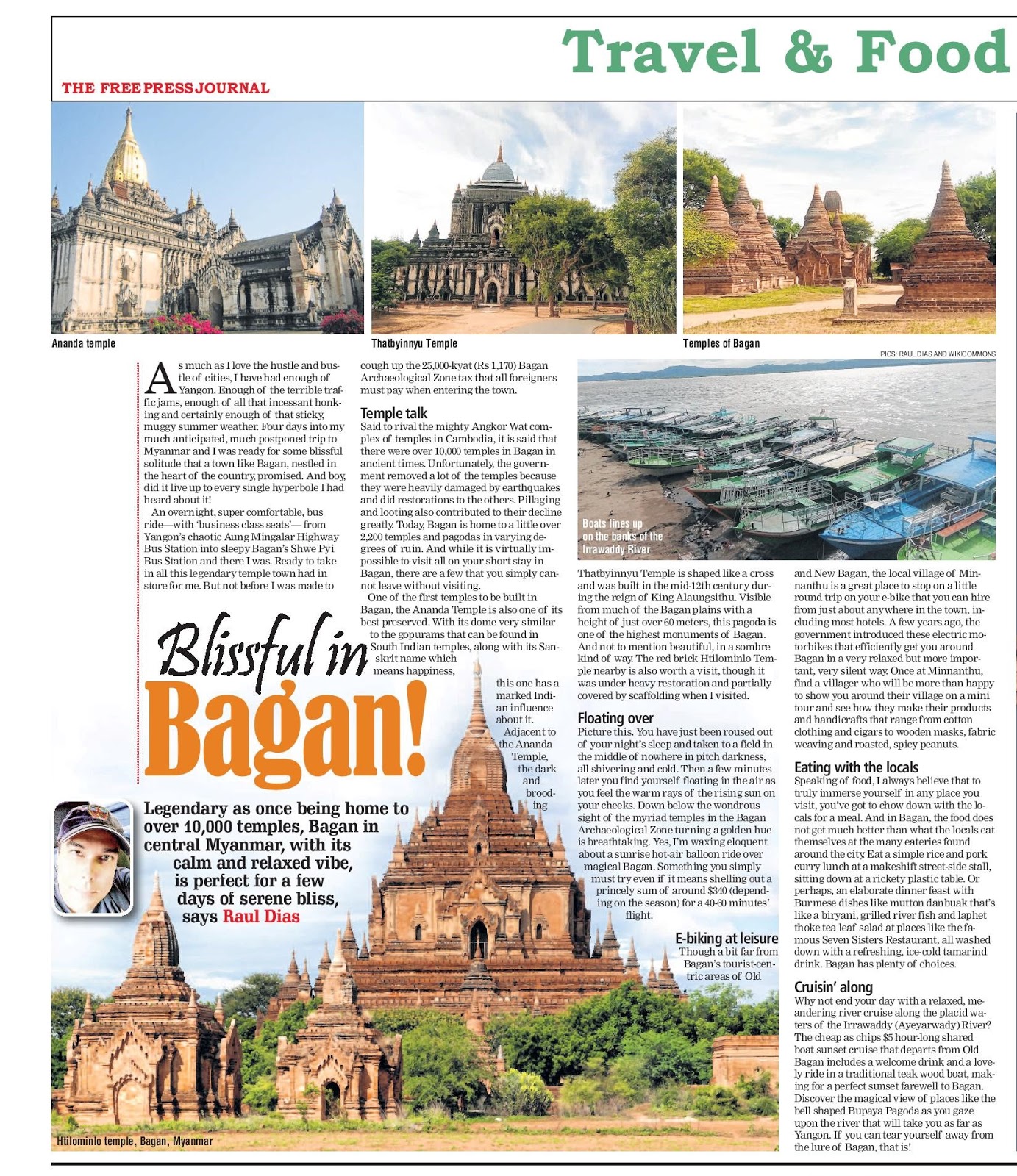
Blissful in Bagan!


Legendary as once being home to over 10,000 temples, Bagan in central Myanmar with its calm and relaxed vibe is perfect for a few days of serene bliss, says Raul Dias who comes back with his recommendations of unmissable things to see and do in the temple town.


By Raul Dias 
       
As much as I love the hustle and bustle of cities, I had had enough of Yangon. Enough of the terrible traffic jams, enough of all that incessant honking and certainly enough of that sticky, muggy summer weather. Four days into my much anticipated, much postponed trip to Myanmar and I was ready for some blissful solitude that a town like Bagan, nestled in the heart of the country promised. And boy, did it live up to every single hyperbole I had heard about it, or what!
An overnight, super comfortable, bus ride—with ‘business class seats’—from Yangon’s chaotic Aung Mingalar Highway Bus Station into sleepy Bagan’s Shwe Pyi Bus Station and there I was. Ready to take in all this legendary temple town had in store for me. But not before I was made to cough up the 25,000-kyat (Rs 1,170) Bagan Archaeological Zone tax that all foreigners must pay when entering the town.

Temple Talk
Said to rival the mighty Angkor Wat complex of temples in Cambodia, it is said that there were over 10,000 temples in Bagan in ancient times. Unfortunately, the government removed a lot of the temples because they were heavily damaged by earthquakes and did restorations to the others. Pillaging and looting also contributed to their decline greatly. Today, Bagan is home to a little over 2,200 temples and pagodas in varying degrees of ruin. And while it is virtually impossible to visit all on your short stay in Bagan, there are a few that you simply cannot leave without visiting.
One of the first temples to be built in Bagan, the Ananda Temple is also one of its best preserved. With its dome very similar to the gopurams that can be found in South Indian temples, along with its Sanskrit name which means happiness, this one has a marked Indian influence about it. 
Adjacent to the Ananda Temple, the dark and brooding Thatbyinnyu Temple is shaped like a cross and was built in the mid-12th century during the reign of King Alaungsithu. Visible from much of the Bagan plains with a height of just over 60 meters, this pagoda is one of the highest monuments of Bagan. And not to mention beautiful, in a somber kind of way. The red brick Htilominlo Temple nearby is also worth a visit, though it was under heavy restoration and partially covered by scaffolding when I visited.

Float Over the Ancient City
Picture this. You’ve just been roused out of your night’s sleep and taken to a field in the middle of nowhere in pitch darkness, all shivering and cold. Then a few minutes later you find yourself floating in the air as you feel the warm rays of the rising sun on your cheeks. Down below the wondrous sight of the myriad temples in the Bagan Archaeological Zone turning a golden hue is breathtaking. Yes, I’m waxing eloquent about a sunrise hot-air balloon ride over magical Bagan. Something you simply must try even if it means shelling out a princely sum of around $340 (depending on the season) for a 40-60 minutes flight.

E-Bike Around Minnanthu Village
Though a bit far from Bagan’s tourist-centric areas of Old and New Bagan, the local village of Minnanthu is a great place to stop on a little round trip on your e-bike that you can hire from just about anywhere in the town, including most hotels. A few years ago, the government introduced these electric motorbikes that efficiently get you around Bagan in a very relaxed but more important, very silent way. Once at Minnanthu, find a villager who will be more than happy to show around their village on a mini tour and see how they make their products and handicrafts that range from cotton clothing and cigars to wooden masks, fabric weaving and roasted, spicy peanuts.

Eat with the Locals!
Speaking of food, I always believe that to truly immerse yourself in any place you visit, you’ve got to chow down with the locals for a meal. And in Bagan, the food does not get much better than what the locals eat themselves at the many eateries found around the city. Eat a simple rice and pork curry lunch at a makeshift street-side stall, sitting down at a rickety plastic table. Or perhaps, an elaborate dinner feast with Burmese dishes like mutton danbuak that’s like a biryani, grilled river fish and laphet thoke tea leaf salad at places like the famous Seven Sisters Restaurant, all washed down with a refreshing, ice-cold tamarind drink. Bagan has plenty of choices.

Cruisin’ Along…
Why not end your day with a relaxed, meandering river cruise along the placid waters of the Irrawaddy (Ayeyarwady) River? The cheap as chips $5 hour-long shared boat sunset cruise that departs from Old Bagan includes a welcome drink and a lovely ride in a traditional teak wood boat, making for a perfect sunset farewell to Bagan. Discover the magical view of places like the bell shaped Bupaya Pagoda as you gaze upon the river that will take you as far as Yangon. If you can tear yourself away from the lure of Bagan, that is!  

FACT FILE
Getting There
There are daily flights from Kolkata and New Delhi to Yangon on airlines like Air India and Myanmar Airways International. You can reach Bagan via bus or taxi from Yangon (9 hours). There are also daily 1.2 hours flights from Yangon. Indians are now eligible for an eVisa to Myanmar, but they must arrive via Yangon, Nay Pyi Taw or Mandalay airports.
When to Visit
The best time to visit Bagan is between November and February. Bagan is hot most of the year but in these months, it is a pleasant 30 degrees. Avoid the summer, which runs from March to May.
Accommodation
Bagan has an excellent selection of hotels to choose from to suit all budgets and tastes. Some of the best are:
* The Hotel Umbra Bagan (www.thehotelumbrabagan.com)
* Bagan Thande Hotel (www.thandehotel.com/bagan)
* Temple View Bagan (www.facebook.com/templeviewhotel)

(An edited version of this article first appeared in the 7th October 2018 issue of The Free Press Journal newspaper's Weekend section on page 3 http://www.freepressjournal.in/travel/why-bagan-in-central-myanmar-is-serene-bliss/1369763)

Thursday, October 4, 2018

Chiang Mai For The Mind, Body and Soul

On your next trip to Chiang Mai, why not go on a vegan food tour, or perhaps learn more about the ancient art of the yantra tattoo? Better still, step out of your comfort zone and join a hill tribe in their rice planting activity, while picking up a thing or two about soul healing in the forest.


By Raul Dias

A mixed bag of clichés. That’s one of the first things that pops into the minds of most when we think of Thailand. From the ubiquitous, raver-infested full moon parties on its many not-so-pristine, beach-fronted islands and Bollywood-themed dinner cruises along the Chao Phraya river to the unfathomable opportunities for conspicuous consumption that its bustling capital city of Bangkok offers, finding something new to do in Thailand seems like a pipe dream. And amidst all this crass commercialism and tourist-targeted bogus, the true-blue ‘traveller’ seems to get left out of the equation like a neglected stepchild! But all’s not lost, as I recently found out.
On a recent trip to the north of the country, I had an epiphany of sorts. The hilly Lanna region to be more specific, painted a whole other image of Thailand for me, with its artistic brushstrokes and colourful hues. Thus, bestowing upon the city of Chiang Mai at the very heart of Lanna, a decidedly artistic and cultural cache that makes it a great jumping off point for the traveller seeking the path that’s woefully (and thankfully!) untrodden.  

For The Body…
A firm believer that to truly get the pulse of any new place surging through my veins, I simply have got to start my innings with a taste of the local food. First things first. The food of the north is very different from that of the rest of Thailand. A lighter, more herbaceous take on the coconut milk-redolent dishes of the south, the cuisine of Lanna is aromatic and spicy. And the lynchpins of the cuisine have got to be the piquant, lemon-y Chiang Mai sausage and a brutally fiery mushroom salad called yum hed.
To get a more immersive foodie experience I signed up with the newly launched Airbnb Experiences for a four-hours, hands-on long cookery class with Chef Chanrat Karatna who helped me discover the secrets of authentic Northern Thai cuisine. Here, I learned to whip up from scratch the light khew wan kai chicken curry and the Northern Thailand version of the ubiquitous somtamthai papaya and prawn salad, all served with sticky black rice that is a specialty of the Lanna region.
Now, the words ‘vegan’ and ‘Thai food’ mentioned in the same sentence, seem like the greatest oxymoron. Wrong! The Plant-based Food Experience with Keidra, a local Chiang Mai resident and vegan food enthusiast is a food tour with a difference. The four-and-a-half hours tour takes people for a ride in a bright red songtaew (Thai-style pick-up truck) first to the local fruit and vegetable JJ Market where you can taste exotic Thai fruits like the longan and the snake fruit, while learning about their healing powers. It then careens towards the Lanna’s Herb stall of the famous ‘Juice Lady of Chiang Mai’ where you can sample different herbal healing juices. The tour ends with an all-vegan meal at a few of Keidra’s favourite vegan restaurants like Nong Bee’s and Anchan for some further dope on Thai, Burmese, and Western plant-based dishes.

For The Soul…  
While tattoos have always been a sore (pun unintended) topic for me—with their permanency being the major off-putting factor—knowing more about them has always been a source of fascination. And so, I found myself signing up for another super-unique Airbnb Yantra Tattoo Experience that saw me leave the city of Chiang Mai for the quite village of Samnak, a little less than an hour away. Here, my guide Nikom, a former monk introduced me to another monk-turned-tattoo master Arjan Sompong who gave me a crash course in all things Yantra Tattoo.
Apparently, the traditional hand done Thai tattoo is not regarded as a tattoo, but as an indelible talisman imbedded into the wearer’s skin. While there are several types and patterns of Yantra Tattoos with their own respective meanings and purposes, they all feature ancient geometric symbols, animals or deity designs. These motifs are believed to offer protection to the wearer against bad luck and bestow upon them good fortune.
More interestingly, I was also told about the very rare invisible Yantra Tattoo that Sompong does, where a mixture of black sesame seed oil and invisible tattoo ink is injected into the recipient’s dermis layer. The mantras imbued into the person are meant to protect them from all harm, without the tattoo being traceable at all.
Now, at the risk of fueling another cliché of “heading to the hills to find healing”, here’s another rather unusual activity for the soul that one must try when in Chiang Mai. Claiming to possess the power to heal herself and others in vastly different ways; emotionally, spiritually, and even physically, Naiyana offers her very unique four-hour meditative ‘Soul and Energy Healing in the Forest’ experience.
At Yardfahmadin, her healing home nestled deep in the woods outside Chiang Mai, besides a gurgling stream Naiyana teaches people the ancient healing art of Omtri. This therapy is said to be a fusion of several powerful healing modalities, combining crystal healing, Reiki, and traditional Asian healing practices to help to bring your mental, emotional and physical energies into alignment, all by accessing your soul’s own inner wisdom. Besides said to bring inner peace and harmony, Omtri also allegedly helps balance and stabilise physical energy, provides relief from aches and pains, and relieve specific issues, such as anxiety, depression and insomnia.

For The Mind…
Bringing into perspective Chiang Mai’s prowess as an arts and craft stronghold are a number of activities one can partake in that help unleash the mind’s creativity. Initiated by Khun Jao, and hosted by Emika, Made in Chiang Mai is an Airbnb Experiences project that relies on the support of local people to help travellers get a better understanding of the arts scene. Located 45 minutes outside of the Chiang Mai city centre, the village of On-Tai is where one can learn everything from working with clay from a local expert to meeting with the village artisans and learning how do bamboo and cotton weaving to picking up the nuances of the natural tie-dying process.
To end my sojourn in the Lanna region, I decided to do something rather different. And so off it was with Pat, my tattooed, Steven Tyler doppelganger of a guide in his off roader for a tryst with the Karen hill tribe. Our destination: an authentic Karen village a good hour’s drive away from Chiang Mai over bumpy, nausea-inducing mountain roads. A place that seems untouched by time, where the villagers still live in traditional stilt bamboo houses.
As it was lunch time, we were invited to sit down cross-legged on the thatched floor and partake in a traditional lunch of a watery, bitter herb-flavoured chicken curry with a side of stir friend pumpkin leaves—all washed down with a tasty home distilled rice-based drink. It was only after we were sated that the villagers took us around their super clean village, sharing with us everything from their rather complicated fabric weaving techniques and rattan basket making to planting the all-important rice crop and herb foraging.
Live like a local. How’s that as the new mantra of travel with a purpose?


(An edited version of this article first appeared in the October 2018 issue of Jetwings International in-flight magazine of Jet Airways http://www.jetairways.com/EN/IN/jetexperience/magazines.aspx)