Showing posts with label BAGAN. Show all posts

Sunday, October 28, 2018

Notes from Myanmar


By Raul Dias

It’s two days into my long-awaited trip to Myanmar and I’m a tad dejected. No one seems to have the slightest inkling when I speak of erstwhile Burma’s greatest “gift”’ to India—and one of my favourite on-screen dancers of all time—the Anglo-Burmese Helen Richardson, simply known to us as the mononymous ‘Helen’. Not my Bollywood-obsessed taxi driver whom I hail at the super swanky Yangon International Airport. And certainly not Sanda, my loquacious hotel receptionist who can always be found humming the latest filmi ditty. But one mention of Salman Khan, Helen’s stepson and every face lights up with unabashed adulation, coupled with starstruck wonder.

India Calling
In fact, the Nay Pyi Taw Cinema, still sitting pretty amidst all its faded grandeur on Yangon’s main arterial Sule Pagoda Road—and a stone’s throw from where I’m staying—is showing Race 3, Salman’s latest dud (well, in India at least!) to jam-packed houses. And get this…in its original, intended lingua franca of Hindi. No dubbing required for the Myanmarese hoi polloi who are said to devour every new Bollywood offering ravenously. And as much I would have loved to see this first hand, sitting through two-and-a-half odd hours of the flick seems like self-inflicted torture. And I’m no masochist! 
I choose instead to take in the city sights, starting with the most hallowed of all of Yangon’s pagodas—the sublime 2,500 years old Shwedagon Pagoda, glinting in the mid-day sun in all its golden splendour. Three hours later and a quick consult with my trusted travel app lets me know that I’m just a few meters away from the site of a rather interesting desi connection. Said to be the location of the grave of Bahadur Shah Zafar, the last Mughal emperor of India, the dargah on Zi Wa Ka Road built in his honour may be off limits for my shorts-clad self, but the caretaker is happy to take a picture of the innermost sanctum sanctorum that houses the tomb for me with my phone.

Same, Same Yet Different!
Interestingly, it is the local food that augments this apparent Myanmarese-Indian affinity the most strongly for me. The highly-authentic Bombay-style mutton biryani (with potatoes, et al) that I buy a take-way portion of at the Nilar Biryani Shop on Anawratha Road comes with a little dose of home sickness, as its septuagenarian owner fondly tells me that his grandfather emigrated to Yangon from my home city of Mumbai in the late 1800s.
The next day, for a teatime snack, I saunter down to the paan stalls-infested Northeast corner of Yangon’s Maha Bandula Park, where along Merchant Road street food hawkers peddle a dish that defies convention. Yes, the samosa salad or samusa thohk with its decidedly Indian underpinnings is an evening time snack that is the delicious sum of its chopped vegetable samosa bits, stewed chickpeas, fried shallots, cabbage, and sliced boiled potatoes parts. To this, a ladle full of fiery broth is added just before serving, making it a sort of spicy soup-salad hybrid.
For dinner, I go for a chitti kala meal that’s said to be an interpretation of Chettiar cuisine and one that is very popular in Yangon. My thali-like dish of a flaky htat taya palata (layered paratha) is the perfect mop for gravies like the piquant chicken curry and the green peas stew called pé-byohk. I wash this down with a near-to-authentic falooda-like drink called hpaluda and chase all this with a single malaing lohn i.e. Myanmar’s version of the gulab jamun.

Hamara Bajaj
A few days later, I find myself whizzing past pagoda after pagoda in the ancient, holy city of Bagan, nestled in the heart of the country. My autorickshaw driver Win Min Oo, while declaring his undying love for his India-made Bajaj tuk tuk, lets me in on one of the greatest culinary surprises I’ve yet to encounter. While speaking of his wedding a few years ago, he tells me that no feast in Myanmar can ever be considered complete without the serving of a dish he calls danbauk and insists is Indian. It’s only a few hours later, post some intense culinary research, do I realise that Win was talking about. Apparently, the Mughlai slow oven cooking method of dum pukht is what the people of Bagan call the regional variant of biryani that is served with mango pickle, fresh mint and green chili. 
Marvelling at how films, culture and most importantly food can be great equalisers—never mind the distance in both time and geography that exists between old Awadh and modern-day Bagan—I settle down for my sunset dinner at one of Bagan’s many Irrawaddy riverfront restaurants. A plate of fragrant danbauk in front of me and my ears tuned in to an 80s Bappi Lahiri song.   

(An edited version of this article first appeared in the 28th October 2018 issue of The Hindu newspaper's Sunday Magazine section on page 7 https://www.thehindu.com/life-and-style/travel/notes-from-myanmar/article25333644.ece)


Sunday, October 7, 2018

Blissful in Bagan!


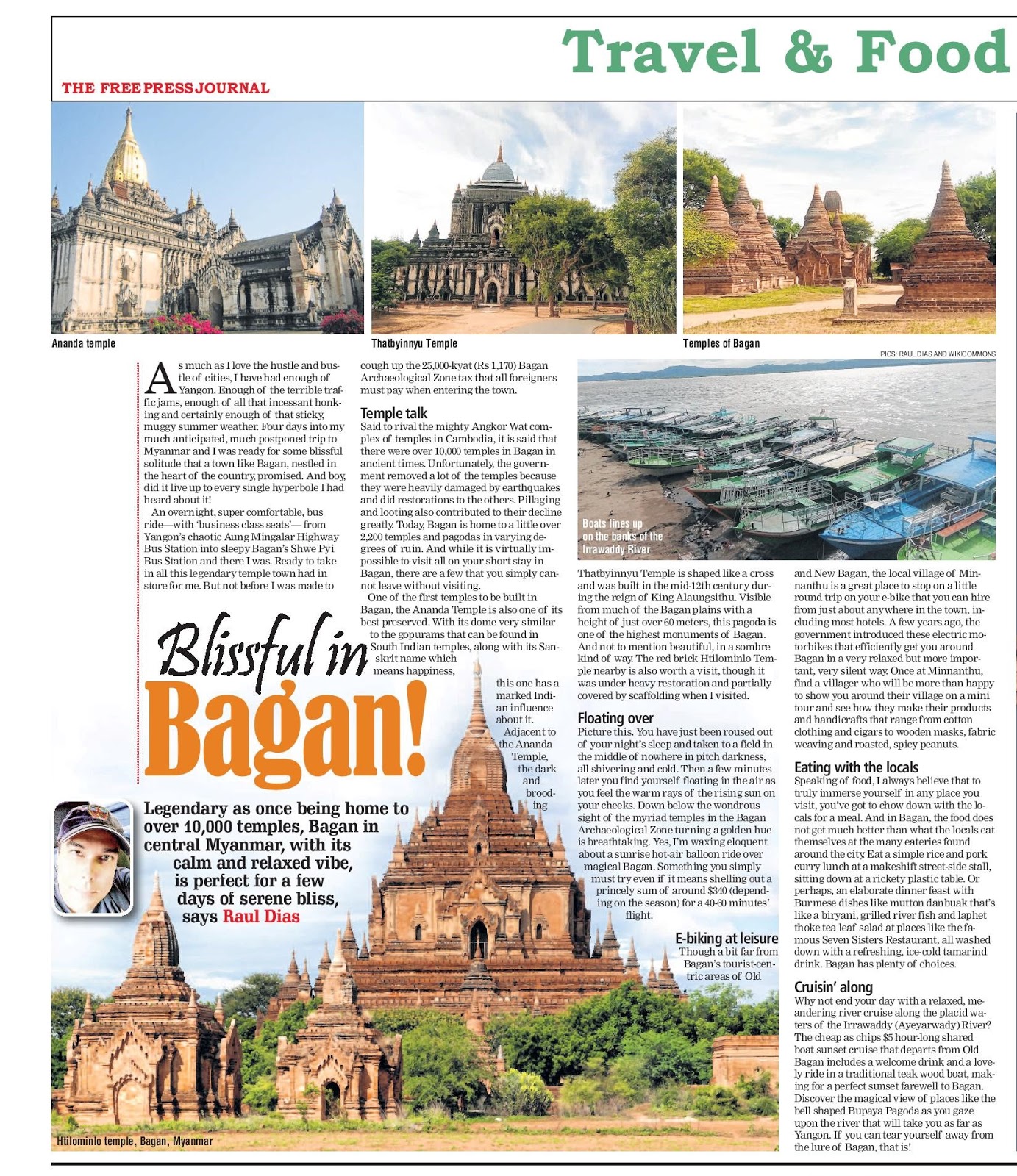
Legendary as once being home to over 10,000 temples, Bagan in central Myanmar with its calm and relaxed vibe is perfect for a few days of serene bliss, says Raul Dias who comes back with his recommendations of unmissable things to see and do in the temple town.


By Raul Dias 
       
As much as I love the hustle and bustle of cities, I had had enough of Yangon. Enough of the terrible traffic jams, enough of all that incessant honking and certainly enough of that sticky, muggy summer weather. Four days into my much anticipated, much postponed trip to Myanmar and I was ready for some blissful solitude that a town like Bagan, nestled in the heart of the country promised. And boy, did it live up to every single hyperbole I had heard about it, or what!
An overnight, super comfortable, bus ride—with ‘business class seats’—from Yangon’s chaotic Aung Mingalar Highway Bus Station into sleepy Bagan’s Shwe Pyi Bus Station and there I was. Ready to take in all this legendary temple town had in store for me. But not before I was made to cough up the 25,000-kyat (Rs 1,170) Bagan Archaeological Zone tax that all foreigners must pay when entering the town.

Temple Talk
Said to rival the mighty Angkor Wat complex of temples in Cambodia, it is said that there were over 10,000 temples in Bagan in ancient times. Unfortunately, the government removed a lot of the temples because they were heavily damaged by earthquakes and did restorations to the others. Pillaging and looting also contributed to their decline greatly. Today, Bagan is home to a little over 2,200 temples and pagodas in varying degrees of ruin. And while it is virtually impossible to visit all on your short stay in Bagan, there are a few that you simply cannot leave without visiting.
One of the first temples to be built in Bagan, the Ananda Temple is also one of its best preserved. With its dome very similar to the gopurams that can be found in South Indian temples, along with its Sanskrit name which means happiness, this one has a marked Indian influence about it. 
Adjacent to the Ananda Temple, the dark and brooding Thatbyinnyu Temple is shaped like a cross and was built in the mid-12th century during the reign of King Alaungsithu. Visible from much of the Bagan plains with a height of just over 60 meters, this pagoda is one of the highest monuments of Bagan. And not to mention beautiful, in a somber kind of way. The red brick Htilominlo Temple nearby is also worth a visit, though it was under heavy restoration and partially covered by scaffolding when I visited.

Float Over the Ancient City
Picture this. You’ve just been roused out of your night’s sleep and taken to a field in the middle of nowhere in pitch darkness, all shivering and cold. Then a few minutes later you find yourself floating in the air as you feel the warm rays of the rising sun on your cheeks. Down below the wondrous sight of the myriad temples in the Bagan Archaeological Zone turning a golden hue is breathtaking. Yes, I’m waxing eloquent about a sunrise hot-air balloon ride over magical Bagan. Something you simply must try even if it means shelling out a princely sum of around $340 (depending on the season) for a 40-60 minutes flight.

E-Bike Around Minnanthu Village
Though a bit far from Bagan’s tourist-centric areas of Old and New Bagan, the local village of Minnanthu is a great place to stop on a little round trip on your e-bike that you can hire from just about anywhere in the town, including most hotels. A few years ago, the government introduced these electric motorbikes that efficiently get you around Bagan in a very relaxed but more important, very silent way. Once at Minnanthu, find a villager who will be more than happy to show around their village on a mini tour and see how they make their products and handicrafts that range from cotton clothing and cigars to wooden masks, fabric weaving and roasted, spicy peanuts.

Eat with the Locals!
Speaking of food, I always believe that to truly immerse yourself in any place you visit, you’ve got to chow down with the locals for a meal. And in Bagan, the food does not get much better than what the locals eat themselves at the many eateries found around the city. Eat a simple rice and pork curry lunch at a makeshift street-side stall, sitting down at a rickety plastic table. Or perhaps, an elaborate dinner feast with Burmese dishes like mutton danbuak that’s like a biryani, grilled river fish and laphet thoke tea leaf salad at places like the famous Seven Sisters Restaurant, all washed down with a refreshing, ice-cold tamarind drink. Bagan has plenty of choices.

Cruisin’ Along…
Why not end your day with a relaxed, meandering river cruise along the placid waters of the Irrawaddy (Ayeyarwady) River? The cheap as chips $5 hour-long shared boat sunset cruise that departs from Old Bagan includes a welcome drink and a lovely ride in a traditional teak wood boat, making for a perfect sunset farewell to Bagan. Discover the magical view of places like the bell shaped Bupaya Pagoda as you gaze upon the river that will take you as far as Yangon. If you can tear yourself away from the lure of Bagan, that is!  

FACT FILE
Getting There
There are daily flights from Kolkata and New Delhi to Yangon on airlines like Air India and Myanmar Airways International. You can reach Bagan via bus or taxi from Yangon (9 hours). There are also daily 1.2 hours flights from Yangon. Indians are now eligible for an eVisa to Myanmar, but they must arrive via Yangon, Nay Pyi Taw or Mandalay airports.
When to Visit
The best time to visit Bagan is between November and February. Bagan is hot most of the year but in these months, it is a pleasant 30 degrees. Avoid the summer, which runs from March to May.
Accommodation
Bagan has an excellent selection of hotels to choose from to suit all budgets and tastes. Some of the best are:
* The Hotel Umbra Bagan (www.thehotelumbrabagan.com)
* Bagan Thande Hotel (www.thandehotel.com/bagan)
* Temple View Bagan (www.facebook.com/templeviewhotel)

(An edited version of this article first appeared in the 7th October 2018 issue of The Free Press Journal newspaper's Weekend section on page 3 http://www.freepressjournal.in/travel/why-bagan-in-central-myanmar-is-serene-bliss/1369763)