Showing posts with label MYANMAR. Show all posts

Wednesday, January 17, 2024

East Asia's Food Towns


(This article first appeared online on 17th January 2024 on Live Mint and in print on 18th January in Mint newspaper India https://lifestyle.livemint.com/food/discover/east-asia-food-places-gi-tag-111705460453578.html)

Saturday, December 5, 2020

Holding 'suey'!

With as many iterations as its myriad components, the Burmese dish of khao suey is a well-travelled one.


By Raul Dias


'A sort of Burmese bhel' is perhaps one of the most succinct--if a tad short of being apt--descriptions for khao suey that I recently came across on a pan-Asian, Mumbai-based restaurant's menu card. None of that flowery 'tender morsels of farm-raised chicken, simmered in an unctuous coconut milk broth...' hyperbolic overdrive, menu jargon seem to veer towards these days at most other places. 

For the uninitiated among us (though I highly doubt there would be many), khao suey is a much-loved, and dare-I-say, callously co-opted curried noodle dish of Burmese origin that had been shamelessly adapted and tweaked the world over and here in India in particular. But more on that later. 


Bowls of Sunshine

With its soothing, yet punchy taste, khao suey can easily be classified as a comfort food dish. One that can be scarfed down at anytime of the day like they do in Myanmar and other South East Asian countries. It sees everything from chicken, beef, pork, seafood and even tofu morsels added to a spicy, (mostly) coconut milk- and turmeric-based curry. This bright orange hued curry is then ladled over thin rice noodles to form a soup-meets-stew kind of hybrid dish. 

But hold on! It needs more jazzing up. The supporting acts to the main show take the form of a variety of condiments that range from crispy fried shallots and garlic to halved, boiled eggs, fresh coriander fronds and roasted, crushed peanuts. Each adding textural and flavourful heft to the dish.

As I travelled around Myanmar a few years ago, I realised, that, much like how the word ‘curry’ is misconstrued in the West that divests it of its genericness, khao suey is a similar victim. In the Burmese language, khao suey simply means rice noodles. How one treats those noodles in a dish, creates local variations of what we know commonly as khao suey, the all-in-one meal.


The name game

The dry noodle version of the dish called shwedaung khao suey, that is popular as a street-side snack in places like Yangon, is akin to a crunchy salad. And this is perhaps how the 'Burmese bhel' inference comes into play. While the coconut milk-laden, Southern Myanmarese ohn no khao suey is more in line with the iteration of khao suey we are familiar with in India. 

Crossing the Myanmarese border from the town of Payathonsu into Sangkhla Buri in Northern Thailand via the Three Pagodas Pass, I noticed how easily khao suey had segued into the local cuisine. Known as khao soi Islam, the pork-bereft version (substituted by beef or chicken) is almost similar to ohn no khao suey and is prepared mostly by the Muslim community who prefer adding the locally grown mustard greens in a pickled form to the dish. 

The other neighbour of Myanmar that has its own version of the dish is Laos. This Northern Laotian version also called khao soi is more of a soup made with wide rice noodles, chopped pork and has that unmistakable funky taste of fermented soy beans. All this is topped off with pork rind, coriander and bean sprouts. Interestingly, many are of the belief that the two versions of the shared Singaporean and Malaysian dish of laksa i.e assam (meaning: sour) and curry laksa owe their genesis to khao suey due to their startling similarities. 


Colonial cousins

Perhaps the greatest surprise in store for me on the khao suey front was the rather serendipitous discovery of the Memoni Muslim dish of khausa and how closely it is related to Burmese khao suey. Tasting this truly desi version of the dish at a Memoni food pop-up by a Mumbai-based home chef a few weeks ago, I couldn’t but help marvel at how well the dish had travelled and had gotten adapted along the way.

Often bearing the moniker of the 'sailor businessmen of India,' the Memons, who originally hail from Gujarat, have always had very strong ties to Myanmar since the time it was known as British-occupied Burma. Mainly involved in the pre-independence textile, oil and paper production trade, they would travel to Burma regularly. With a few even settling there permanently and trading from the British set-up port at Akyub, which is in present-day Sitwe.

Many Memons subsequently moved back to India in 1947, with a second exodus taking place in the early 1960s after the Burmese military junta regime, known to be intolerant of foreigners, came into power. Bringing back with them an edible emissary that they named khausa. Adapted to suit their tastes, khausa employs the more Italian-style wheat spaghetti in lieu of rice noodles. This is topped off with a cubed chicken curry made with yoghurt, coconut milk and gram flour. Garnishes take the form of piquant sliced green chillies, ginger juliennes, and crunchy deep-fried samosa dough strips, with a sprinkling of chaat masala giving it an unmistakably desi tadka. 

Sure wins the vote for the most widely travelled and adapted dish, wouldn’t you say?


(An edited version of this article first appeared online in The Hindu Business Line newspaper's BLink section on 5th December 2020 https://www.thehindubusinessline.com/blink/takeaway/khao-suey-is-burmas-global-dish/article33249771.ece)

Saturday, May 18, 2019

Ruling the Roost!

As the world’s largest raw material supplier of East Asia’s prized bird nests soup, Bokpyin in southern Myanmar knows how to pamper the nest-producing swiftlets with everything from purpose-built apartments to daily, evening acoustic entertainment.    


By Raul Dias

Though he says he’s just turned 43, Htway Cho’s full head of snow white hair and weather-beaten, wrinkly face easily add on a couple of extra decades to his countenance. He’s not surprised when I tell him that. “This is what 20 years of climbing cliffs will do to you!” Cho smiles, revealing a set of orange, betel nut-stained teeth.
My guide Cho, like hundreds of other men—and even a few women, he tells me—of the sleepy, seaside town of Bokpyin in Myanmar’s southern peninsular Tanintharyi region is a bird nest harvester. A hunter-gatherer, who, until nine years ago would risk life and limb scaling the treacherous cliffs of islands like Kuant Ngar and Yay Aye that are part of the region’s Myeik archipelago. All this in pursuit of one of the most elusive, and thus expensive, animal products consumed by humans—a prized cache of pearly white bird nests made from the dried-up saliva produced by the male white-nest swiftlet (Aerodramus fuciphagus). A product that is said to have tremendous health and beauty benefits when consumed regularly as a soup.
These days however, the scene couldn’t be more different for Cho and his posse. Ever since the former military junta-owned Union of Myanmar Economic Holdings Limited or UMEHL that the harvesters worked for, gave up its monopoly over the harvest of the nests in 2011, exports surged. And to keep up with the demand for the dried nests—a kilogram of which can sell for as much as US $1,300 in the Chinese market—the canny residents of Bokpyin came up with an ingenious idea. 

Back ‘Stories’
“We realised that we didn’t need to go out to the swiftlets. Rather, let them come to us,” says Cho. This “eureka” moment came to the townsfolk, when, a few years ago, they noticed a flock of swiftlets had taken over an old, abandoned house where hundreds of nests were found. Soon, there were dozens of such buildings—some even purpose built and multi-storied—that were ‘let out’ to the swiftlets. “And so, we started adding floors to our existing buildings to accommodate the birds who come to roost at dusk daily. We collect the nests three to four times a year. But only after the hatchlings have matured and flown away,” Cho is quick to add.
Today, there are at least a 150 such grey, concrete swiftlets tenements scattered across the town. Interestingly, land prices in Bokpyin have sky-rocketed to unprecedented highs due to this phenomenon. A plot in downtown Bokpyin, for instance, can sell for as high as US $77,000, which is as much one would expect to pay in some parts of the country’s commercial capital of Yangon!
So successful has been this ‘swiftlet in situ’ model that it is not only being replicated by other towns in Myanmar like Kawthaung, but also in neighbouring southern Thailand where the Pak Phanang District of the Nakhon Si Thammarat province is fast becoming another hub for such nesting houses. 

Of Static Birdsong and More…
Walking through the non-descript town that was once Myanmar’s leading producer of betel nut, rubber and palm oil one late afternoon, all my senses were at once made aware of the town’s newest residents. It was not just the overwhelming avian odour that hit my nostrils, but the sight of thousands of birds circling overhead was enough to make me feel like I was in Myanmar’s remake of Alfred Hitchcock’s 1963 classic The Birds.
But it was another one of my senses that was most affected. Suddenly Bokpyin’s traffic din was all but silenced with a unique mixture of assorted bird sounds—from twittering to chirping to even the occasional cawing. It turned out to be emanating from the various speakers and boom boxes installed in the nesting homes in a bid to attract more winged tenants. A brilliant move.
“What about the bird droppings, doesn’t that cause nuisance?” I question Cho in all my urban insouciance. “Simple. Once a week we collect all of it to sell off as manure,” is his matter-of-fact rebuttal.
Once again, Bokpyin’s ingenuity comes to the fore!


TRAVEL LOG

Getting There 
One can get into Bokpyin either by a two-hour flight or by an overnight bus journey from Yangon. There are also weekly flights from Bangkok to Bokpyin. There are daily flights that link both Yangon and Bangkok to several Indian cities. To travel within Bokpyin one can either hire a scooter or a car with a driver or simply walk, given its compact size. Myanmar now offers a visa on arrival for Indians that’s available at most major international airports in the country for a fee of $50.

Stay
With more accommodation options on offer for the prized swiftlets, the only, single guesthouse in Bokpyin to offer a good night’s rest to the town’s human visitors is the very basic and internet-bereft U Marle Guesthouse next to the bus station. Here, one can expect to pay 20,000 kyat (Rs 915 approx.) for a double room or 11,000 kyat (Rs 503 approx.) for a single room with a shared bathroom and without breakfast.

Tip
* Due to the nutri-collagen present in the swiftlets’ saliva, drinking a bowl of bird nest soup is believed to be great for the complexion and also to maintain youth, though there is no scientific data available to prove this claim.
* From Bokpyin, take a day trip to the nearby town of Kawthaung to see the beautiful steeple-like golden chedi of the famous Pyi Daw Aye Pagoda in downtown. Or perhaps travel a little bit north of Kawthaung to visit the Maliwan Waterfall, just off the main highway.


(An edited version of this article first appeared in the 18th May 2019 issue of The Hindu Business Line newspaper's BLink section on page 21 https://www.thehindubusinessline.com/blink/takeaway/a-myanmar-town-rakes-in-millions-by-letting-out-buildings-to-swiftlets/article27158829.ece)

Sunday, October 28, 2018

Notes from Myanmar


By Raul Dias

It’s two days into my long-awaited trip to Myanmar and I’m a tad dejected. No one seems to have the slightest inkling when I speak of erstwhile Burma’s greatest “gift”’ to India—and one of my favourite on-screen dancers of all time—the Anglo-Burmese Helen Richardson, simply known to us as the mononymous ‘Helen’. Not my Bollywood-obsessed taxi driver whom I hail at the super swanky Yangon International Airport. And certainly not Sanda, my loquacious hotel receptionist who can always be found humming the latest filmi ditty. But one mention of Salman Khan, Helen’s stepson and every face lights up with unabashed adulation, coupled with starstruck wonder.

India Calling
In fact, the Nay Pyi Taw Cinema, still sitting pretty amidst all its faded grandeur on Yangon’s main arterial Sule Pagoda Road—and a stone’s throw from where I’m staying—is showing Race 3, Salman’s latest dud (well, in India at least!) to jam-packed houses. And get this…in its original, intended lingua franca of Hindi. No dubbing required for the Myanmarese hoi polloi who are said to devour every new Bollywood offering ravenously. And as much I would have loved to see this first hand, sitting through two-and-a-half odd hours of the flick seems like self-inflicted torture. And I’m no masochist! 
I choose instead to take in the city sights, starting with the most hallowed of all of Yangon’s pagodas—the sublime 2,500 years old Shwedagon Pagoda, glinting in the mid-day sun in all its golden splendour. Three hours later and a quick consult with my trusted travel app lets me know that I’m just a few meters away from the site of a rather interesting desi connection. Said to be the location of the grave of Bahadur Shah Zafar, the last Mughal emperor of India, the dargah on Zi Wa Ka Road built in his honour may be off limits for my shorts-clad self, but the caretaker is happy to take a picture of the innermost sanctum sanctorum that houses the tomb for me with my phone.

Same, Same Yet Different!
Interestingly, it is the local food that augments this apparent Myanmarese-Indian affinity the most strongly for me. The highly-authentic Bombay-style mutton biryani (with potatoes, et al) that I buy a take-way portion of at the Nilar Biryani Shop on Anawratha Road comes with a little dose of home sickness, as its septuagenarian owner fondly tells me that his grandfather emigrated to Yangon from my home city of Mumbai in the late 1800s.
The next day, for a teatime snack, I saunter down to the paan stalls-infested Northeast corner of Yangon’s Maha Bandula Park, where along Merchant Road street food hawkers peddle a dish that defies convention. Yes, the samosa salad or samusa thohk with its decidedly Indian underpinnings is an evening time snack that is the delicious sum of its chopped vegetable samosa bits, stewed chickpeas, fried shallots, cabbage, and sliced boiled potatoes parts. To this, a ladle full of fiery broth is added just before serving, making it a sort of spicy soup-salad hybrid.
For dinner, I go for a chitti kala meal that’s said to be an interpretation of Chettiar cuisine and one that is very popular in Yangon. My thali-like dish of a flaky htat taya palata (layered paratha) is the perfect mop for gravies like the piquant chicken curry and the green peas stew called pé-byohk. I wash this down with a near-to-authentic falooda-like drink called hpaluda and chase all this with a single malaing lohn i.e. Myanmar’s version of the gulab jamun.

Hamara Bajaj
A few days later, I find myself whizzing past pagoda after pagoda in the ancient, holy city of Bagan, nestled in the heart of the country. My autorickshaw driver Win Min Oo, while declaring his undying love for his India-made Bajaj tuk tuk, lets me in on one of the greatest culinary surprises I’ve yet to encounter. While speaking of his wedding a few years ago, he tells me that no feast in Myanmar can ever be considered complete without the serving of a dish he calls danbauk and insists is Indian. It’s only a few hours later, post some intense culinary research, do I realise that Win was talking about. Apparently, the Mughlai slow oven cooking method of dum pukht is what the people of Bagan call the regional variant of biryani that is served with mango pickle, fresh mint and green chili. 
Marvelling at how films, culture and most importantly food can be great equalisers—never mind the distance in both time and geography that exists between old Awadh and modern-day Bagan—I settle down for my sunset dinner at one of Bagan’s many Irrawaddy riverfront restaurants. A plate of fragrant danbauk in front of me and my ears tuned in to an 80s Bappi Lahiri song.   

(An edited version of this article first appeared in the 28th October 2018 issue of The Hindu newspaper's Sunday Magazine section on page 7 https://www.thehindu.com/life-and-style/travel/notes-from-myanmar/article25333644.ece)


Sunday, October 7, 2018

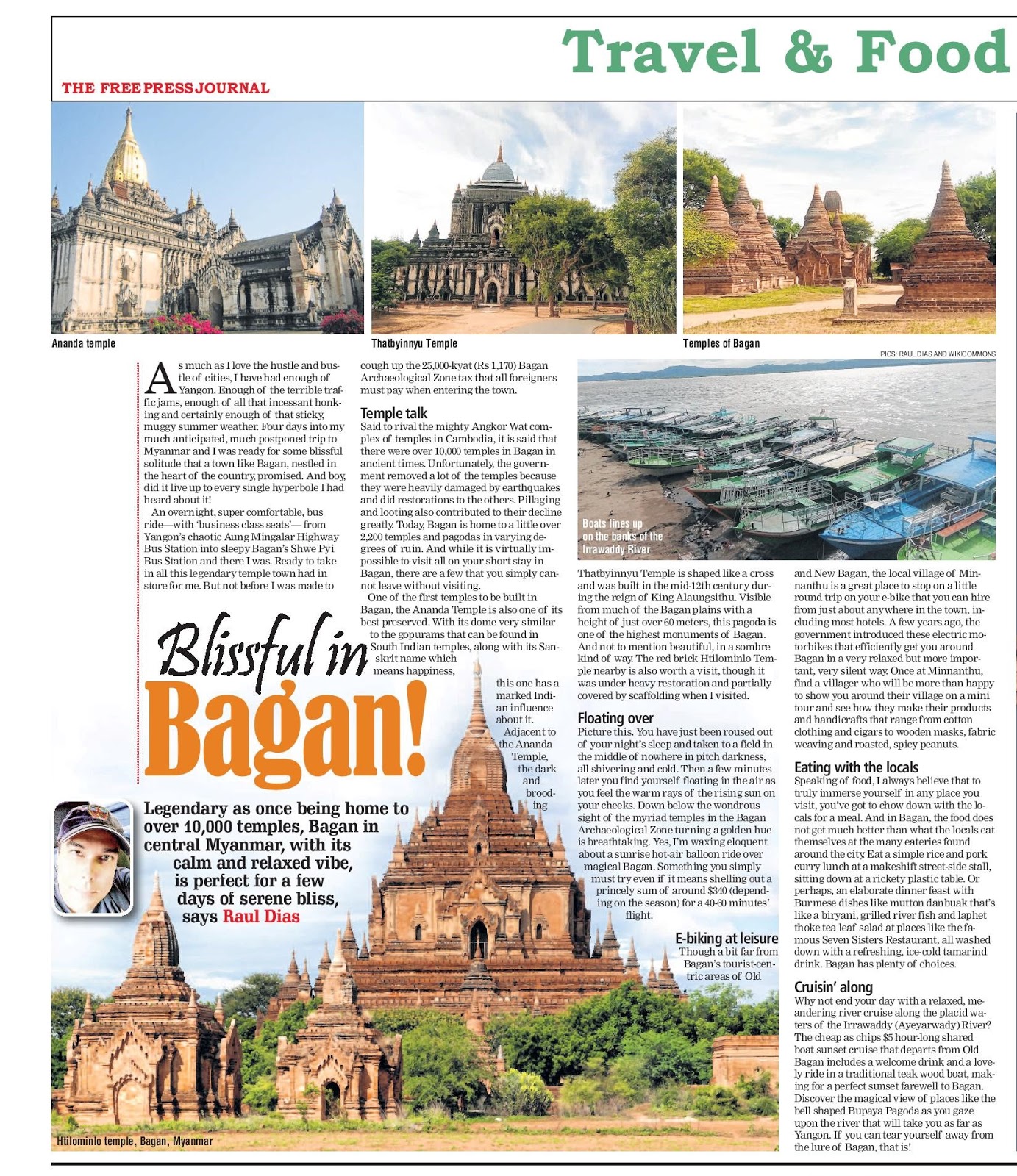
Blissful in Bagan!


Legendary as once being home to over 10,000 temples, Bagan in central Myanmar with its calm and relaxed vibe is perfect for a few days of serene bliss, says Raul Dias who comes back with his recommendations of unmissable things to see and do in the temple town.


By Raul Dias 
       
As much as I love the hustle and bustle of cities, I had had enough of Yangon. Enough of the terrible traffic jams, enough of all that incessant honking and certainly enough of that sticky, muggy summer weather. Four days into my much anticipated, much postponed trip to Myanmar and I was ready for some blissful solitude that a town like Bagan, nestled in the heart of the country promised. And boy, did it live up to every single hyperbole I had heard about it, or what!
An overnight, super comfortable, bus ride—with ‘business class seats’—from Yangon’s chaotic Aung Mingalar Highway Bus Station into sleepy Bagan’s Shwe Pyi Bus Station and there I was. Ready to take in all this legendary temple town had in store for me. But not before I was made to cough up the 25,000-kyat (Rs 1,170) Bagan Archaeological Zone tax that all foreigners must pay when entering the town.

Temple Talk
Said to rival the mighty Angkor Wat complex of temples in Cambodia, it is said that there were over 10,000 temples in Bagan in ancient times. Unfortunately, the government removed a lot of the temples because they were heavily damaged by earthquakes and did restorations to the others. Pillaging and looting also contributed to their decline greatly. Today, Bagan is home to a little over 2,200 temples and pagodas in varying degrees of ruin. And while it is virtually impossible to visit all on your short stay in Bagan, there are a few that you simply cannot leave without visiting.
One of the first temples to be built in Bagan, the Ananda Temple is also one of its best preserved. With its dome very similar to the gopurams that can be found in South Indian temples, along with its Sanskrit name which means happiness, this one has a marked Indian influence about it. 
Adjacent to the Ananda Temple, the dark and brooding Thatbyinnyu Temple is shaped like a cross and was built in the mid-12th century during the reign of King Alaungsithu. Visible from much of the Bagan plains with a height of just over 60 meters, this pagoda is one of the highest monuments of Bagan. And not to mention beautiful, in a somber kind of way. The red brick Htilominlo Temple nearby is also worth a visit, though it was under heavy restoration and partially covered by scaffolding when I visited.

Float Over the Ancient City
Picture this. You’ve just been roused out of your night’s sleep and taken to a field in the middle of nowhere in pitch darkness, all shivering and cold. Then a few minutes later you find yourself floating in the air as you feel the warm rays of the rising sun on your cheeks. Down below the wondrous sight of the myriad temples in the Bagan Archaeological Zone turning a golden hue is breathtaking. Yes, I’m waxing eloquent about a sunrise hot-air balloon ride over magical Bagan. Something you simply must try even if it means shelling out a princely sum of around $340 (depending on the season) for a 40-60 minutes flight.

E-Bike Around Minnanthu Village
Though a bit far from Bagan’s tourist-centric areas of Old and New Bagan, the local village of Minnanthu is a great place to stop on a little round trip on your e-bike that you can hire from just about anywhere in the town, including most hotels. A few years ago, the government introduced these electric motorbikes that efficiently get you around Bagan in a very relaxed but more important, very silent way. Once at Minnanthu, find a villager who will be more than happy to show around their village on a mini tour and see how they make their products and handicrafts that range from cotton clothing and cigars to wooden masks, fabric weaving and roasted, spicy peanuts.

Eat with the Locals!
Speaking of food, I always believe that to truly immerse yourself in any place you visit, you’ve got to chow down with the locals for a meal. And in Bagan, the food does not get much better than what the locals eat themselves at the many eateries found around the city. Eat a simple rice and pork curry lunch at a makeshift street-side stall, sitting down at a rickety plastic table. Or perhaps, an elaborate dinner feast with Burmese dishes like mutton danbuak that’s like a biryani, grilled river fish and laphet thoke tea leaf salad at places like the famous Seven Sisters Restaurant, all washed down with a refreshing, ice-cold tamarind drink. Bagan has plenty of choices.

Cruisin’ Along…
Why not end your day with a relaxed, meandering river cruise along the placid waters of the Irrawaddy (Ayeyarwady) River? The cheap as chips $5 hour-long shared boat sunset cruise that departs from Old Bagan includes a welcome drink and a lovely ride in a traditional teak wood boat, making for a perfect sunset farewell to Bagan. Discover the magical view of places like the bell shaped Bupaya Pagoda as you gaze upon the river that will take you as far as Yangon. If you can tear yourself away from the lure of Bagan, that is!  

FACT FILE
Getting There
There are daily flights from Kolkata and New Delhi to Yangon on airlines like Air India and Myanmar Airways International. You can reach Bagan via bus or taxi from Yangon (9 hours). There are also daily 1.2 hours flights from Yangon. Indians are now eligible for an eVisa to Myanmar, but they must arrive via Yangon, Nay Pyi Taw or Mandalay airports.
When to Visit
The best time to visit Bagan is between November and February. Bagan is hot most of the year but in these months, it is a pleasant 30 degrees. Avoid the summer, which runs from March to May.
Accommodation
Bagan has an excellent selection of hotels to choose from to suit all budgets and tastes. Some of the best are:
* The Hotel Umbra Bagan (www.thehotelumbrabagan.com)
* Bagan Thande Hotel (www.thandehotel.com/bagan)
* Temple View Bagan (www.facebook.com/templeviewhotel)

(An edited version of this article first appeared in the 7th October 2018 issue of The Free Press Journal newspaper's Weekend section on page 3 http://www.freepressjournal.in/travel/why-bagan-in-central-myanmar-is-serene-bliss/1369763)