Sunday, October 28, 2018

Notes from Myanmar


By Raul Dias

It’s two days into my long-awaited trip to Myanmar and I’m a tad dejected. No one seems to have the slightest inkling when I speak of erstwhile Burma’s greatest “gift”’ to India—and one of my favourite on-screen dancers of all time—the Anglo-Burmese Helen Richardson, simply known to us as the mononymous ‘Helen’. Not my Bollywood-obsessed taxi driver whom I hail at the super swanky Yangon International Airport. And certainly not Sanda, my loquacious hotel receptionist who can always be found humming the latest filmi ditty. But one mention of Salman Khan, Helen’s stepson and every face lights up with unabashed adulation, coupled with starstruck wonder.

India Calling
In fact, the Nay Pyi Taw Cinema, still sitting pretty amidst all its faded grandeur on Yangon’s main arterial Sule Pagoda Road—and a stone’s throw from where I’m staying—is showing Race 3, Salman’s latest dud (well, in India at least!) to jam-packed houses. And get this…in its original, intended lingua franca of Hindi. No dubbing required for the Myanmarese hoi polloi who are said to devour every new Bollywood offering ravenously. And as much I would have loved to see this first hand, sitting through two-and-a-half odd hours of the flick seems like self-inflicted torture. And I’m no masochist! 
I choose instead to take in the city sights, starting with the most hallowed of all of Yangon’s pagodas—the sublime 2,500 years old Shwedagon Pagoda, glinting in the mid-day sun in all its golden splendour. Three hours later and a quick consult with my trusted travel app lets me know that I’m just a few meters away from the site of a rather interesting desi connection. Said to be the location of the grave of Bahadur Shah Zafar, the last Mughal emperor of India, the dargah on Zi Wa Ka Road built in his honour may be off limits for my shorts-clad self, but the caretaker is happy to take a picture of the innermost sanctum sanctorum that houses the tomb for me with my phone.

Same, Same Yet Different!
Interestingly, it is the local food that augments this apparent Myanmarese-Indian affinity the most strongly for me. The highly-authentic Bombay-style mutton biryani (with potatoes, et al) that I buy a take-way portion of at the Nilar Biryani Shop on Anawratha Road comes with a little dose of home sickness, as its septuagenarian owner fondly tells me that his grandfather emigrated to Yangon from my home city of Mumbai in the late 1800s.
The next day, for a teatime snack, I saunter down to the paan stalls-infested Northeast corner of Yangon’s Maha Bandula Park, where along Merchant Road street food hawkers peddle a dish that defies convention. Yes, the samosa salad or samusa thohk with its decidedly Indian underpinnings is an evening time snack that is the delicious sum of its chopped vegetable samosa bits, stewed chickpeas, fried shallots, cabbage, and sliced boiled potatoes parts. To this, a ladle full of fiery broth is added just before serving, making it a sort of spicy soup-salad hybrid.
For dinner, I go for a chitti kala meal that’s said to be an interpretation of Chettiar cuisine and one that is very popular in Yangon. My thali-like dish of a flaky htat taya palata (layered paratha) is the perfect mop for gravies like the piquant chicken curry and the green peas stew called pé-byohk. I wash this down with a near-to-authentic falooda-like drink called hpaluda and chase all this with a single malaing lohn i.e. Myanmar’s version of the gulab jamun.

Hamara Bajaj
A few days later, I find myself whizzing past pagoda after pagoda in the ancient, holy city of Bagan, nestled in the heart of the country. My autorickshaw driver Win Min Oo, while declaring his undying love for his India-made Bajaj tuk tuk, lets me in on one of the greatest culinary surprises I’ve yet to encounter. While speaking of his wedding a few years ago, he tells me that no feast in Myanmar can ever be considered complete without the serving of a dish he calls danbauk and insists is Indian. It’s only a few hours later, post some intense culinary research, do I realise that Win was talking about. Apparently, the Mughlai slow oven cooking method of dum pukht is what the people of Bagan call the regional variant of biryani that is served with mango pickle, fresh mint and green chili. 
Marvelling at how films, culture and most importantly food can be great equalisers—never mind the distance in both time and geography that exists between old Awadh and modern-day Bagan—I settle down for my sunset dinner at one of Bagan’s many Irrawaddy riverfront restaurants. A plate of fragrant danbauk in front of me and my ears tuned in to an 80s Bappi Lahiri song.   

(An edited version of this article first appeared in the 28th October 2018 issue of The Hindu newspaper's Sunday Magazine section on page 7 https://www.thehindu.com/life-and-style/travel/notes-from-myanmar/article25333644.ece)


Sunday, October 21, 2018

Sri Lanka with a Difference!

On your next trip to Sri Lanka, why not learn a bit of surfing or perhaps enjoy a brilliant sunrise at a non-touristy archeological site? Raul Dias puts together a list of unique things to do in Sri Lanka with the newly launched Airbnb Experiences  


By Raul Dias

This August, when I found myself in Sri Lanka for the ‘nth’ time, I realised something that left me a tad rattled. On all my previous trips to the gorgeous tear drop island, I had more or less indulged in the same activities, eaten the same food and been to the same places. A clichéd trip to Kandy nestled in the very the heart of the country to pay obeisance at the Temple of the Tooth. Tick. Beach bumming till my skin was burnt to a toasty brown at Bentota in the southwest. Tick. Getting my fill of delicious tea in the ‘up country’ of Nuwara Eliya. Tick.
But not anymore. I promised myself then and there that this time would be different. And so, I proceeded to put my money where my mouth is by signing up for a varied set of activities that the newly launched Airbnb Experiences Sri Lanka offers travellers like myself who want to go against the proverbial ‘tourist’ grain and do something refreshingly different. 
Here are my recommendations:

See the Sunrise at Pidurangala Rock
One of Sri Lanka’s lesser known archeological sites, the Pidurangala Rock in the Central Province is often eclipsed by the grandeur of its neighbours—Dambulla and Sigiriya. Speaking of which, Pidurangala is adjacent to latter and offers a 360-degree view of the mighty Sigiriya Rock as it is only slightly lower. Start your travels in the country with an early morning hike up to the rock with your host Asanka. His two-hour hike ($65 per person) to this hidden gem lets you connect with mother nature, meditate and enjoy the beautiful sunrise with a warm cup of freshly brewed Sri Lankan tea. Do not forget the bring your cameras to capture the magical moment. You can either join Asanka from Colombo or from the entrance of the Pidurangal Temple down below.

Meet the Elephants on a Minneriya Park Safari
The three-hour long Jeep safari ($32 per person) starts from the main entrance of the Minneriya Park near the car park. Once you have gone through the standard process of entry into the park, you will venture into the untamed wild of Minneriya in the country’s North Central Province which is famous for the Elephant Gathering. Soon you will make your way to the banks of the stunning Minneriya Reservoir. You will get to see groups of crocodiles resting on the banks or swimming about the lakes, vibrant birds of prey going fishing along with many other birds and animals including herds of elephants visiting to quench their thirst and to take a rest. The sight of these gentle giants is the real treat at Minneriya and their unique scent is a good indicator to choose the trails where you are guaranteed to see as many pachyderms as possible.

Learn to Surf the Waves at Mirissa
Legendary for its world-class surfing scene, Mirissa at the very southern tip of Sri Lanka is where I suggest you head to for a superb introductory surfing lesson. Conducted by Priyal who has been an ISA (International Surfing Association) Level 1 certified surf coach for the last seven years, this two-hour lesson ($25 per person) starts with a meet up at Priyal’s surf camp where you are explained the basics of the water sport. You then head to the surfing beach by riding in his specially designed, colourful tuk tuk where the practical lessons take place. This could be either the Weligama Beach break for beginners or Madiha for intermediate surfers. At the
beach is where you will get an idea on how to find the right balance and maintain your posture on the board. Priyal also makes sure to spend some time talking about safety rules and surfers’ etiquette. Afterwards, you get to hit the water to put all you have learnt into practice.

The Selyn Fair Trade Experience
This 6.5-hour fair trade tour ($55 per person) in Sri Lanka’s North Western Province’s capital of Kurunegala was conceptualised by Selyna who heads business development at Selyn as a fundraiser for the Selyn Foundation and Yashodara, who leads the tours. You start the tour at the dye plant where the handloom process begins with the dyeing of 100% cotton yarn into the assorted colours used for the production. Next, experience the tradition of handloom that dates to the inception of Sri Lankan history. You will then be treated to lunch prepared by the villagers, after which you move to their headquarters and “toy factory”, where around 125 women from in and around Kurunegala work together to finish the woven fabric into Selyn products. The final stop is at their main showroom where the story of Selyn began 25 years ago when Sandra Wanduragala started the foundation.
 

FACT FILE
Getting There
There are daily direct flights from most cities in India to Sri Lanka’s capital Colombo on airlines like Srilankan Airlines, Jet Airways, Air India and Spice Jet. Travel within Sri Lanka is easy with many buses, mini vans and car hire companies offering their services.
When to Visit
The months from October to February are the best time to travel to Sri Lanka, when the country experiences a pleasant climate with plenty of cultural and artistic events taking place.
Accommodation
Though most of Sri Lanka has an excellent selection of hotels to choose from to suit all budgets and tastes, why not get more up close and personal with the city and live like a local? Airbnb has an amazing portfolio of vacation homes that you can rent out. Visit
www.airbnb.co.in for more information on accommodation options and the new, curated Airbnb Experiences around Sri Lanka.

(An edited version of this article first appeared in the 21st October 2018 issue of The Free Press Journal newspaper's Weekend section on page 3 http://www.freepressjournal.in/travel/heres-a-list-of-unique-things-to-do-in-sri-lanka-with-newly-launched-airbnb-experiences/1379656)


Tuesday, October 16, 2018

Yummy Bite off the Big Apple!

With a menu peppered with tasty American diner-style comfort food, made and presented as close to authentic as possible, Bandra’s New York City Diner is a great, new addition to the city’s casual dining scene.  


By Raul Dias

As one of Mumbai’s most well-respected and pioneering restaurateurs, Chef Meldan D’Cunha has always had firm grip on the pulse of the city’s dining habits. The same man who gave us the Mangalorean cuisine-centric Soul Fry (when regional cuisine eateries were still in their embryonic stage!) and then Casa Soul Fry, now brings to Mumbai’s shores an authentic taste of American diner-style comfort food with his latest offering—New York City Diner. Interestingly, this Bandra Reclamation eatery opened just a few days after he shut down his wildly popular restobar, The Local in Fort.
A smallish, cozy space paying homage to all things New York—from the kitschy pop culture posters on the walls to the apple red couch and metallic chairs—this diner exudes a chilled out, relaxed vibe that seems to be attracting the student brigade by the droves. We are told by the manager that the inspiration behind the diner came to Chef Meldan on a recent trip to the US when he went there for his daughter’s wedding and was bowled over by the food truck scene in New York and neighbouring New Jersey.
And so, we take a cue from that and call for an order of the disco fries (Rs 220) that are a New Jersey diner classic. Slathered in a yummy cheese sauce and sprinkled with bits of bacon, olives and BBQ chicken, the generous portion of potato fries makes for a great start. Though described as a single slice on the menu, the jalapeno and basil pizza slice (Rs 150) came to our table cut in three hefty wedges, each one an explosion of molten cheese and herbaceous basil with the piquant-sour hit of pickled jalapeno rounding it off perfectly.
Suitably straightforward, if a tad ho-hum and bland, our cranberry spritzer (Rs 40) was nothing much to talk about, but its buy-one-get-one-free accompanying coconut spritzer (Rs 40) had a unique, creamy coconut-y taste that made it seem more like a milkshake than a carbonated drink. Speaking of milkshakes, the blueberry and jim-jam Manhattan extreme shake (Rs 240) using the insanely delicious berry overload ice cream by Koldplay was worth every paisa…and calorie too!
Perfectly messy, the kind that requires a minimum of five paper napkins to clean up, the lamb sloppy joe (Rs 240) accompanied by a moat of crisp tapioca chips was all the things a great sandwich should be. Gooey, meaty and making for messy satisfaction! Disappointment reared its ugly head with the duo of dry, under-stuffed chicken cafreal buns (Rs 120) that we suspect was a sort of one off ode on the menu to the erstwhile The Local. Totally avoidable.
For mains, we settled for a few diner classics one of which took the form of a plate heaped with biscuits and chicken gravy (Rs 280). A chunky, minced chicken white sauce gravy jazzed up with pepper and nutmeg, slathered over six buttery, crumbly savoury biscuits and topped off with a shredded omelette was one of the best renditions of the southern American dish we’d ever eaten. Another south classic, the shrimps and grits with bacon (Rs 380) was the comforting sum of 7-8 juicy, plump crustaceans cooked with cheese and bacon, sat atop a bed of buttery grits, which is a savoury porridge made from coarsely ground cornmeal, butter and milk, and drizzled with chilli oil to cut through all that richness.
While we’d go back in a heartbeat just for that one single dish, there’s so much more we’d like to try the next time we find ourselves at New York City Diner. Buttermilk fried chicken (Rs 320), we have our eyes on you!

TIME: 11am to 11pm 
AT: Shop no. 20, ONGC Colony, Opposite Lilavati Hospital, Reclamation, Bandra West.
CALL: 9820282522

(A shorter, edited version of this review appeared in the 16th October 2018 issue of the Mid-Day newspaper, India on page 19 https://m.mid-day.com/articles/mumbai-food-american-diner-style-eatery-in-bandra-is-a-crowd-pleaser/19895163)

Friday, October 12, 2018

High is Not Always Mighty

With a confusing menu, lacklustre food and drink and far-from-attentive service, the only saving grace of this new 14th story Goregaon restobar is the view on offer…  


By Raul Dias

Paying homage to the city of Bombay in more ways than one, least of all with its pun-ridden name, the two-month-old Bomb’ar’s greatest—and perhaps, only—ace up its sleeve is its rather atmospheric location. Perched on the 14th floor of a high-rise in Goregaon West, overlooking the commercial superhub that is the Inorbit Mall and offering an eye full of the lush, green hills of Filmcity in the east, this restobar rides high. With plenty of natural light streaming in, the out-of-place-during-the-day strobe lights seem woefully redundant. The less said about the indigestion-causing thumping beats amplified from the DJ booth at 1pm the better.
A large black and white portrait of Marilyn Monroe with a kitten stares down at you as you make yourself comfortable at a table that’s surrounded by cobalt blue chairs and matching, tufted couches. Both the food and drinks’ menu are further peppered with plenty of ‘Bombay’ puns. Take for instance the cocktail that we call for. Worli’s sea breeze (Rs 450) comes to the table replete with high drama in a glass beaker shrouded in a dry ice-induced haze. But sadly, that is the only thing good about this weak, watery drink that leaves us seriously doubting the presence of the alleged gin and white rum pours to its lemon thyme and honey parts.
Again, the glorious view assuages our low spirits (pun intended!). And while the thick, double-glazed glass window panels manage to filter out the din from the traffic below, a murder of crows seem super-curious with what’s going on at our table, as they incessantly peck at the glass from outside. Well, at least someone seems interested in us! That’s much more than we can say for the lethargic, uninformed wait staff. Water tumblers beg to be topped off, while orders are bungled up royally.
Even a simple request for an explanation of a dish like the conversation starter platter (Rs 355) foxes them enough for the manager to come to our rescue. Well, in case you were wondering, the platter is made up of a trio of starters like soggy paani puris served with a shot of tasteless mint water, paapdi chaat with boiled potato cubes doused in sour, beaten yogurt that seems to have gone bad and a serving of an innovative sounding, but badly executed, over-spiced lamb shammi kebab ‘dahi bhalla’ again slathered with that same stale dahi.
Hoping our mains fare better, we anxiously await our order of yellow prawn curry served with basil fried rice (Rs 525). Though generously portioned with 5-6 plump specimens, the prawn curry is a sickly sweet, gloopy mess that we have to will down our throats with all our might. The rice is a little ray of hope with its fluffy mouthfeel and peppery basil hit. Our other main, the chicken steak in devilled sauce (Rs 495), though stinting on its promise of miso-terragon butter sees two juicy, well-grilled breast fillets swimming in a sauce that tastes deceptively of ketchup. And not in a good way.
Disappointment rears its ugly head once again when it’s time for dessert. The apple and pear crumble tart (Rs 175) is the sum of a gritty, over sweetened apple sauce sitting atop a raw, under-baked shortcrust pastry shell and served with four blobs of artificial, non-dairy (we asked!) whipped cream. The side of ‘cinnamon’ ice cream has none of that comforting warmth that the fragrant spice imparts and tastes like any other pedestrian vanilla scoop.
Now, if only the view could have filled our bellies like it did our hearts…   
 
TIME: 11am to 1am 
AT: 14th Floor, 1st Avenue, Off Goregaon-Malad Link Road, Goregaon West.
CALL: 9136080052/53

(A shorter, edited version of this review appeared in the 12th October 2018 issue of the Mid-Day newspaper, India on page 30 https://m.mid-day.com/articles/mumbai-food-bombar-will-leave-you-bombed-out/19884154)

Sunday, October 7, 2018

A-N-A-T-O-M-I-Z-E: $1,000 Golden Opulence Sundae


By Raul Dias

Cutting a swathe of anticipation through the elegantly appointed room, the palpable sense of impending drama was laying itself thick. Seeing other tourists with camera phones poised and awestruck expressions pat in place, there was little doubt that we were going to be in for a treat. It was sheer happenstance at play as I found myself at the hallowed New York City café cum patisserie Serendipity 3 in the chi-chi Upper East Side neighbourhood of Manhattan. That’s the same place with the rather oxymoronic (and divine!) frozen hot chocolate that has put them on every hipster “foodstagrammer’s” top list.
There with three other friends to get my quarter share of the world’s most expensive $214 grilled cheese sandwich, little did I realise that I’d soon be a spectator to an extravaganza that would make our shared sandwich seem as cheap as chips! With an average of just one order of the $1,000 Golden Opulence Sundae placed every month, its rather public assemblage is pure theater.
Three scoops of rare Tahitian vanilla bean ice cream—that are further flecked with Madagascar vanilla drawn straight from the pod—are placed in a Baccarat Harcourt crystal goblet that’s lined with 23k gold leaf, or what we in India know as varq. Alternating each ice cream scoop is the ladling of a luscious sauce made from melted Amedei Porcelana, which is one of the world’s most expensive chocolate. The sundae is then given a shower of goodies like truffles of rare Chuao chocolate made from cocoa beans cultivated off the coast of Venezuela, golden almond dragées and glacé candied fruit from Fauchon in Paris.
Topping it all off is a dusting of actual American Golden caviar harvested from the whitefish which lives in the Northern Great Lakes. But here, a salt-free version of the caviar is used that’s macerated in fresh passion fruit and orange juices along with a splash of Armagnac. And if all that’s not enough for you, more gold leaf is added. And a final garnish of an edible, gold paint-dipped sugar orchid crowns it, as it is placed in front of you with a 18k solid gold sundae spoon.
And yes, you can keep the goblet. But it’s an emphatic “NO” to the golden spoon! 


(This column first appeared in the 7th October 2018 issue of The Hindu newspaper's Sunday Magazine section on page 8)


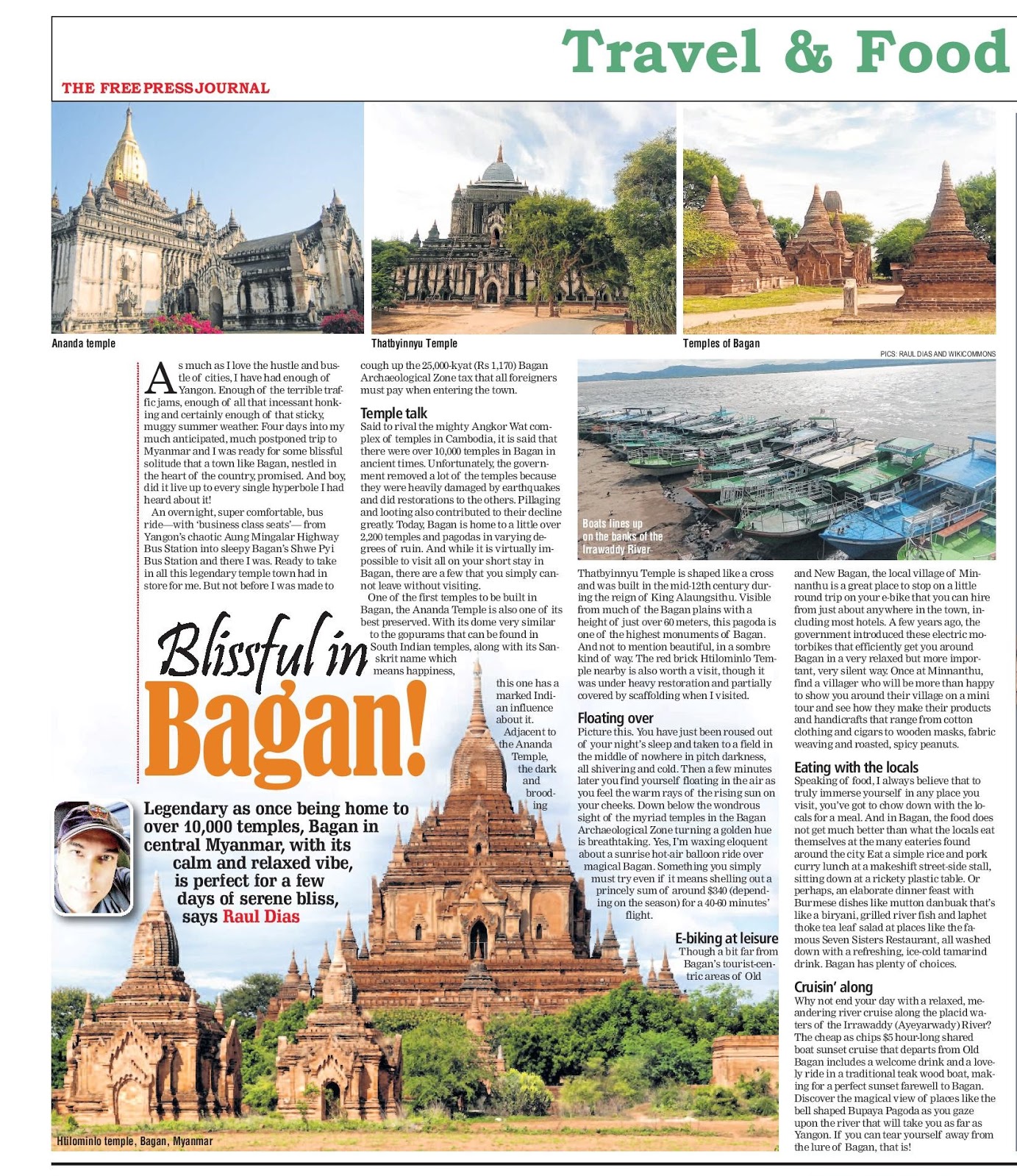
Blissful in Bagan!


Legendary as once being home to over 10,000 temples, Bagan in central Myanmar with its calm and relaxed vibe is perfect for a few days of serene bliss, says Raul Dias who comes back with his recommendations of unmissable things to see and do in the temple town.


By Raul Dias 
       
As much as I love the hustle and bustle of cities, I had had enough of Yangon. Enough of the terrible traffic jams, enough of all that incessant honking and certainly enough of that sticky, muggy summer weather. Four days into my much anticipated, much postponed trip to Myanmar and I was ready for some blissful solitude that a town like Bagan, nestled in the heart of the country promised. And boy, did it live up to every single hyperbole I had heard about it, or what!
An overnight, super comfortable, bus ride—with ‘business class seats’—from Yangon’s chaotic Aung Mingalar Highway Bus Station into sleepy Bagan’s Shwe Pyi Bus Station and there I was. Ready to take in all this legendary temple town had in store for me. But not before I was made to cough up the 25,000-kyat (Rs 1,170) Bagan Archaeological Zone tax that all foreigners must pay when entering the town.

Temple Talk
Said to rival the mighty Angkor Wat complex of temples in Cambodia, it is said that there were over 10,000 temples in Bagan in ancient times. Unfortunately, the government removed a lot of the temples because they were heavily damaged by earthquakes and did restorations to the others. Pillaging and looting also contributed to their decline greatly. Today, Bagan is home to a little over 2,200 temples and pagodas in varying degrees of ruin. And while it is virtually impossible to visit all on your short stay in Bagan, there are a few that you simply cannot leave without visiting.
One of the first temples to be built in Bagan, the Ananda Temple is also one of its best preserved. With its dome very similar to the gopurams that can be found in South Indian temples, along with its Sanskrit name which means happiness, this one has a marked Indian influence about it. 
Adjacent to the Ananda Temple, the dark and brooding Thatbyinnyu Temple is shaped like a cross and was built in the mid-12th century during the reign of King Alaungsithu. Visible from much of the Bagan plains with a height of just over 60 meters, this pagoda is one of the highest monuments of Bagan. And not to mention beautiful, in a somber kind of way. The red brick Htilominlo Temple nearby is also worth a visit, though it was under heavy restoration and partially covered by scaffolding when I visited.

Float Over the Ancient City
Picture this. You’ve just been roused out of your night’s sleep and taken to a field in the middle of nowhere in pitch darkness, all shivering and cold. Then a few minutes later you find yourself floating in the air as you feel the warm rays of the rising sun on your cheeks. Down below the wondrous sight of the myriad temples in the Bagan Archaeological Zone turning a golden hue is breathtaking. Yes, I’m waxing eloquent about a sunrise hot-air balloon ride over magical Bagan. Something you simply must try even if it means shelling out a princely sum of around $340 (depending on the season) for a 40-60 minutes flight.

E-Bike Around Minnanthu Village
Though a bit far from Bagan’s tourist-centric areas of Old and New Bagan, the local village of Minnanthu is a great place to stop on a little round trip on your e-bike that you can hire from just about anywhere in the town, including most hotels. A few years ago, the government introduced these electric motorbikes that efficiently get you around Bagan in a very relaxed but more important, very silent way. Once at Minnanthu, find a villager who will be more than happy to show around their village on a mini tour and see how they make their products and handicrafts that range from cotton clothing and cigars to wooden masks, fabric weaving and roasted, spicy peanuts.

Eat with the Locals!
Speaking of food, I always believe that to truly immerse yourself in any place you visit, you’ve got to chow down with the locals for a meal. And in Bagan, the food does not get much better than what the locals eat themselves at the many eateries found around the city. Eat a simple rice and pork curry lunch at a makeshift street-side stall, sitting down at a rickety plastic table. Or perhaps, an elaborate dinner feast with Burmese dishes like mutton danbuak that’s like a biryani, grilled river fish and laphet thoke tea leaf salad at places like the famous Seven Sisters Restaurant, all washed down with a refreshing, ice-cold tamarind drink. Bagan has plenty of choices.

Cruisin’ Along…
Why not end your day with a relaxed, meandering river cruise along the placid waters of the Irrawaddy (Ayeyarwady) River? The cheap as chips $5 hour-long shared boat sunset cruise that departs from Old Bagan includes a welcome drink and a lovely ride in a traditional teak wood boat, making for a perfect sunset farewell to Bagan. Discover the magical view of places like the bell shaped Bupaya Pagoda as you gaze upon the river that will take you as far as Yangon. If you can tear yourself away from the lure of Bagan, that is!  

FACT FILE
Getting There
There are daily flights from Kolkata and New Delhi to Yangon on airlines like Air India and Myanmar Airways International. You can reach Bagan via bus or taxi from Yangon (9 hours). There are also daily 1.2 hours flights from Yangon. Indians are now eligible for an eVisa to Myanmar, but they must arrive via Yangon, Nay Pyi Taw or Mandalay airports.
When to Visit
The best time to visit Bagan is between November and February. Bagan is hot most of the year but in these months, it is a pleasant 30 degrees. Avoid the summer, which runs from March to May.
Accommodation
Bagan has an excellent selection of hotels to choose from to suit all budgets and tastes. Some of the best are:
* The Hotel Umbra Bagan (www.thehotelumbrabagan.com)
* Bagan Thande Hotel (www.thandehotel.com/bagan)
* Temple View Bagan (www.facebook.com/templeviewhotel)

(An edited version of this article first appeared in the 7th October 2018 issue of The Free Press Journal newspaper's Weekend section on page 3 http://www.freepressjournal.in/travel/why-bagan-in-central-myanmar-is-serene-bliss/1369763)

Saturday, October 6, 2018

Hop in to Kangaroo Island!


Almost literally a hop, skip and a jump away from the city of Adelaide, the flora- and fauna-rich Kangaroo Island is South Australia’s best kept little secret, offering a range of things to see and do.


By Raul Dias

Honest confession: I don’t do very well ensconced in the confines of a tiny plane. It’s just something about being cooped up like sardines in a tin can that gets to me. Sadly, at just under half an hour, that’s the fastest—and most logical way—to get to the stunning Kangaroo Island from Adelaide. What with the sea journey between the Cape Jervis Port (two hours south of Adelaide) and the Penneshaw Port on Kangaroo Island raking up a good four hours in total, along with driving time to and from the two ports.
Suspended from the mainland of South Australia like a dusty ruby, thanks to its red mud, the island always held great sway to a traveller like myself who had only read about it in other travel tales, thus far. And so, braving the short flight aboard the tiny Regional Express plane, I soldiered on as the twin-propeller aircraft swooped its way down towards terra firma…
With 541 km of coastline and 155 km long by 55 km wide, Kangaroo Island is Australia’s third largest island, but the minuscule size of its one and only airport at Kingscote, the island’s capital town, belies this distinction. Waiting for my group of three friends and I outside the small terminal building was our guide for the next two days Nikki Redman with her jazzed up mini bus, ready to show us the island where she’s spent all her life and which she loves with a fierce passion.

All ‘Seal’ed Up!
Our first stop on the island was Seal Bay. Nestled along the island’s southern coast, Seal Bay is a playground for over 600 Australian sea-lions (neophoca cinerea) that seem to spend all day in the pursuit of their beauty sleep. Taking the weathered wooden pathway from the astonishingly well-equipped visitor’s centre down the white sanded beach, we made our way past clusters of plump mum and baby pairs of sea-lions in various stages of their seasonal moulting, some with soft tufts of new white fur, while others, like fashion-conscious ladies, still shedding their brownish-black ‘last season togs’. But the benign giants aren’t the only residents that call this fecund paradise home, we were lucky to get a glimpse of a group of elusive Hooded Plovers as well as some white-bellied Sea-Eagles taking flight. All I truly wanted to do there right then and there was to plonk myself on the beach and commune with nature at its purest, undiluted best. But that was sadly not to be.

Nature’s Grotto
Lured away with the threat of abandonment, we reluctantly headed back to the bus, so that we could savour more of Kangaroo Island’s bounty. Looming in the horizon like an erect beacon of hope, the Cape du Couedic Lighthouse is like a sentinel guarding the eerie, almost subterranean grotto of Admirals Arch. A truly fascinating wild sculpture of nature, formed by an old coastal dune being cemented together, then eroded, Admirals Arch is a place where time comes to a grinding halt. A place where one’s reverie is punctured time and again by the bellowing of the New Zealand seals that bask on the jagged rocks that jut out angrily into the sea as though proving a point. Taking the boardwalk that runs around the cliff face down into the bowels of the spectacular natural grotto, we got to the viewing platform that made for a perfect photo-op with the brutal waves doing their very own number down below. The howling wind caressed us into submission as the pungent odour of seal excrement hit our nostrils, signalling that our time was up in the cave that was beginning to look like the devil’s living room of my nightmares.

Meeting the Namesakes
Leaving my nightmares where they belonged, at the bottom of Admirals Arch, something (or rather someone) more soothing and docile beckoned. One of the things on my ‘To Do’ list when I first decided to take a trip to the land down under was just about to be struck off – tea with kangaroos for whom this beautiful island is named after!
And so, we made our way to Grassdale in the Kelly Hill Conservation Park after a tryst with some pesky pelicans at the beautiful Stokes Bay. Once a farm run by Lucy Edwards, who sold it off when it got too much to manage on her own, Grassdale is now a place for rambunctious kangaroos with tiny little joeys in their pouches to frolic about in. Sipping freshly brewed tea and tucking into shortbread biscuits, we watched as the marsupials went about their business picking at tender shoots that were beginning to emerge from the red soil.

To Bee or not to Bee!
Next day, up bright and early, we made our way to our first stop of the day—Clifford’s Honey Farm in the island’s MacGillivray neighbourhood. This family-run honey farm produces high quality honeys from various native plants—each with a distinctive flavour. I particularly enjoyed the cup gum variety.
The strain of the placid Ligurian bee, that was brought to Kangaroo Island from Italy, is disease free and high yielding, and in great demand worldwide. Clifford let us know that Kangaroo Island is the only place in the world with a wild population of the bees and has been designated as a bee sanctuary. The fine, pure honey produced by these bees is made into a variety of honey products at the farm, including honeycomb, honey ice-cream and even honey beer. The latter being a spur of the moment, unusual invention by Clifford’s son-in-law that works surprisingly well, I might add.

Hic, Hic Hurrah
And speaking of a drink, a tasting selection of gins including a yummy Thai-style chilli gin was what we tried next at the rustic chic-looking Kangaroo Island Spirits straight off the Playford Highway in Cygnet River. Located within a rather ramshackle exterior, the distillery is where liqueurs, gins and vodkas are all handmade in small batches using hand crafted copper pot stills. These high-quality spirits are additive and preservative free and where possible are made using native Australian botanicals and locally grown or sourced ingredients, including the Island favourite...you guessed it, Ligurian honey!

Rock and Roll
And buzzing we all were once again as the otherworldly Remarkable Rocks began to play a game of hide and go seek with our eyes, darting in and out of focus as we drove through a thicket of Tate’s grass tress towards the rock formation. A huge cluster of weather-beaten granite boulders perched on a large granite dome that drops 75 metres to the sea, these numinous icons of Kangaroo Island appear to be the creation of an extra territorial being… or perhaps it was just Mother Nature playing abstractionist sculptor for the day.
But then again, that’s just what Kangaroo Island does to you. It makes you imagine things you’d never imagined before and see things from a whole other perspective.


FACT FILE
Getting there
There is a daily 30-minute flight to Kingscote on Regional Express from Adelaide on the mainland of South Australia. For travelling within Kangaroo Island, it is advisable to either hire out the services of a tour company such as Kangaroo Island Odysseys (www.kiodysseys.com.au ) or perhaps self-drive a hired car, as there is virtually no public transport on the island.
Visas
Indian passport holders need a visa to enter Australia, which is easy to procure with the introduction of the very efficient e-visa facility.
When to visit
With Kangaroo Island enjoying pleasant climate during the autumn and spring seasons, the best months to travel are from March to May and from September to early November. Summers from December to February can get a bit hot.
Accommodation
Kangaroo Island has an excellent selection of hotels to choose from to suit all budgets and tastes. Some of the best options are:
* Aurora Ozone Hotel (www.ozonehotelki.com.au)
* Kangaroo Island Seafront (www.seafront.com.au)
* Mercure Kangaroo Island Lodge (www.www.kilodge.com.au)


For more information, visit www.southaustralia.com

(A differently edited version of this piece was first published in the October 2018 issue of The Week's Smart Life magazine)