Saturday, November 14, 2020

Bells, Broken Hearts and Paper Cranes

Celebrating the innocence of childhood in their own unique ways, this trio of monuments around the world are places of immense beauty and gut-wrenching despair in equal measure 


By Raul Dias

Decades ago, a wise one close to me had prophesied that this day would come. “One day, you are going to mourn the loss of your childhood!”, a precocious, 13-going-on-30-year-old me was warned.

This, after I was caught doing something no child of 13 should have ever indulged in. With the insufferable insouciance of an approaching adolescence as my ally, I cast aside that prophecy like a pair of smelly socks. But now, I grieve. 

And it took a pandemic to put it all into perspective. I long for the days of my childhood when I feared so very little that plagues the adult me today. The health of loved ones, work-related stress and most of all, that big, dark question mark looming over our collective, uncertain future. All constantly piercing thorns in my side. 

So today, as India celebrates Children's Day, I have decided to take a short little detour from my worldly worries. And go back to three places around the world, which in some way or form have helped me recoup a little bit of my lost childhood as I visited each of them at different points in my life as a travel writer. Places reflective of immense beauty and gut-wrenching despair in equal measure. Each dedicated to children and childhood--both lost and found.


Peals of peace

Lying on the outskirts of Sofia, Bulgaria's unremarkable capital, the Business Park suburb with its monoliths of glass and steel seems like an unlikely place to find a monument honouring children. But in 1979, when the Kambanite Park was established, the area was nothing more than a grassy woodland with abundant wildlife gambolling about at the base of the Vitosha mountain. 

Besides being the year of my birth, 1979 was also declared by the United Nations as the International Year of the Child. As part of the International Children’s Assembly's 'Flag of Peace' events held across the world, Bulgaria decided to up the ante and construct its very own monument to commemorate it. Named after the Bulgarian word for bells, “kambanite”, the monument's main bell tower is composed of four, 37-meter vertical concrete pylons that meet at the top to form a hollow sphere symbolising the earth, with its seven bells representing the seven continents. 

But what makes it the largest percussion instrument in Europe are the 133 (and growing!) bells sent in by countries around the world to reaffirm their commitment towards the betterment of the lives of children. These bells are arranged in four semi circles around the base of the main bell tower and range in shape, size and even age. 

While Bulgaria’s bell weighs in at a whopping 1,300 kgs, in honour of the 1,300th  anniversary of the country's birth as a nation in 681AD, the oldest bell dates back to the 11th century. Each of the bells are emblazoned with a message of peace from the children of that particular nation. While an inscription at the monument’s base reads, “Children of the future accept the eternal, fiery call of immortality - Unity, Creativity, Beauty.” 


Soaring high

I travel way back in time once again to my childhood, as I find myself sitting in my fifth grade origami crafts class, willing my chubby fingers to fashion a sheet of red marble paper into a crane bird. That year, my school was among the chosen few from India called upon to send in a couple of hundred such origami paper cranes all the way to Hiroshima, Japan. To add to Sadako Sasaki's collection. Housed in a dozen or so glass cabinets, our paper cranes would form part of the thousands of others sent in every year by children around the world to Hiroshima's Children's Peace Memorial, we were told. 

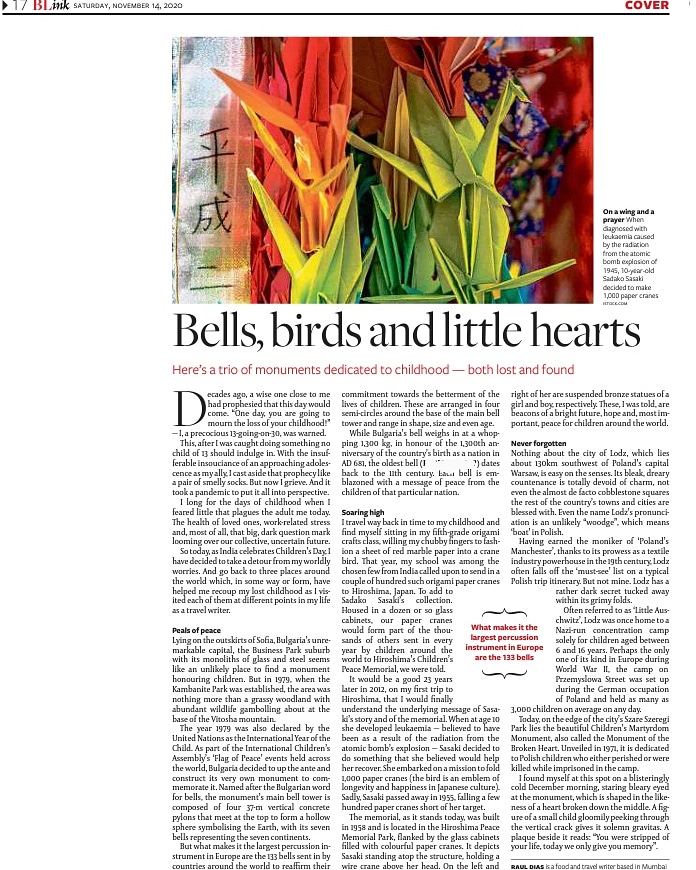
It would be a good 23 years later in 2012, on my first trip to Hiroshima, that I would finally understand the underlying message of Sadako's story and of the memorial. When at age 10 she developed leukaemia--which was believed to have been a result of radiation from the atomic bomb's (ironically called 'Little Boy') explosion--Sadako decided to do something that she believed would help her recover. She embarked on a mission to fold 1,000 paper cranes. As cranes are believed to be emblems of longevity and happiness in Japanese culture. Sadly, Sadako passed away in 1955 falling a few hundred paper cranes short of her target.

The memorial, as it stands today, was built in 1958 and is located in the Hiroshima Peace Memorial Park, flanked by the glass cabinets filled with colourful paper cranes. It depicts Sadako standing atop the structure, holding a wire crane above her head. On the left and right of her are suspended bronze statues of a girl and boy, respectively. These, I was told, are beacons of a bright future, hope, and most importantly, peace for children around the world.


Never forgotten

Nothing about the city of Lodz that lies about 130km southwest of Poland's capital Warsaw is easy on the senses. Its bleak, dreary countenance is totally devoid of any charm, punctuated by the absence of those almost de-facto cobblestone squares the rest of the country’s towns and cities are blessed with. Even the name Lodz's pronunciation is an unlikely "woodge" that means 'boat' in Polish.

Having earned the moniker of 'Poland's Manchester' thanks to its prowess as a textile industry powerhouse in the 19th century, Lodz often falls off the 'must-see' list on a typical Polish trip itinerary. But not mine. For you see, Lodz has a rather dark secret tucked away within its grimy folds. 

Often referred to as 'Little Auschwitz', Lodz was once home to a concentration camp solely for children aged between 6 and 16 years. Perhaps, the only one of its kind in Europe during World War II, the camp on Przemyslowa street was set up during the German occupation of Poland and held as many as 3,000 children on an average at any one day. 

Today, on the edge of the city's Szare Szeregi Park lies the beautiful Children's Martyrdom Monument also called the Monument of the Broken Heart. Unveiled in 1971, the monument is dedicated to Polish children who either perished or were murdered while being imprisoned in the camp. 

I found myself at this spot on a blisteringly cold December morning, staring bleary eyed at the monument that is shaped in the likeness of a heart broken down the middle. A figure of a small child gloomily peeking through the vertical crack giving it solemn gravitas. A plaque besides it reads: "you were stripped of your life, today we only give you memory."


(An edited version of this article first appeared in the 14th November 2020 issue of The Hindu Business Line newspaper's BLink section on page 17 https://www.thehindubusinessline.com/blink/cover/three-monuments-dedicated-to-children/article33091946.ece )

Tuesday, November 10, 2020

Behind The Brand: Mehul Jakharia, Founder Of Eyewearlabs


This article was first published online on 10th November 2020 in Luxury Lifestyle Magazine, UK https://www.luxurylifestylemag.co.uk/style-and-beauty/behind-the-brand-mehul-jakharia-founder-of-eyewearlabs/ 

Check out Eyewearlabs range here: https://www.eyewearlabs.com/?ref=mGB38

Sunday, November 1, 2020

Raw Beauties!


Showing us that there’s a whole lot more to raw fish dishes than plain old Japanese sashimi are a host of interesting and exotic preparations from as far as Peru to the Philippines. Smart Life introduces you to a few such edible wonders.  

By Raul Dias

It’s safe to say that most of the world’s love affair with raw fish is rather recent. And one that is in its embryonic stages as far the average Indian diner is concerned. Once looked upon as freakishly alien and best left to where it belonged, the raw fish wonder that is Japanese sashimi has ensnared the entire world with its fresh, clean taste and healthy diet appeal. 

Today, sushi bars are an ubiquitous site the world over, with patrons hungry for a piece of that freshly sliced amberjack or for a portion of those gossamer thin slivers of yellowfin tuna—all anointed with a dab of wasabi and a splash of shoyu (soy sauce). And while smoked salmon too has made its way around the world via Scandinavia in the form of gravlax and New York (where it is known as lox), our notion of raw fish preparations is still woefully confined to the above-mentioned two. Not anymore! 

Digging a little deeper into the vast sphere of world cuisine shows us the existence of a whole smorgasbord (pun intended!) of raw fish dish iterations from a diverse number of places that have been enjoyed for centuries in various forms and styles.

Here are a few such raw revelations: 


Poké from Hawaii

Pronounced poh-kay and meaning to “cut crosswise into pieces” this supremely healthy and tasty one bowl Hawaiian origin dish is a very simple preparation that sees short grain sushi rice that has been pre-vinegared as the base. This rice is then topped with diced raw fish and other seafood that can range from salmon and tuna to octopus and sea urchin. A splash of soy, a squirt of Japanese mayonnaise, a dusting of the Japanese spice blend called furikake, sesame seeds and dried flakes of nori (seaweed) finish off this dish that is criminally addictive and clean tasting. Interestingly, very similar to poké is the Korean dish called hoedeopbap that consists of marinated raw tuna served over rice.


Ceviche from Peru

Over the last decade or so the popularity of this paradoxically raw, yet ‘cooked’ fish dish from Peru has reached dizzying heights. This seemingly simple dish is a complex preparation made from fresh raw fish cured in citrus juices, such as lemon or lime, and spiced with ají chillies and other seasonings including chopped onions, salt, and coriander. It is the all-important citrus that cooks the fish, turning its translucent flesh into a milky opaque. Ceviche is usually accompanied by side dishes that complement its flavours such as sweet potato, lettuce, roasted corn kernels called cancha and the current hipster chic craze—avocado!


Kokoda from Fiji

Coming to us straight from the swaying coconut trees and cool waters of the lush Fijian islands, this raw fish dish celebrates two of the island’s greatest resources—coconuts and its abundant seafood. Pronounced ko-kon-da, kokoda is a refreshing salad-appetizer that’s perfect after a day swimming the cerulean ocean. Just like a ceviche, cubed white fish like snapper, walu or mahi mahi is first marinated in a citrus mixture so that it cures and cooks and then a splash of cooling coconut cream is added to give the dish its creamy consistency. Diced tomatoes and a few fronds of coriander finish off this dish that is always served in a hollowed-out coconut shell.  


Crudo and Carpaccio from Italy

Literally meaning ‘crude’ or ‘raw’ in Italian, crudo is a super popular and versatile raw fish dish from Italy that can be anything from slices of raw fish drizzled over with olive oil and seasoning, to a chopped version just like a steak tartare that’s always topped with an egg yolk. Similarly, fish carpaccio is the pescatarian version of the thinly sliced raw beef dish of the same name that was invented in 1950 by Giuseppe Cipriani, founder of Harry’s Bar in Venice and named in honour of Vittore Carpaccio, the Venetian painter known for his characteristic red and white tones.  


Yusheng from China

Literally meaning “raw fish” the dish is basically a Cantonese-style raw fish salad consisting of strips of raw fish mixed with shredded vegetables and a variety of sauces and condiments, among other ingredients. Also known as the “prosperity toss”, yusheng has been a Cantonese favourite for decades with the most common form being the qicai yusheng (seven-coloured raw fish salad) served in local restaurants during the Chinese New Year period. And although versions of it are thought to have existed in ancient China, the contemporary version was created and popularised in the 1960s.


Kinilaw from the Philippines

An interesting raw fish dish that is closely related to not one but two dishes on this list, kinilaw from the Philippines borrows elements from both a ceviche and a kokoda. Hailing from the Visayan region of the archipelago, the name kinilaw is derived from the word, “kilaw”, which means raw or uncooked. Just like a ceviche, the seafood is ‘cooked’ without the application of heat but is rather cured in vinegar. Additional souring agents like the native calamansi (a lime-orange like fruit), tamarind, or green mangoes are added to enhance its tartness. To complete the dish, black pepper, onions, ginger, seaweed and sliced chilies are also added. And in some parts of the country, just like a kokoda, a dash of coconut milk or cream is added to give the dish a creamy, sweetish send-off! 

(A differently edited version of this piece was first published in the November 2020 issue of The Week's Smart Life magazine)


Death and All His (Mexican) Friends!

Celebrating death in myriad ways, with no excuses made for its intimacy with life, is Mexico’s idea of a good time


By Raul Dias

There is a heartbreakingly beautiful saying in Mexico that goes something like this… “you never really die until your name is spoken for the last time”. 

This is perhaps why the concept of death in Mexican culture is one that is so unique and unlike any other in the world. As I travelled around this wonderfully ‘alive’ country a few years ago, I discovered that as much as they mourn death, Mexicans also celebrate it with joy and unbridled mirth. Bordering on a defiant nonchalance, one might even say. But not quite.

And there is no day more poignant than today’s North American holiday of Halloween to put the Mexican attitude towards death into perspective. Now, while the average American approaches death with fear, turning the dead into monsters—worthy, only of being paraded around as fancy-dressed, macabre creatures as they go ‘trick-or-treating’ about their neighbourhood—the Mexican prefers a riotous co-existence. All this, along a colourful path of both least resistance and total abandonment!   

Living Death

It is no great surprise then that one of Mexico’s most important festivals celebrates not life, but death with the greatest of abandon. Día de Muertos—which takes place on the second day of November each year all over Mexico—is a fusion of the Catholic feast of All Souls’ Day with the day of the dead of the pre-Hispanic Tarasco people of Michoacán. It is believed that the dead return to their earthly homes for one day. Quite like in the animated movie Coco (2017), the underlying philosophy here is that death is not a full stop put at the end of a life, but a continuation of it in a parallel dimension.

I was lucky enough to witness one such Día de Muertos in Mexico City that changed the way I looked at death forever. As much as two days before the festival, Mexicans visit the graves of deceased family members, adorning them with brightly coloured paper decorations and marigold flowers known locally as cempasúchil. The brightness of which, they believe, evokes the sun. Small gifts called ofrendas in the form of glittery, sugared skulls and dancing skeletons called calaveras are left behind at the graves by the relatives. This, after they spend at least 24 hours in the cemetery, communing with the dead in a sort of hybrid tailgate party-meets-picnic. Highlighted by plenty of eating, drinking and playing of music.   

Double, double toil and trouble

“Que buscabas?” was a question hurled at me by almost every smiling shopkeeper I encountered. “What are you looking for?” they asked. I found myself at the Mercado de Sonora on a rather chilly Autumn afternoon. Dedicated solely to witchcraft, potions, and other death rituals, this market located just southeast of Mexico City’s main center—in a neighbourhood known as Merced Balbuena—truly is the place to go to to get your freak on. 

To the average José, it might appear to be a normal place. Food stalls selling everything from tripe tacos to luridly-coloured fruit drinks called aguas frescas decanted into large glass containers are all lined up in neat isles. Letting my olfactory senses take lead, I sauntered down to the back. Into an area of the mercado that is not for the faint of heart.

Rows of shops peddling a virtual menagerie of dried up, dead animals and reptiles, from snakes to armadillos, come into sight. Tiny vials of love potions to more sinister ones of the ‘ruin-your-enemy’ kind were thrust under my reluctant nose for perusal. Soon I was accosted by a rather scary-looking woman and offered a quickie limpia con hueve. A harmless kind of spiritual cleanse, I was told that involves rubbing a fertilised chicken’s egg all over the ‘cleansee’s’ body, before it is smashed onto the floor to disperse off the bad vibes. I quickly skulked away into the incoming human traffic, profusely apologising in my terrible Spanish.

I had been warned that this might happen and to steer clear of it. The mercado is full of quacks and imposters, I was told by my friend Paz. A Mexico City local, Paz claims to have once been tricked into a similar limpia by a self-proclaimed witch, who turned out to be the market’s cleaning lady. 

Saints and sinners

I soon learned that on the first day of every month, thousands of people flock to an altar in a ramshackle part of Mexico City to honour a ‘saint’. One that the country’s all-controlling Catholic Church vehemently denounces. But this denouncement did not surprise me as I joined the thronging devotees on a morning that happened to be the first of November. The number one attraction of the city’s rather rough Barrio Tepito neighbourhood is the shrine dedicated to the scythe-brandishing skeletal figure of Santa Muerte (Saint Death), always garbed in a white sequined wedding gown.

Once again, blending pre-Hispanic rituals with that of Catholicism, Santa Muerte is said to be an avatar of Mictlantecuhtli, the ancient Mexican God of Death. Over the years, this dreaded figure has come to be associated with drug runners and gang members who look upon her as their de facto patron saint. Leaving her candles and bottles of tequila as part of their obeisance is the norm.

Getting into the ‘spirit’ of things truly seems to be a Mexican way of life!


TRAVEL LOG

Getting There 

As there are no direct flights linking India with Mexico, one can get into Mexico City via connecting flights from most major US airports. Travel within Mexico City is extremely easy with plenty of transport options including taxis, public buses and the super-efficient and cheap metro train system. Indians require a visa to visit the country that can be procured from the Mexican Embassy in New Delhi. However, the visa requirement is waived off for those in possession of a valid multiple entry US visa.   

Stay

In-keeping with a city of its mammoth size, Mexico City has every sort of accommodation option to suit all tastes and budgets. Located in the heart of the city in the Centro neighbourhood around Zócalo plaza, Downtown Mexico (www.downtownmexico.com) has a boutique hotel vibe with reasonable room rates, starting at Rs 2,100 for a double room without breakfast. Set in a modern building that is a short walk away from the Cuauhtémoc metro station, Gran Hotel Amazonas (www.hotelamazonas.com.mx) offers rooms starting as low as Rs 1,600 for a double without breakfast.

Tip

* If you are still craving some more chills and thrills, then head to the super-creepy floating Isla del las Muñecas doll island in the canal-infested Mexico City suburb of Xochimilco. Here you will encounter garlands of dolls festooned from almost every gnarly tree’s branch as well as the island’s spooky doll museum. 


(An edited version of this article first appeared in the 31st  October 2020 issue of The Hindu Business Line newspaper's BLink section on page 18 https://www.thehindubusinessline.com/blink/cover/mexicos-day-of-the-dead/article32978112.ece)

Sunday, October 25, 2020

Notes from Baijnath


By Raul Dias

For a handful of places across India, the celebration of good versus evil, that today’s Dussehra festival espouses, is not as definitively black or white as most would like it to be. But then, nor is the mythology that birthed it and thousands of other festivals—both religious and otherwise—not just in India, but around the world as well. Myriad interpretations abound, each shining light on hidden facets.

Just ask the inhabitants of the sleepy little town of Baijnath in the Northern Indian state of Himachal Pradesh! While this year’s Dussehra festivities might be muted ones across the country due to the pandemic, in Baijnath, Dussehra is an annual no-show.

Unsung hero or wrathful foe?

Perched at an altitude of 4,311 feet on the Himalayan Dhauladhar mountain range, Baijnath is one of those rare places in India where neither Dussehra has ever been celebrated, nor the ensuing drama of the Ramleela ever played out. All this, thanks to an unlikeliest protagonist at the very vortex of it all—Ravana. 

Legend has it that the ‘demon king of Lanka’ was an ardent devotee of Lord Shiva and prayed to him deep in the Himalayas seeking immortality. In return for which Ravana chopped off his own ten heads at the altar. So impressed was Lord Shiva with this act of devotion that he is said to have restored the heads. Only this time, six of the heads for the six Puranas and four for the four Vedas. 

The 12th century Baijnath rock temple constructed in the Nagara style of architecture and the surrounding town of the same name were built upon this myth. And to this day, in honour of Ravana’s dedication to Lord Shiva, neither is Ravana’s effigy burnt by the residents, nor do they buy sweets or light any fireworks. Interestingly, the town is also totally devoid of jewellery shops. This is apparently to mourn Lord Hanuman’s torching of Ravana’s Lanka which was said to be made of gold. 

However, according to some, it is not entirely the respect for Ravana and his devotion to Lord Shiva, but also that all-consuming emotion of fear that prevents any Dussehra celebrations from taking place in Baijnath. As in most small towns across India, myths of destructive wrath and punishment abound here too. Everything from decades of bad luck to more ominous ones in the form of an unnatural death to those who take part in any Dussehra festivities, keep the Baijnath townsfolk away, come Dussehra night.   

Dussehra dodgers

Baijnath, however, is not alone in its shunning of Dussehra festivities. There are other Ravana-sympatico places in India where the shine of Dussehra is a tad diminished, if not fully taken off. While the people of Mandsaur in Madhya Pradesh refer to Ravana as their ‘son-in-law’ as they believe that their town is the paternal home of his wife, Mandodari, Bisrakh in Uttar Pradesh claims him as its own. According to local belief, Ravana, the son of a sage named Vishrava and Kaikeshi, a Daitya princess was born in Bisrakh.

As it is believed that Mandore in Rajasthan is where Ravana married Mandodari, on the day of Dussehra, priests of the local Ravan Ki Chanwari temple perform the shraadh ceremony for his soul. In Maharashtra’s Gadchiroli District, the village of Paraswadi is nothing but a glorified hamlet, home to a handful of people from the Gond tribe. They call themselves Ravanwashis or descendants of Ravana, resolutely refusing to be identified as Hindus. 

Perhaps there is no better place than one actually named after Ravana to seek an answer to the million dollar “was he good or evil?” question. Ravangram in Madhya Pradesh is a village that has a legion of devotees who actually worship a 10-feet-long reclining statue of Ravana in an ancient temple constructed by a sect called the Kanyakubja Brahmins that Ravana was said to be a member of.

Putting it all into perspective, one cannot help but ponder on a rather controversial quote often attributed to Winston Churchill. Is history truly written by the victors?                      

(This column first appeared in the 25th October 2020 issue of The Hindu newspaper's Sunday Magazine section on page 7 https://www.thehindu.com/life-and-style/travel/notes-from-baijnath/article32931241.ece)

Saturday, October 10, 2020

Puns on a Platter!


From the downright outrageous to the uproariously funny, weirdly named dishes offer an interesting insight into the culinary ethos of several countries around the world.

By Raul Dias

Growing up part Anglo-Indian on my Mum’s side, my initiation into the realm of oddly named dishes was complete the moment I, a preternaturally ravenous two-year-old, had had my first helping of pish-pash. Simply put, the rather onomatopoeic dish is an Anglo rite of passage every toddler must endure. Made with soft rice and some form of protein (mostly chicken), pish-pash as a dish was first spoken of by English writer Augustus Prinsep in the mid-19th century where he called it “a slop of rice-soup with small pieces of meat in it, much used in the Anglo-Indian nursery.”

Over the years, I would encounter more funnily named Anglo-Indian culinary ‘jewels’ like the meat kofta curry doppelganger with a very rude name of ball curry. Also known as the even ruder “spinster’s delight curry”, the Sunday special would always be enjoyed with its supporting acts that took the form of yellow rice and the scary-sounding (but comfortingly mild) devil chutney. 

Egg banjo, on the other hand is an Anglo snack that was invented by the military during WWII and sees a sunny-side-up fried egg sandwiched between two slices of bread, all doused in the quintessentially British brown sauce. Though the etymology of ‘banjo’ in its name remains a mystery, the sandwich still lives on here in India in the form of the slightly tweaked (both in name and composition) ‘egg benjo’—an insanely popular snack made famous by Indore’s nightly food paradise of Sarafa Bazar. Here, the runny egg is substituted with a more practical folded masala omelette, the sliced bread with a toasted burger bun and brown sauce with tomato ketchup. 

Blighty bites

As a university student in the UK of the mid-2000s, as I navigated my way around various college and dorm cafeterias, I was hit in the face with even more inappropriately named British dishes. Take spotted dick, for instance. 

Now, before images of some virulent, male appendage-related medical condition begin to swirl in your mind, let me assure you of the name’s rather benign innocuity. This traditional British pudding (as desserts are referred to there) is made with flour, suet (a kind of animal lard), caster sugar, lemon zest and dried currants or raisins making up the ‘spotted’ component. The ‘dick’ part being an old English term for a pudding. Served warm with a thin custard sauce, this steamed pudding has been a mainstay across Britain for centuries. 

I am told that the wildly popular Stinking Bishop cheese from Dymock in South West England’s Gloucestershire county apparently gets its nausea-evoking name for the juice of the Stinking Bishop Pear that it is immersed in for its ripening process. Not for its equally putrid odour that is said to be a cross between that of a wet dog and old socks.

Another such bizarrely named specimen is the rather tasty baked savoury dish called toad-in-the-hole. Eaten as part of a light dinner that the Brits call “tea”, the easy-to-prepare dish is a bunch of fried pork sausages (or to use the more colloquial term—bangers) cooked in what is essentially a buttery Yorkshire pudding. But in America, the unfortunately named dish refers to an egg cooked in the hole cut out of a piece of white, sliced bread. 

Servings across the pond

Speaking of America, the land of the free too has its own posse of quirkily named dishes. Some like the molten cheese-exploding burger called the juicy Lucy and the soppy, meat sauce laden sandwich named sloppy Joe paying homage to particularly messy individuals! While others are in honour of “sleepy critters” like the 1970s cocktail party classic of pigs in a blanket that sees tiny, cocktail pork sausages wrapped in flaky pastry and then baked.

Devils on horseback is another iconic 70s party snack where pitted, dried prunes are wrapped in bacon strips and then baked. Interestingly, this snack has evolved from another strangely named turn-of-the-century one called angels on horseback, where freshly shucked oysters stood instead of the prunes.

Deep fried oysters also find a place for themselves in the New Orleans po’ boy sandwich ensconced within the crusty confines of a sliced mini French baguette. A shortened version of the original ‘poor boy sandwich’, the po’ boy was named after the conductors of the local streetcar company, who in 1929, were given the sandwiches free of charge for their daily lunch by a local restaurant during their four-month long strike for better wages.

South of the US in the Caribbean twin island nation of Trinidad & Tobago, a strangely named iteration of our very own Malabar parotta has been the number one snack for over a century. The buss up shut which is the local vernacular for “busted up shirt” is a flaky paratha that is smashed up by the cook using their hands after frying on a griddle. Thus, leaving the flatbread to resemble a torn-up shirt, pieces of which are dunked into spicy chickpea and potato curry and eaten with Trini-style mango achaar.    

Found in translation

Adidas. Helmet. Walkman. Any guesses as to what this trio could possibly mean in the context of food? Well, in the Philippines they are all nicknames given to popular street food snacks, I discovered on a recent trip to the archipelago nation. So, while Adidas is what barbequed chicken feet are called, helmet is the code word for roasted chicken head and walkman is bite sized bits of grilled pig ears.

Still in the Philippines, Bicol express is a spicy stew made with pork, shrimp paste and coconut milk. It is named in honour of the passenger train service of the same name that plies between the capital Manila and the Bicol region that is well-known for its spicy cuisine.

Imam bayildi, as translated onto the English menu cards in restaurants across Turkey reads “the imam fainted” and is an old Ottoman heirloom dish. Here, whole eggplants are stuffed with a mixture of onions, garlic and tomatoes and simmered in olive oil before being served with rice and a dollop of yogurt. It is said to have got its name when an imam who was so overcome by pleasure after eating the dish, fainted.  

Or maybe, the imam had just gotten a whiff of the stinking bishop…?                 

------

Toad-in-the-Hole

INGREDIENTS:

180 gm all-purpose flour

450 gm pork sausages (can be substituted with chicken sausages)

½ tsp salt

Pinch of freshly ground black pepper

3 eggs, beaten

350 ml milk

2 tbsp melted butter

1 tbsp vegetable oil 


METHOD:

1. In a large bowl, whisk together the flour with the salt and a pinch of pepper. Make a well in the center of the flour. Pour in the eggs, milk, and melted butter into the well and whisk into the flour until smooth. Cover and let the batter stand for 30 minutes. 

2. Grease the bottom and sides of a medium-sized, rectangular baking dish with a little vegetable oil. Preheat the oven to 220°C and place the empty dish in it. 

3. Meanwhile, in a frying pan heat remaining oil on medium flame and fry the sausages till golden brown. 

4. Put the sausages in the hot baking dish and pour the batter over the sausages and bake for about 20-30 minutes or until the batter is risen and golden.

5. Cut in wedges and serve warm alongside caramelised onions, brown sauce and buttery mashed potatoes.

(An edited version of this article first appeared in the 10th October 2020 issue of The Hindu Business Line newspaper's BLink section on page 19 https://www.thehindubusinessline.com/blink/takeaway/foods-with-bizarre-names/article32804928.ece)