Tuesday, July 3, 2018

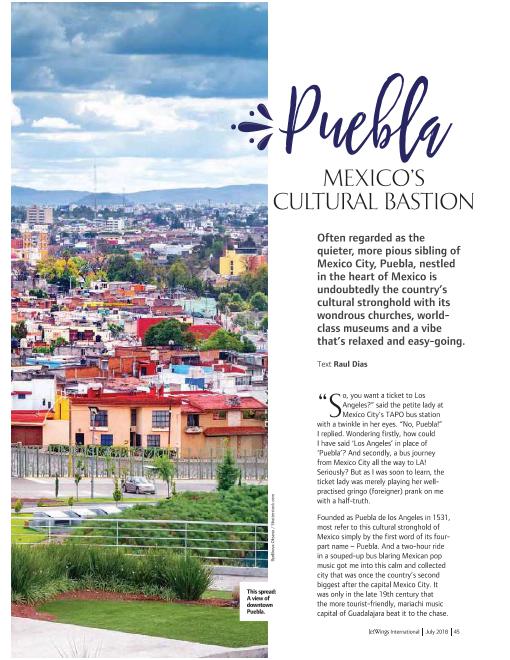
Puebla: Mexico’s Cultural Bastion


Often regarded as the quieter, more pious sibling of Mexico City, Puebla, nestled in the heart of Mexico is undoubtedly the country’s cultural stronghold with its wondrous churches, world-class museums and a vibe that’s relaxed and easy-going.  


By Raul Dias

“So, you want a ticket to Los Angeles?”, said the petite lady at Mexico City’s TAPO bus station with a twinkle in her eyes. “No, Puebla!”, I replied. Wondering firstly, how could I have said ‘Los Angeles’ in place of ‘Puebla’? And secondly, a bus journey from Mexico City all the way to LA! Seriously? But as I was soon to learn, the ticket lady was merely playing her well-practised gringo (foreigner) prank on me with a half-truth.
Technically called Puebla de los Angeles, most refer to this cultural stronghold of Mexico simply by the first word of its four-part name—Puebla. And a two-hour ride in a souped-up bus blaring Mexican pop music got me into this calm and collected city that was once the country’s second biggest after the capital Mexico City. It was only in the late 19th century that the more tourist-friendly, mariachi music capital of Guadalajara beat it to the chase.

Lost and Found!
Blame it on the beauty of Puebla that had me mesmerised, or simply on the language barrier, but neither my combi driver nor I had realised that we had driven past my intended stop, the town square called the zocalo. I had hopped into his fume-spewing vehicle a good half an hour ago, after my intercity bus had deposited me at Puebla’s strangely quiet CAPU bus station. And by now we were way out of the historic center.
To be more precise, I was very close to something I had heard about but had no intention of visiting—Africam Safari. This self-drive through faux safari park is on the road to Presa Valesquillo and is said to be home to a number of native and exotic wildlife. Quickly hailing a passing taxi, whose driver thankfully spoke a bit of English, I headed back down the road towards my intended stop.
Dotted with a cornucopia of cafés and restaurants, with canoodling couples, buskers and balloon sellers aplenty, the zocalo is akin to a circus on steroids and perhaps the only place where Puebla sheds its ‘calm cloak’. No wonder then that it was once the city’s main marketplace where everything from bullfights to public executions took place—often at the same time! Today, this tree-lined square is where the weekly Thursday changing of the flag ceremony takes place amidst great nationalistic fervour.   

City of Churches
There simply is no denying the fact that Puebla truly is Mexico’s most pious city with its denizens, the criollo poblanos often being accused of having a holier-than-thou attitude, both literally and metaphorically. In fact, there is a famous (if a tad exaggerated!) saying that Peubla has 365 churches, with one for every day of the year. But in reality, it’s a more conservative number of 70 that dot the Centro Historico or historic center.   
And this fact was reiterated to me time and again as I sauntered through its cobblestoned alleys and lanes dotted with buildings clad in the colourful azulejo-style tiles. I made my first obeisance-worthy stop at the mother of all Puebla’s ecclesiastical wonders—the Cathedral. As one of the largest in Mexico, this baroque cathedral is just south of the zocalo. Here, it occupies an entire city block and its gargantuan proportions were certainly not lost on me. Its 69 meters-tall twin towers soar above a nave that’s decorated with frescos and flanked on either side by 14 chapels. Dedicated to the Immaculate Conception, the cathedral even finds a place for itself on the face of a $500 Mexican dollar bill.

Of Museums and Then Some More…
Rivalling its church-prowess is the sheer number of museums one can find here. Ever the train geek, thanks to a grandfather who spent all his working life with the Indian Railways, I decided to make the Museo Nacional del Ferrocarril my first museum stop. Once again, located in Puebla’s Centro Historico, at the city’s former train station to be more specific, this railway museum has a superb range of exhibits, from a well-preserved steam engine to pictures of derailments and other locomotive disasters. The latter, strictly for those with a predilection for morbidity! 
Housed in two adjoining historic buildings, the Museo Amparo is a private museum and a treasure-trove of both Hispanic artefacts and pre-Hispanic religious iconography, including a couple of highly decorated human skulls. Another deeply-rooted passion of mine—food—led me to the Museo de Arte Popular Poblano. Set in a former 17th century convent in who’s kitchen the city’s most famous dish Mole Poblano (see box) is said to have originated, the museum today has on display cooking utensils and implements along with a staggering collection of pottery and indigenous costumes. 

The Indian Connection
Having heard a lot about it from Lucio, my friend and host in Mexico City, I simply had to make the Templo de la Compañia de Jesus, a Jesuit church my final stop for the day. Located on the corner of the intersection of the Avenue Palafox y Mendoza and Calle 4 Sur, the church has an interesting Indian connection to it.
Legend has it that a lady called Catarina de San Juan, and better known as ‘China Poblana’, was an Indian princess from Cochin who was kidnapped and enslaved by Portuguese pirates in the mid-17th century and later sold to a Pueblan man called Miguel de Sosa. When Sosa died a few years later, she was freed and took refuge in the church’s attached convent where she lived till her death in 1688. Today, the church is famous for La Tumba de la China Poblana which is what her grave is called lying in the church’s sacristy.
    

Puebla on a Platter
There’s very little doubt that compact little Puebla is the place where some of Mexico’s most iconic and popular dishes originated. Be they of the ubiquitous street food variety or highly sophisticated, complex creations, the Poblanos sure know how to put on a spectacular show with their preparations.
Here’s a serving of some of Puebla’s most famous contributions to Mexican gastronomy.
* Mole Poblano: This spicy, dark-hued sauce that’s ladled over everything from boiled turkey to rice is a laboriously prepared dish with over 30 ingredients, ranging from chocolate to cinnamon and get this…cracker biscuits!  
* Tacos Arabes: Inspired by the Lebanese immigrant community in Puebla, here meat and cheese are wrapped in pita bread instead of corn tortillas.
* Escamoles: Not for the faint of heart, these rice-like ant larvae are first sautéed in butter and then eaten ensconced in a soft tortilla.
* Chiles en Nogada: Large green chilies are stuffed with dried fruit and meat and are covered with a creamy walnut sauce and garnished with red pomegranate seeds. Depicting the colours of the Mexican flag, this delicacy is generally served during Mexico’s September 16 Independence Day celebrations.
* Camotes: One of Puebla’s most beloved sweet treats, these cigar-shaped rolls of colourful coconut wrapped in wax paper can be found peddled from every street corner.

(An edited version of this article first appeared in the July 2018 issue of Jetwings International in-flight magazine of Jet Airways http://www.jetairways.com/EN/IN/jetexperience/magazines.aspx)


Sunday, July 1, 2018

Notes from Dehradun


By Raul Dias

If there ever was a place in India that held the greatest threat to a prepubescent me, it would have to be Dehradun. The mere mention of the word “Dehradun” was enough to see me throw the mother of all tantrums, because of the Uttarakhand State capital’s prowess as the country’s de facto boarding school stronghold. Schools like the mighty Doon School are legendary for ‘straightening out’ obnoxious little tykes. Schools I’d be threatened to be banished to, if I continued to — to use my dad’s favourite verb — misbehave.
But all that changed a few weeks ago, when I found myself in my former bête noire to visit a recently-widowered uncle who was contemplating a major lifestyle change. A resident of the bucolic valley nestled in the foothills of the Himalayas for almost half a century, my uncle was planning on selling his home and moving into what he jokingly called a “boarding school for senior citizens” down the road from his pretty cottage in the city’s Purukul neighbourhood.
As it so happens, no longer is Dehradun’s main calling card its impressive phalanx of boarding schools. For the last decade or so, senior citizens from around India and the world have been flocking to this north Indian town en masse to spend the rest of their years in a serene and peaceful environment. They do this by either buying or renting retiree-friendly homes, or like my uncle, consider shifting into an assisted living facility such as the Antara Senior Living gated community. The year-old facility is a luxurious continuous care proposition offering 200 bespoke apartments on lease that are built over 14 acres, all overlooking the mist-shrouded mountains.
Intrigued by this idea, I decided to visit the facility with montages of the 1985 Hollywood movie Cocoon — where members of a similar assisted living facility rediscover their youth thanks to extra-terrestrial intervention — flashing through my mind.
With an intake age cut-off of 55 years and above, the facility is strictly for senior citizens who live in their own independent apartments that have everything a ‘normal’ flat would have, including staff quarters, but with senior-friendly accoutrements like skid-proof tiling and strategically located panic buttons if assistance is ever required.
But it’s not all about plush, independent apartments and heated indoor pools that make Dehradun a retiree-haven. Offering a more basic, hands-on approach, the Happy Home Senior Citizens Care on the Shimla Bypass Road is a home where seniors can rent rooms and live in a communal set up with meals, and activities like hikes enjoyed as a group, with medical care offered round-the-clock.
Off Dehradun’s Old Mussoorie Road, the Senior Citizen Complex is just like any other co-operative housing society, save for one important detail. All of its 136 apartments are owned by senior citizens aged 55 and above, and it offers everything from communal dining, and prayer halls, to a library and even a guest house for visitors. The complex even has a team of caregivers, along with periodic visits by doctors and other medical specialists.
And while I still don’t know about my uncle’s plans, give me another four decades or so and I might very well find myself committing to spend the autumn of my life there. Yes, in dreaded Dehradun!

(An edited version of this article first appeared in the 1st July 2018 issue of The Hindu newspaper's Sunday Magazine section on page 7 https://www.thehindu.com/life-and-style/travel/notes-from-dehradun/article24288342.ece)

Saturday, June 30, 2018

South Africa’s Other Big 5!

As one of the world’s newest adventure sports capitals South Africa is more than just a world-class safari destination. And the Garden Route in the country’s Western Cape region is just the place to indulge your every adrenaline-laced fantasy, as Raul Dias recently discovered. 


By Raul Dias

Hugging the Indian Ocean with all its might, South Africa’s stunning Garden Route—or to use the local Afrikaner name ‘Tuinroete’—is one of the most popular drives in the world you could ever take. Stretching a languid, 300 kilometres along the south-western coast of South Africa which extends from Mossel Bay in the Western Cape to the Storms River in the Eastern Cape, the route takes in the beauty of places like Knysna, Plettenberg Bay, Mossel Bay and George among others.
Here, nestled amidst the imposing Swartberg mountains you will also find the Outeniqua and Tsitsikamma indigenous forests. You will see a unique mixture of Cape Fynbos and Temperate Forest here, where you can indulge in the many hiking trails and eco- and adventure-tourism activities. Speaking of which, cast aside all preconceived notions of South Africa being a safari stronghold and think adrenaline-pumping, daredevilry when in this region. With everything from cave exploring to bungy jumping and shark cage diving, the Garden Route has it all and then some more.
We bring you South Africa’s ‘Other Big 5’…

1. Great White Shark Diving
With probably the most accessible Great White Sharks in the world, Seal Island in Mossel Bay is only 2 kilometres from the harbour and very close to the local beach. Once you meet the shark diving crew, you can enjoy a light breakfast and will receive a safety briefing about the boat and the trip to come. Arriving at anchor site, the crew will immediately start to chum the water to attract the sharks which consists of natural marine products and fish which is natural to their diet. Once the sharks are around the boat and comfortable with the boat, the cage will be dropped into the water and attached to the side of the boat. Then you will be lowered into the cage and your close encounter with good old ‘Jaws’ will begin! Interestingly, you do not need any experience in diving to do the shark cage dive, as this is a simple surface dive and non-technical. (www.sharkzone.co.za)

2. Go Cave Exploring at Cango
The magnificent Cango Caves in the Klein Karoo area of the Garden Route are regarded as South Africa’s largest show caves. And rightly so! Discovered by Dutch colonists in 1780, the caves are said to have begun forming 20 million years ago when acidic ground water chemically eroded the 100-million-year-old limestone rock. Take the daily adventure tour and visit the deepest sections of the caves. Once inside the 5.3 kilometres long caves, put aside any latent claustrophobia, as you wriggle and slither your way into the bowels of the cold, damp caves. Make sure to stop every now and then to ogle at the dramatic melted wax-like formations of stalactites and stalagmites. And they have equally dramatic monikers like ‘Bridal Chamber’, ‘Cleopatra’s Needle’ and ‘Frozen Waterfall’ to name a few. (www.cango-caves.co.za)

3. Ride an Ostrich!
Oudtshoorn is famous for its huge ostrich population, which thrive in the semi-desert conditions. To ride an ostrich, you need to visit one of the town’s many ostrich show farms like Highgate. Here, you can first observe large flocks of ostriches at various stages of development. You will then be instructed on how to hold on along with the commands to be employed to stop the bird and off you go for the ride of your life. And once you’re done with your ostrich race, make sure to add to the adventure and try an ostrich steak or an ostrich egg (which feeds 20 people). You can also visit the shop on site and purchase exclusive leather handbags and feather boas and a variety of decorated and plain ostrich eggshells. (www.highgate.co.za)

4. Close Encounter Whale Watching
With the only close encounter whale watching permit holder for the greater Knysna area, Ocean Odyssey takes you on its 26-seater boat for a spot of whale watching. Departing from Thesen Harbour Town, an island off the main Knysna coast, the boat cruises across the sweeping Knysna estuary and out to sea through the iconic Knysna Heads in search of both the Southern Right and Humpback whales. These two species of whales are said to leave their icy feeding grounds off Antarctica and migrate and calve in the warmer waters of this coastline and chances of sighting a few are very good here. But don’t worry. Even if the mighty gentle giants of the ocean prove to be elusive the day you set out to visit them, their playful companions—the bottlenose dolphins are always present along the Knysna Heads to show you a wonderful time! (www.oceanodyssey.co.za)

5. Jump the World’s Highest Bungy Jump
We’ve truly saved the best…or, rather the most dreaded of all Garden Route activities for last! Combining the thrills of a bungy jump and of being part of a Guinness World Record, this jump off the Bloukrans Bridge that fords over the Bloukrans River valley at a depth of 216 meters, is terrifying to say the very least, but worth every ounce of adrenaline that kicks in once you’re done with it. Recognised as the ‘highest bungy from a bridge’ in the world, the Bloukrans Bungy uses pendulum bungy technology to ensure that you get to enjoy a 360-degree view of the beautiful Tsitsikamma National Park and of Africa’s highest bridge. But one needn’t do the bungy to enjoy the view, Face Adrenalin, the guys who conduct the jump, also offer ziplining and a walk under the bridge for non-jumpers. (www.faceadrenalin.com)


FACT FILE
Getting there 
Although there are no direct flights from India to South Africa at the moment, the best way to get there is via Dubai on Emirates that has daily flights to and from Cape Town, Durban and Johannesburg. Once in South Africa, you can hire a car and drive down the Garden Route. Book a car at www.avis.co.za, www.europcar.co.za or www.budget.co.za. Indian passport holders need a visa to enter South Africa, which is easy to procure via the VFS facility.

When to visit
Because South Africa is situated in the Southern Hemisphere, the seasons are in reverse. This means that spring (mid-September to November) through to summer (late November to March) are ideal times for a vacation along the Garden Route when the temperature hovers between a comfortable 19C to 25C.

Accommodation
The Garden Route has an excellent selection of hotels to choose from to suit all budgets and tastes. Some of the best options are:
* Turnberry Boutique Hotel (www.turnberryhotel.co.za) in Oudtshoorn
* Belvidere Manor Hotel (www.belvidere.co.za) in Knysna
* Park House Lodge (www.parkhouse.co.za) in Mossel Bay

(An edited version of this article appeared in the 29th June 2018 issue of the Afternoon Despatch & Courier newspaper, India on pages 14 and 15 http://www.afternoondc.in/48-hrs/south-africas-other-big-5/article_225973)

Monday, June 18, 2018

Sushi 2.0

Today, on International Sushi Day, we liberate all you sushi fans from the shackles of boring, old, run-of-the-mill iterations and introduce you to six of the most unusual and odd ball interpretations of sushi available in the city.


By Raul Dias

Prawns and Edamame Sushi Pizza
If there’s one aspect of sushi that’s truly remarkable, then that would have to be its ability to experiment with both ingredients and presentation styles. Take this innovative sushi pizza for example. Locally sourced prawns and that quintessential Japanese ingredient, edamame are combined with a honey, chilli and fresh mango sauce and shaped to resemble a slice of pizza. “Sushi and pizza are perhaps two the most loved comfort foods and there couldn’t have been a better occasion than International Sushi Day to celebrate the confluence of the two,” says Chef Paul Kinny, Culinary Director, Shizusan Shophouse & Bar.  
At Shizusan Shophouse & Bar, High Street Phoenix, Lower Parel.
Call 62373536
Cost
Rs 375 (per slice)


BLT Sushi Sandwich
Pushing the boundary even further, this sushi variant gets a top score on the innovation charts! Taking the classic all-American bacon, lettuce and tomato sandwich and giving it a far eastern fillip as a sushi are the guys at The Fatty Bao. Here, bacon, lettuce and roasted tomato are layered in vinegared-rice and a nori sheet for the ultimate sushi sandwich hybrid. “This sandwich sushi is inspired by the onigirazu sushi, where sushi rice and nori sheets are used to make sandwich shapes with various fillings,” says Chef Prashanth, Executive Chef, The Fatty Bao.
At The Fatty Bao, G1, 108, Morya Classic, Off New Link Road, Andheri West.
Call 62366323/7738008460
Cost Rs 490 (4 pieces)


Tsu No Maki

Just when you thought you’d seen the last mango of the season, you see it well-represented in this totally wacky maki sushi. Joining the salmon-tuna protein duo are slivers of ripe mango and vinegar-sushi rice to make a quadrant shaped piece of sushi. And this is why it is named Tsu No Maki, because in Japanese “Tsu No” means four. “Classical sushi consists of seasonal ingredients prepared using the most sophisticated methods to bring out the best natural flavour of the dish. Where as in the case of innovative versions of sushi, we use local and seasonal ingredients like mango which are much appreciated by our guests,” says Chef Yogendra Adep, Chef De Cuisine, The St. Regis Mumbai

At Yuuka, Level 37, The St. Regis Mumbai, 462, Senapati Bapat Marg, Lower Parel West.
Call
61628422
Cost
Rs 2,100 (8 pieces)


Gobo Nigiri

As one of Japanese cuisine’s most popular ingredients, the burdock root or gobo is a herb that not just detoxifies the blood, but it is also great for the lymphatic system and skin. Distilling the goodness of this ingredient that we very rarely see in Indian Japanese restaurants is Pa Pa Ya’s all veg Gobo Nigiri. Here, gobo root is combined with carrot, cucumber and avocado that are rolled in a nori sheet, resulting in a sweet, yet pungent sushi roll. “Gobo has a high percentage of irons and vitamins A and B. While creating the dish I wanted to keep the taste authentic as well as make it a healthier option for sushi with the further addition of carrots, cucumber and avocado,” says Chef Sahil Singh, Sr Executive Chef, Pa Pa Ya.
At Pa Pa Ya, Hotel Diplomat, B. K. Boman Behram Marg, Colaba.
Call
8451011174
Cost
Rs 625 (8 pieces)


Battera Sushi with Salmon and Tuna
Very little is known about the Osaka-style pressed sushi called oshizushi. Introducing us, to not just this regional sushi speciality, but going one step further and topping it off with three very unusual ingredients—avocado tartare, capers and onion salsa is the Battera Sushi with salmon and tuna. “Battera sushi, that is moulded in a special wooden box, is both fun to eat and lovely to look at. And not to mention different from the usual monotony of rolled sushi, that one sees everywhere,” says Chef Vikram Khatri, Executive Chef, Hello Guppy.
At Hello Guppy, Ground Floor, Godrej-BKC, G-Block, BKC.
Call 26534720
Cost
Rs 720 (8 pieces)


Mafia Roll
Never mind its rather intimidating name, this sushi roll is all about fun. How else can one explain the use of popping corn as one of its main ingredients? This uramaki (inside out) roll of corn tempura with piquillo peppers and gochujang mayonnaise that’s garnished with some popcorn and parsley has an interesting story behind its name. “The pop and bang of the Italian Mafia is carried forward into this sushi roll which has popping corn and fiery roasted piquillo peppers along with the bang of spicy gochujang mayonnaise,” says Chef Farrokh Khambata, Owner-Chef, Joss.
At Joss, Ground Floor, Savoy Chambers, Linking Road, Santacruz West.
Call
26617771
Cost
Rs 850 (8 pieces)


Recipe for…
Sriracha Blush Maki Sushi


Ingredients:
15gm Avocado Cubes
15gm Cucumber Batons
10gm Shredded Carrot
15gm Jalapeño Tempura Fried
15gm Cream Cheese
10gm Black Sesame Seeds
120gm Sushi Rice (boiled)
30ml Sushi Vinegar
1 Nori Seaweed Sheet
10ml Sriracha Hot Chilli Sauce
10gm Tobanjan Paste
10gm Togarashi Japanese Spice Powder
10gm Kewpie Japanese Mayonnaise


Method:
* Place the nori sheet on a sushi mat and spread the cooked and vinegar-sprinkled sushi rice on it. Sprinkle togarashi and sesame seeds on top of the rice.
* Turn over the sheet. Put cream cheese, avocado, cucumber, carrot, fried jalapeño tempura in the centre of the sheet.
* Roll it tightly and cut into eight pieces and arrange on a platter.
* Drizzle with Kewpie mayonnaise mixed with tobanjan paste and dot with sriracha sauce.


--Recipe courtesy Chef Paul Kinny, Culinary Director, Shizusan Shophouse & Bar

(An edited version of this article appeared in the 18th June 2018 issue of the Mid-Day newspaper, India on page 22 https://www.mid-day.com/articles/international-sushi-day-heres-six-unusual-picks-from-across-mumbais-eateries/19530158)

Sunday, June 10, 2018

A-N-A-T-O-M-I-Z-E: Chocolate Shooter


By Raul Dias

It’s a bone-numbingly chilly day in Antwerp, Belgium and there’s a palpable sense of nervousness and apprehension building up in the room. All this, as a bunch of us line up for our first…well, line! My feeble protests that it’s my very first time ‘shooting up’ fall on deaf ears. My initiator into the world of ‘nasal pleasure’ pays no attention to my agitated state of mind and thrusts the tiny plexiglass apparatus in front of my reluctant nose.
On his count of “three”, I hear the gentle vibrating sound of a released spring. “Sniff!” I’m told, and I do just that, albeit hesitatingly. The bitter-smelling powder travels up my nasal canal, invading secret olfactory places hitherto unconquered. Suddenly, my palate is exploding with the multitude of sensations and flavours dancing on it. I can taste cocoa, vanilla and ginger at the back of my throat. Separately at first, and then all at the same time. My initiation is complete…
Now, before you begin to get any ideas about my rather graphic debut experiment of ‘snorting up’ as it were, let me set the record straight. I was merely indulging in the coolest chocolate sensation to invade Belgium, the chocolate capital of the world—The Chocolate Shooter at the famous chocolate shop The Chocolate Line by master chocolatiere Dominique Persoone.
Apparently, this tiny spring-triggered contraption is what one uses to snort up powdered flavoured cocoa for the ultimate theobromine-induced high. All this, thanks to recent research that has shown us how important our nose is when tasting food. Hence, the guys at this Belgian chocolate institution came up with the idea of allowing it to enjoy a chocolate ‘tasting’ of its own. And according to them, sniffing cocoa with raspberry or ginger and mint will help enhance the pleasure of the chocolate experience.
And there couldn’t have been a more apt and opportune time to launch this bizarre, yet innovative contraption than a few years ago at the birthday celebrations of one of the most notorious rock bands—The Rolling Stones! At first, only available to try and buy at the store’s Antwerp and Bruges branches, The Chocolate Shooter can now be bought online as well.

(This column first appeared in the 10th June 2018 issue of The Hindu newspaper's Sunday Magazine section on page 8 http://www.thehindu.com/todays-paper/tp-features/tp-sundaymagazine/chocolate-shooter/article24125692.ece)


Sunday, June 3, 2018

Notes from Durban


By Raul Dias

Durban. Miami. Mumbai. Geographically speaking, there couldn’t be a more disparate trio of cities. But if there is one very important factor that links them all together, then that would have to be the abundance of Art Deco-inspired structures. This architectural style that originated in the early 1920s in France and flourished worldwide until World War II is characterised by bold colours, glamorous ornamentation, and geometric shapes—particularly that of the columnal pilasters that take the eye on an upwards swoop.
Considered the Art Deco capital of not just South Africa, but of all of Africa, Durban that hugs the Indian Ocean provides enough impetus for fans of the architectural style to spend a day or two traipsing about its Art Deco-infested streets.

Golden Mile
Interestingly, just like Miami’s South Beach and Mumbai’s Marine Drive, Durban’s impressive cache of Art Deco buildings can also be found straddling the city’s glamourous waterfront aptly called ‘The Golden Mile’. Stretching from the Moses Mabhida Stadium in the north to the uShaka Beach at the south end, here is where Durban puts on a show with some of the world of Art Deco’s greatest hits on full display!
While some residential buildings, such as Quadrant House on the Victoria Embankment, emphasise the city’s maritime background with its scalloped crenulations and other nautical motifs, there are others that highlight the city’s myriad cultural influences. So, on one hand we see distinct Saracenic architectural influences in buildings such as Ebrahim Court and the Essop Moosa Building, that are built in a style reflecting the interests of Durban’s Muslim traders in the 1930s.
Magnificent structures like the Colonial Mutual Building constructed in 1933 bear numerous African animal influences. Here, we see a virtual menagerie of geometric eagles, antelopes, and lions that intermingle seamlessly with Gothic and Roman-esque designs that take the form of chevrons, sunbursts and fluted columns.
What’s particularly noteworthy about Durban is the fact that the Art Deco architectural movement isn’t merely a relic of the past, but a living, organic part of the cityscape. Constructed in late 2002, at the top end of the Golden Mile, the Suncoast Casino and Entertainment World is a prime example of the city’s Neo Art Deco revival scene with its faux jazz era glitz and glamour. 

Public Art For All
And it’s not just residential and commercial buildings that reflect this apparent Art Deco obsession Durban seems to be inflicted with. A post WWII construction—built to celebrate the lives of young men and women who went to war against Fascism—the Memorial Tower Building at the University of KwaZulu Natal is a stunning edifice with a central tower that reminds one of another Art Deco icon, Manhattan’s Empire State Building.
As one of Durban’s earliest Art Deco structures, the Cenotaph in the city’s Albert Luthuli Square was the result of an architectural competition held in 1921. At the base of this Cenotaph, one can find a blue and gold sculpture featuring a fallen warrior—depicting those killed in both world wars—being transported to heaven in the arms of two semi-circular winged angels.

Preservation Initiatives
As is the case with most developing cities, a severe lack of funds and city development schemes are often the reasons why such heritage structures fall into disrepair and are thus in fear of becoming derelict with time. And Durban’s situation is no different. To counter this, the Durban Art Deco Society was formed in 1999 to bring public attention to these Art Deco jewels.
While the society encourages owners of Art Deco style buildings to be aware of their heritage and offers advice on restoration and repainting, it also helps raise funds for the same. It does this by organising tours for tourists guided by architects and specialists in conservationist architecture to know more about this movement and its relevance in today’s architectural milieu.  

(An edited version of this article first appeared in the 3rd June 2018 issue of The Hindu newspaper's Sunday Magazine section on page 7 http://www.thehindu.com/life-and-style/travel/notes-from-durban/article24065439.ece)


Saturday, June 2, 2018

48 Hours in Oslo

A vibrant city with a rich maritime legacy, Oslo isn’t just the dynamic capital of Norway, but also the perfect place to enjoy a quick two-day jaunt spent discovering its treasure-trove of attractions and flavours.


(An edited version of this article first appeared in the June 2018 issue of Jetwings Domestic in-flight magazine of Jet Airways http://www.jetairways.com/EN/IN/jetexperience/magazines.aspx)